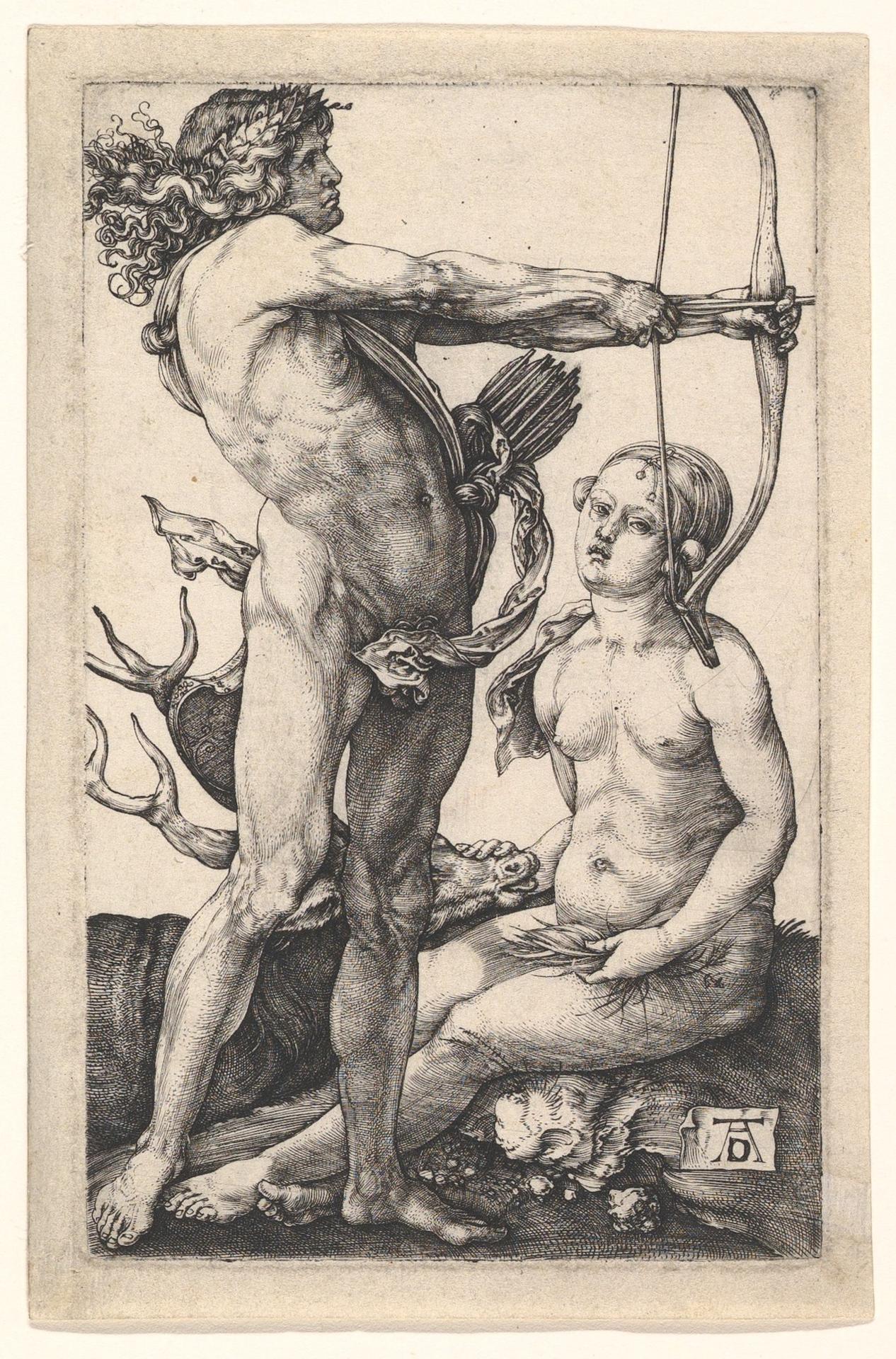
Apollo and Diana
Original title: Apollo and Diana
kurzbeschreibung
Albrecht Dürer's engraving 'Apollo and Diana' (ca. 1503) depicts the sun god Apollo and the goddess Diana in a pastoral setting. The work showcases Dürer's mastery of the engraving medium and his engagement with classical mythology.
Description
The composition features Apollo standing on the left, holding a bow, with his muscular torso and curly hair rendered in meticulous detail. Diana sits on the ground to the right, gazing upward, her draped garment falling across her hips and lower body. In the background, a stag with antlers and a shield-like object are visible, adding to the mythological atmosphere. The monochrome engraving relies on fine, evenly distributed lines to model forms and create a balanced, symmetrical arrangement.
Context
Created around 1503, this engraving reflects Dürer's fascination with classical antiquity, a hallmark of Renaissance humanism. Apollo and Diana were popular subjects in Italian art, and Dürer likely drew on literary sources and earlier visual traditions. The work dates from a period when Dürer was producing some of his most innovative prints in Nuremberg.
Impact
The engraving conveys a sense of ideal beauty and serene dignity, characteristic of Dürer's classical figures. The careful rendering of anatomy and drapery invites close viewing, while the balanced composition imparts a timeless, monumental quality.
Technique
Dürer employed the engraving technique, incising lines into a copper plate with a burin. The print's fine, cross-hatched lines allow for subtle tonal gradations and precise detailing, demonstrating Dürer's technical virtuosity in the medium.
AI-generated description text
Source: Metropolitan Museum of Art · Public domain (CC0)