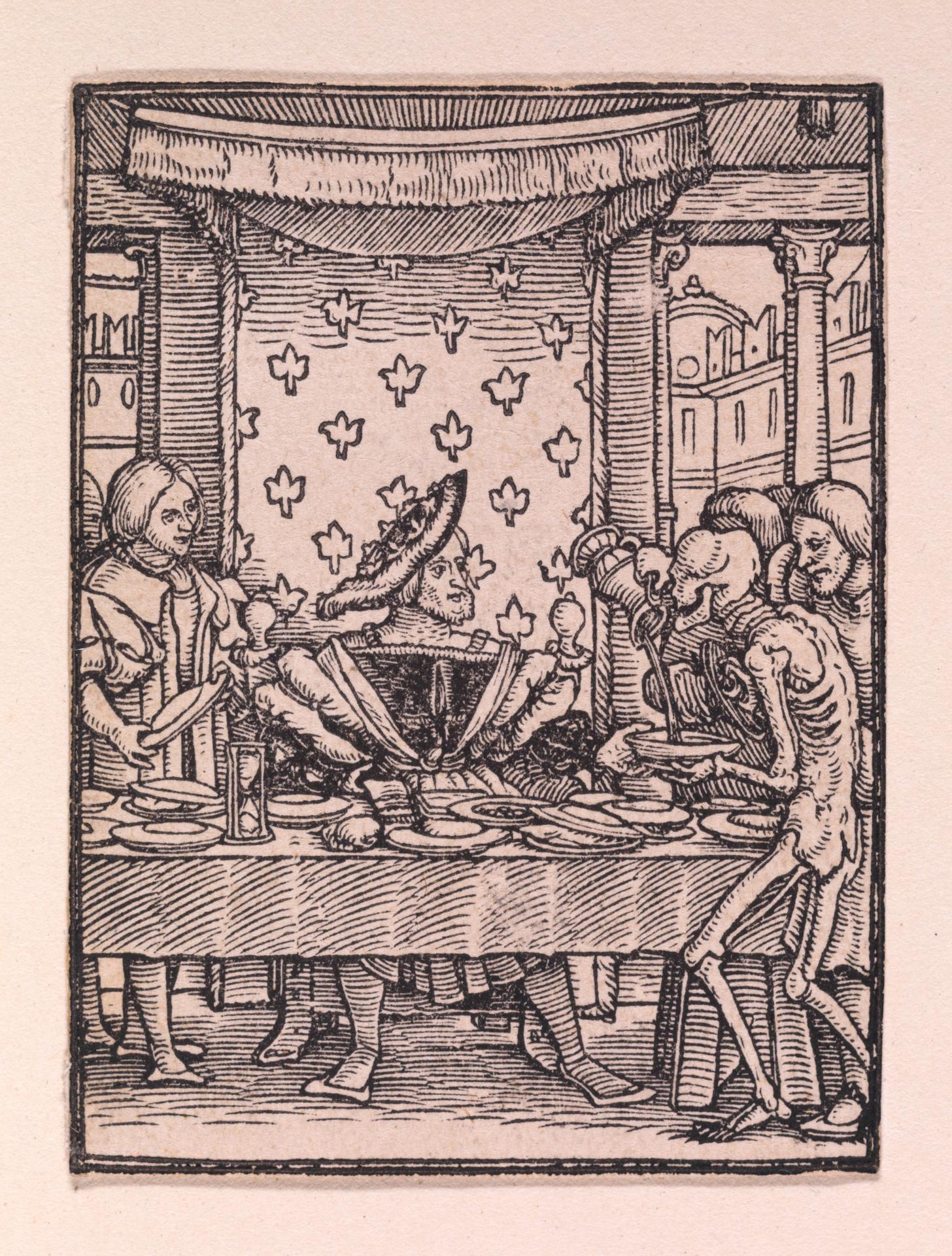
The Rich Man, from 'The Dance of Death'
Original title: The Rich Man, from "The Dance of Death"
kurzbeschreibung
Where many Dance of Death sheets have the skeleton bursting in as a sudden attacker, this woodcut by Hans Holbein the Younger stages a quiet confrontation at a set table: a rich man is dining, and a skeleton has settled itself across from him. Drawn around 1526 and published in 1538, the print belongs to Holbein's celebrated Dance of Death cycle, which holds up the transience of all earthly things.
Description
A man in costly dress, his head topped with a striking ornament, sits at a table laid with food. Beside him is a skeleton that helps itself to the meal, while an angel-like figure carries a plate toward the table. Floral patterning on a hanging cloth and a colonnade suggest a sumptuous hall. Everything stays monochrome, and the sheet's character comes from precise, densely packed lines.
Context
This sheet comes from Holbein's Dance of Death series, first issued in Lyon in 1538 even though the designs were ready by about 1526. In Reformation-era Europe, mortality and the equality of all ranks before death were widely debated subjects. Holbein made the designs for a Basel publisher, and various block cutters transferred them to wood.
Impact
With wealth and death seated so close together, the image is insistent, reminding viewers of their own mortality. That the skeleton joins the meal as a matter of course makes the unsettling message all the more palpable: no one is exempt from death.
Technique
To produce the print, the design was cut into a wooden block and then pulled as an impression. Crisp contours and very finely handled lines distinguish Holbein's graphic hand. Working in black and white yields strong contrasts of light and dark that bring the figures forward in space.
AI-generated description text
Source: Metropolitan Museum of Art · Public Domain (CC0 1.0)