The Resurrection (ca. 1562–63, Met-Objekt 1968)
Original title: The Resurrection
kurzbeschreibung
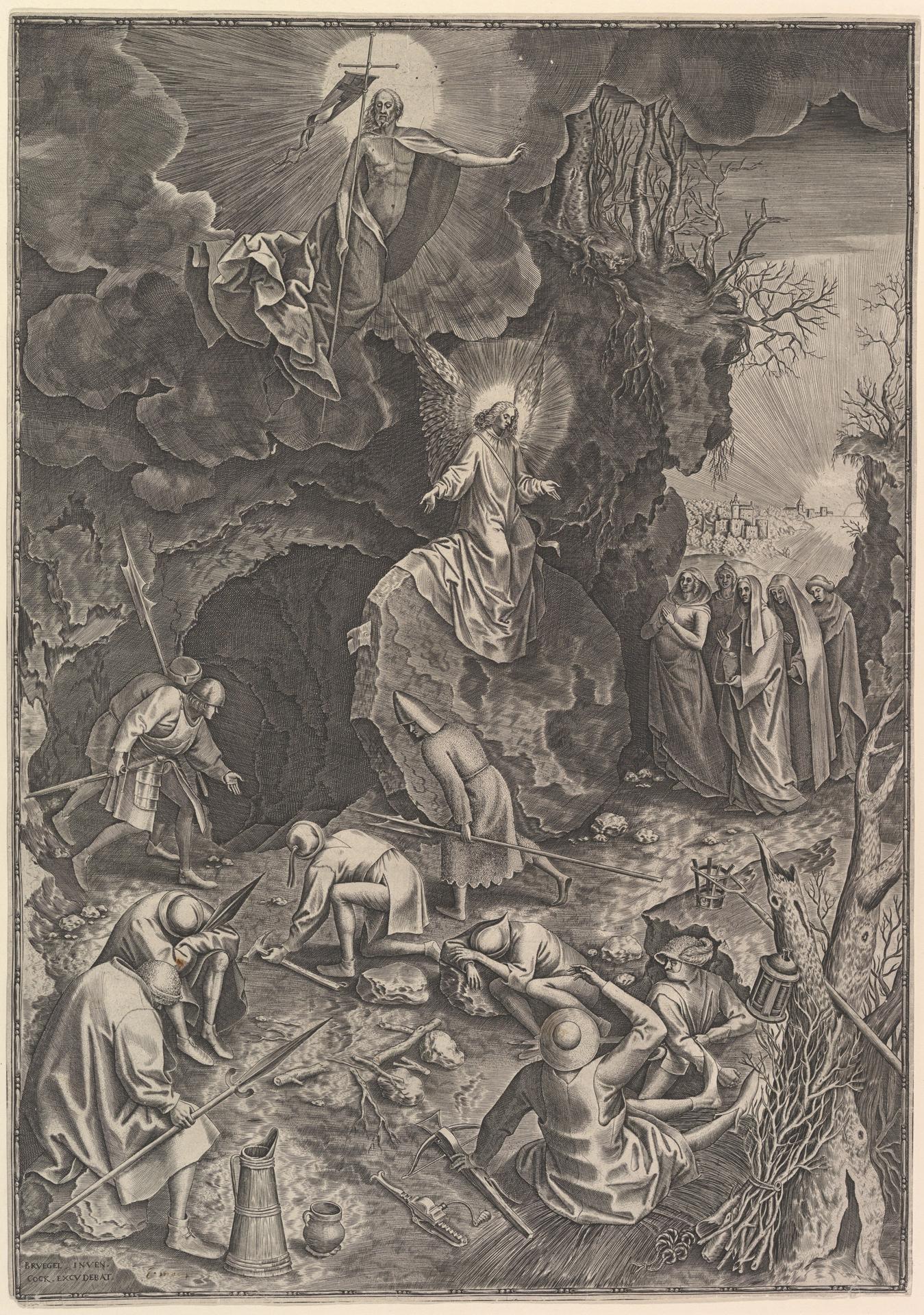
Christ stands elevated at the center, encircled by a radiant halo; above him hovers another figure holding a cross. Philips Galle's 'The Resurrection,' made around 1562–63 as an engraving, arranges the events in a symmetrical layout. In the lower area, several people are scattered in various postures — some kneeling, others upright, some with tools, suggesting workers or peasants.
Description
A luminous circle surrounds the central figure of Christ, making him the source of light in the print. Above him floats a second figure, readable as an angel or God the Father; this figure also radiates light and holds a cross. The lower half is filled with several people in shifting poses: some kneeling or bent over, others standing upright, in simple garments, a few with implements in their hands. Shadows fall across part of their faces, deepening the dramatic mood. The arrangement remains symmetrical, with the resurrected figure as the pivot, while the figures below align in a row.
Context
Philips Galle (1537–1612), a Netherlandish engraver and publisher, became known chiefly for reproductive prints after works by prominent contemporaries. Around 1562–63 he was working in Antwerp, then a center of engraving and publishing. This print exists in the first of three states, suggesting careful revision and wide circulation. In the Renaissance, the Resurrection was a common motif in religious art, often standing for faith and the hope of salvation.
Impact
The radiant figure of Christ at the center and the symmetrical layout give the print a solemn, exalted mood. Bright areas and dark shadows contrast sharply, drawing the eye to the divine event. Dense, finely placed lines and hatching make the forms stand out in relief.
Technique
Executed as an engraving, the print uses fine lines and hatching to model forms and surfaces precisely. Tonal gradations from light to dark arise from varying the density of the strokes; the rays around Christ and the upper figure are emphasized as zones of light. The present example is the first of three states, indicating that the plate was revised after the initial printing.
AI-generated description text
Source: Metropolitan Museum of Art · Public Domain (CC0 1.0)