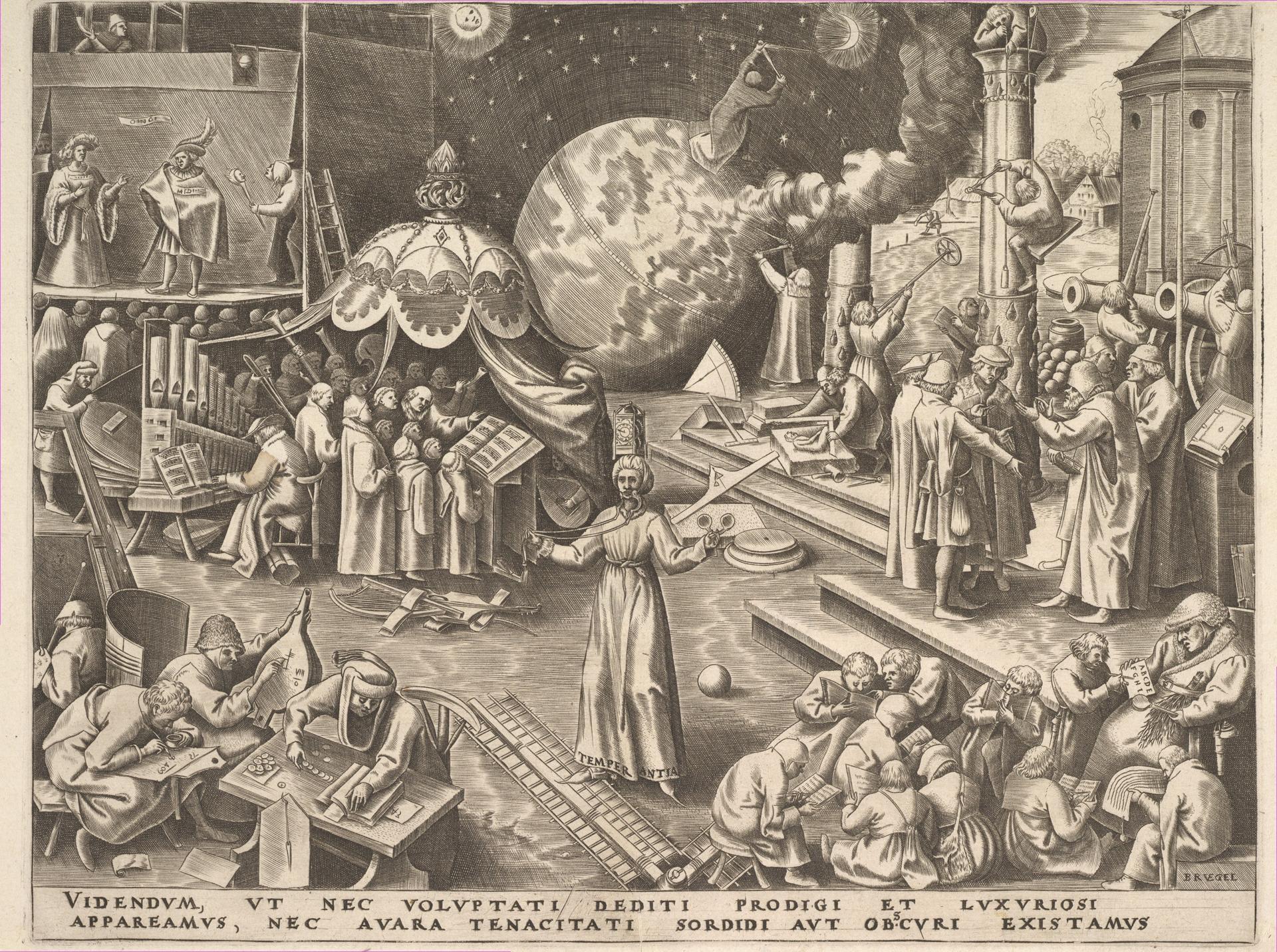
Temperance (Temperantia), from "The Virtues"
Original title: Temperance (Temperantia), from "The Virtues"
kurzbeschreibung
Philips Galle produced this sheet around 1559–60 as part of his series on the virtues. It presents the personification of Temperance (Temperantia) in a layered allegorical staging. The figure sits enthroned at the center, holding a sword; scattered around her are numerous figures embodying various human activities and sensory perceptions.
Description
The layout is dense with incident: Temperance stands front and center, clothed and armed with a sword. On the left, people make music in a room with instruments, while on the right figures busy themselves with a large globe. Further back, others handle instruments and scrolls; below, people carry out craftwork at tables. The image remains monochrome, built on strong contrasts of light and dark.
Context
Galle made this engraving as a contribution to a series of virtues, a format common in the sixteenth-century Netherlands. The pairing of Temperantia with a sword and the surrounding activities follows the Renaissance iconographic tradition of understanding virtues as effective forces in human life. The Antwerp engraver often worked from designs by artists such as Maarten van Heemskerck—hence the complex visual language.
Impact
The sheet holds attention through its narrative richness, inviting viewers to explore each scene. The sharp contrasts between light and shadow give the view dramatic depth and support the allegorical message. The precise linework demonstrates Galle's craftsmanship and makes the print an appealing example of sixteenth-century printmaking.
Technique
This is an engraving in the first of two states. The sheet measures 24.4 x 31.2 cm, the plate 22.3 x 29.1 cm. The engraving process allows for fine lines and hatching, which are used here for the detailed rendering of the figures and the setting.
AI-generated description text
Source: Metropolitan Museum of Art · Public Domain (CC0 1.0)