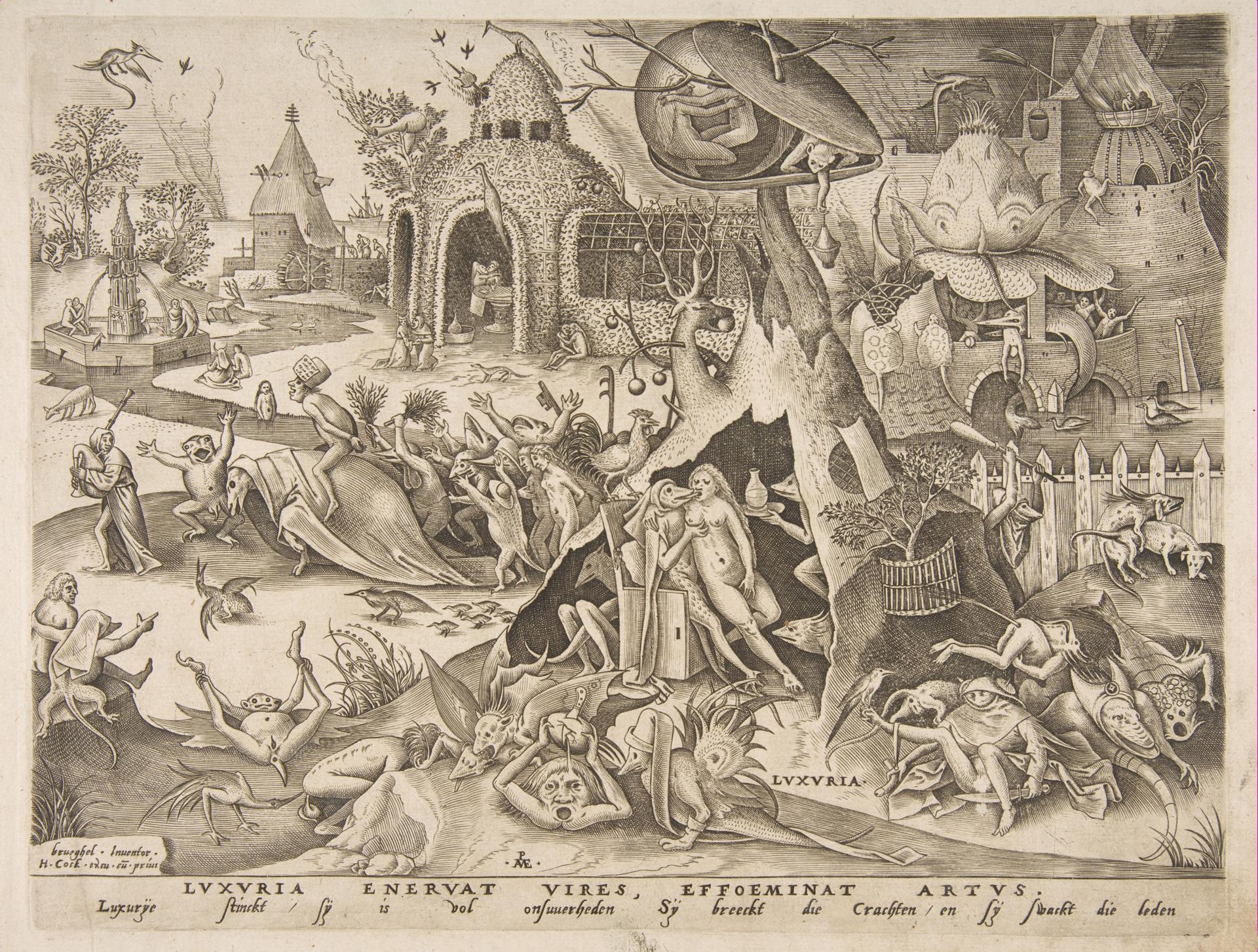
Lust (Luxuria) from The Seven Deadly Sins
Original title: Lust (Luxuria) from The Seven Deadly Sins
kurzbeschreibung
A naked female body sits on a wide-open belly – this motif carries the engraving Lust (Luxuria) by Pieter van der Heyden, struck in 1558. Around the figure, people and animals crowd into scenes of indulgence and gluttony. The print belongs to a series on the seven deadly sins and is a monochrome engraving.
Description
Your eye is first pulled to the naked woman named Luxuria, seated at the centre on a large, gaping belly; a bird watches her. She is enclosed by people in shifting poses, sitting or eating and drinking in simple dwellings. Deeper zones of the image fill with more figures, trees, a well and a church, forming a dense, restless fabric. Colour is entirely absent; the evenly distributed light and the formal language point to the Renaissance and Flemish tradition.
Context
Van der Heyden, a sixteenth-century Flemish engraver, translated designs by painters such as Pieter Bruegel the Elder into prints. The series The Seven Deadly Sins came out in 1558, published and distributed by Hieronymus Cock in Antwerp, then one of the leading addresses for printmaking. Moralising image series of this kind were hugely popular in the sixteenth century because they made Christian teaching on virtue and sin vivid. For this print, a Bruegel design may be presumed, which attests to the close collaboration among Antwerp artists.
Impact
A sense of oppression sets in as your gaze travels across the many figures and the drastically demonstrated consequences of lust and gluttony. The even lighting and precise linework feel sober, almost protocol-like; both carry the allegorical message rather than softening it. In the end, a persistent impression of the sinfulness of human desires remains.
Technique
The motif was engraved into a copper plate, from which impressions were then pulled on paper. Extremely fine lines and carefully placed hatching allow high detail and a rich gradation of tones. The plate measures 22.6 x 29.7 cm, the sheet 26 x 33.7 cm – formats typical for print series of the Renaissance.
AI-generated description text
Source: Metropolitan Museum of Art · Public Domain (CC0 1.0)