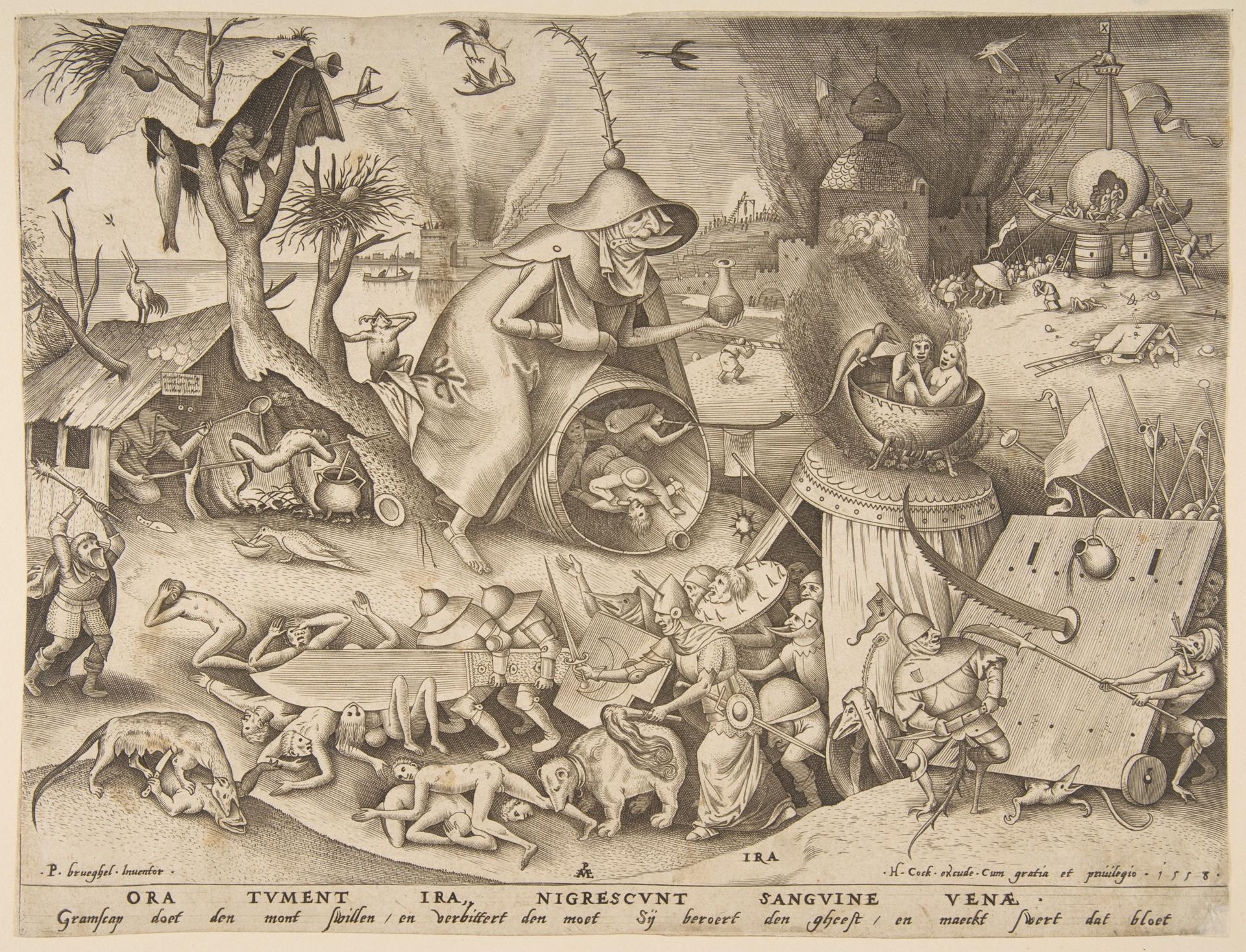
Anger (Ira), from the series The Seven Deadly Sins
Original title: Anger (Ira), from the series The Seven Deadly Sins
kurzbeschreibung
Pieter van der Heyden engraved Zorn (Ira) in 1558 after a design by Pieter Bruegel the Elder. The print presents the deadly sin of anger as an allegory: a female figure wearing a large hat and holding a jug stands at the center, surrounded by numerous small scenes in which the consequences of wrath unfold. This engraving belongs to a series of six prints on the seven deadly sins.
Description
A female figure with a wide-brimmed hat and a jug in her hand embodies Wrath and forms the core of the densely packed layout. Around her, people come to blows, while nearby animals express fear or despair. Trees, buildings, and further figures fill the rear area, layering the scene into several planes of depth. Executed in black and white, the print uses graduated hatching and contrasts to create light and a sense of space.
Context
The series The Seven Deadly Sins derives from designs by Pieter Bruegel the Elder from 1558, which Pieter van der Heyden transferred to copper. Bruegel conceived these models at a time when allegorical moral images enjoyed great popularity in the Netherlands. Hieronymus Cock, one of the most influential print publishers in Antwerp at the time, acted as publisher. The prints were intended to offer moral instruction, combining Christian pictorial tradition with satirical and popular elements.
Impact
The crowded, tightly filled arrangement produces a sense of claustrophobia and makes the destructive force of anger directly palpable. Clear lines and expressive gestures give the sheet a dramatic tension that draws the viewer into the detailed action.
Technique
As an engraving, the print was made by incising lines into a copper plate and then printing it. Van der Heyden employed fine, parallel hatching to model shadow and spatial depth. This precise, detailed line work characterizes Renaissance printmaking and allows Bruegel's design to be reproduced very faithfully.
AI-generated description text
Source: Metropolitan Museum of Art · Public Domain (CC0 1.0)