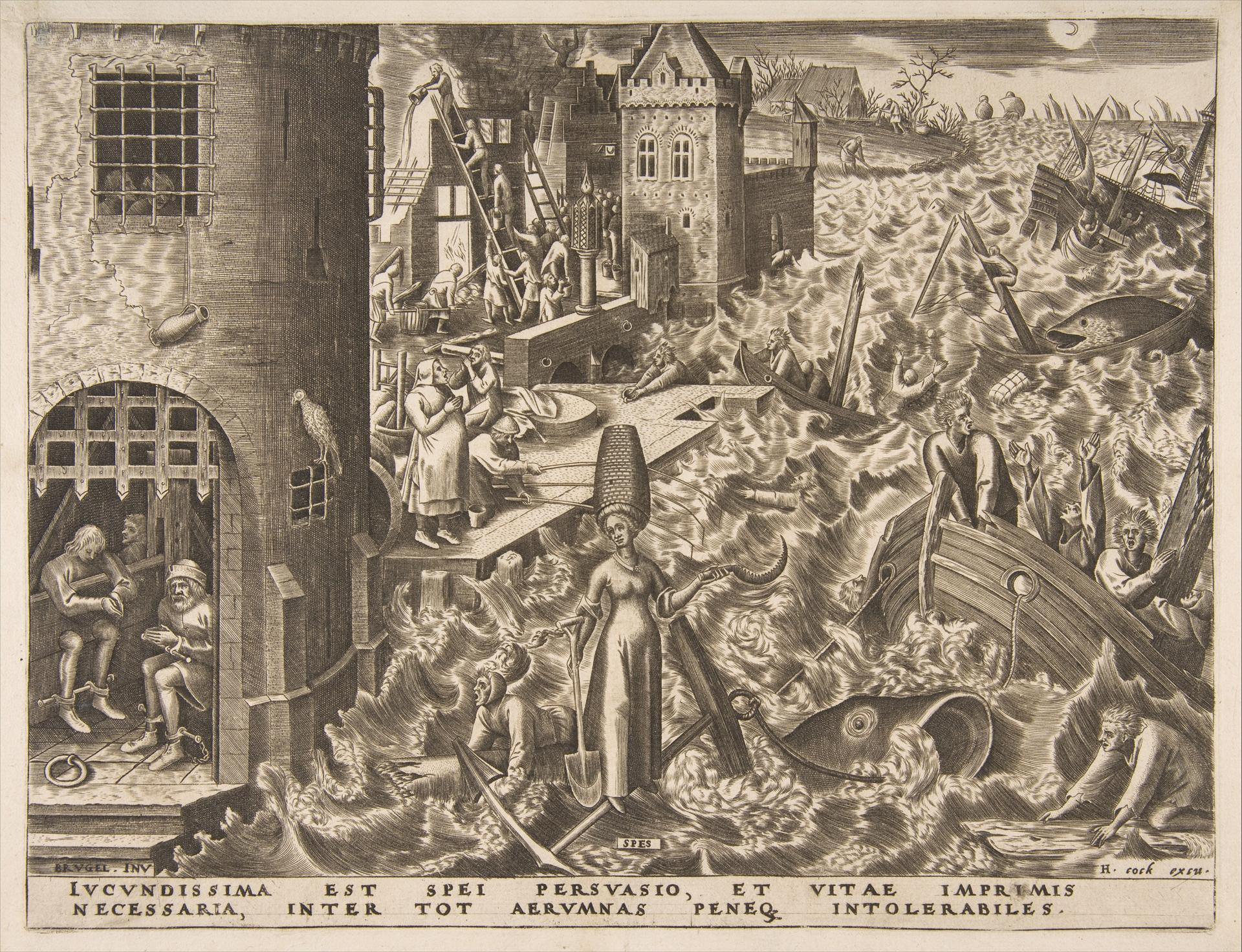
Hope (Spes), from 'The Virtues'
Original title: Hope (Spes), from "The Virtues"
kurzbeschreibung
Pieter Bruegel the Elder made the etching Hope (Spes) between 1559 and 1560 as part of his series on the virtues. It presents the allegorical figure of Hope standing in a city stricken by a flood. The plate measures 22.6 by 29.3 cm and is executed as an etching.
Description
In the foreground, the personification of Hope stands on a rocky islet, wearing a long gown and holding a spade, while water laps around her. Behind her lies a city, through which a great river breaks and spills over walls and houses. Many people are seen in boats or engaged in rescue and defensive efforts, while others are confined in prisons or cells. The layout feels restless, carried by the flow of water and the movements of the figures. Black and white with many gradations of grey, light falls from above and emphasizes figures and watercourses.
Context
This print belongs to Bruegel's series The Virtues, made around 1559–60. Hieronymus Cock in Antwerp, a center of copperplate engraving, published it. Bruegel supplied the designs, which professional engravers transferred to the plate. The figure of Hope who withstands amid catastrophe follows the moral imagery of the time, which understood virtues as active attitudes in adversity.
Impact
A strong tension arises between the calm figure of Hope in the middle and the chaotic, threatening activity all around. The precise linework and dramatic light give the sheet a lively, almost narrative quality. Bruegel's arrangement brings the allegory into focus without neglecting the detailed portrayal of the emergency.
Technique
The lines are incised into a metal plate, bitten with acid, and then printed on paper—an etching. The sharp, clear strokes produce fine shading and detailed structures of walls, water surfaces, and figures. The inscription at the lower edge gives the title and author information, as was typical for print series of the period.
AI-generated description text
Source: Metropolitan Museum of Art · Public Domain (CC0 1.0)