The Parable of the Good Shepherd
Original title: The Parable of the Good Shepherd
kurzbeschreibung
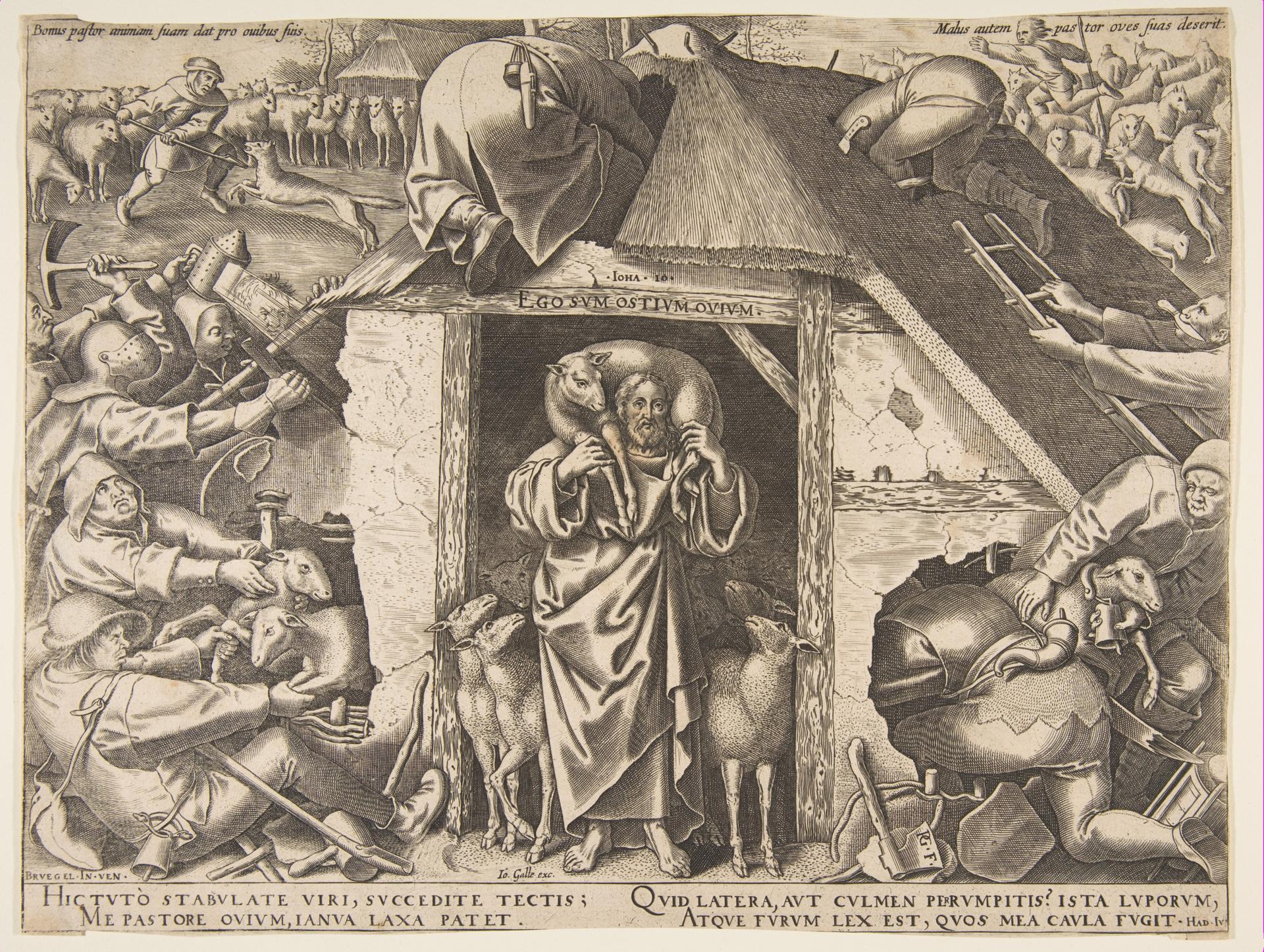
Unlike many prints of its day on the same subject, this 1565 engraving by Pieter Bruegel the Elder does not isolate the biblical parable of the Good Shepherd but sets it inside busy rural life. Christ, a sheep in his arm, stands before a thatched hut, surrounded by shepherds, sheep and other figures in a richly detailed landscape. The sheet is the fourth state of four and measures 22.3 x 29.3 cm.
Description
Christ in a long robe, a sheep carried on his arm, forms the still point before a straw-roofed hut. Figures gather around him: shepherds driving sheep, others shearing wool or bearing loads. The image is packed with activity, and the interplay of shepherd, flock and bystanders is told through many small touches. Behind the hut more sheep and people move through the landscape. Grey tones, crisp lines and even lighting define the print, as was usual for Renaissance graphic work.
Context
Made in 1565, during a period when Bruegel was known for his dense biblical scenes and peasant life. The parable of the Good Shepherd (John 10:1-21) was among the popular subjects of sixteenth-century religious art and presented Christ as the protector of the faithful. Bruegel produced several prints, often issued by publishers such as Hieronymus Cock. This sheet shows how Renaissance art translated biblical themes into contemporary landscapes and everyday scenes.
Impact
The dense storytelling draws the viewer into the biblical scene. Even lines and a calm layout let the parable emerge clearly, almost like a lesson. The sacred centre and ordinary chores sit side by side, producing a mood that is lively and contemplative at once.
Technique
Engraving works by cutting lines into a copper plate and transferring them with printing ink onto paper. Sharp, precise lines and fine hatching yield high detail and an even grey tone. To speak of the fourth state of four means the plate was reworked and printed in several editions.
AI-generated description text
Source: Metropolitan Museum of Art · Public Domain (CC0 1.0)