The Stone Operation or The Witch of Mallegem
Original title: The Stone Operation or the Witch of Mallegem
kurzbeschreibung
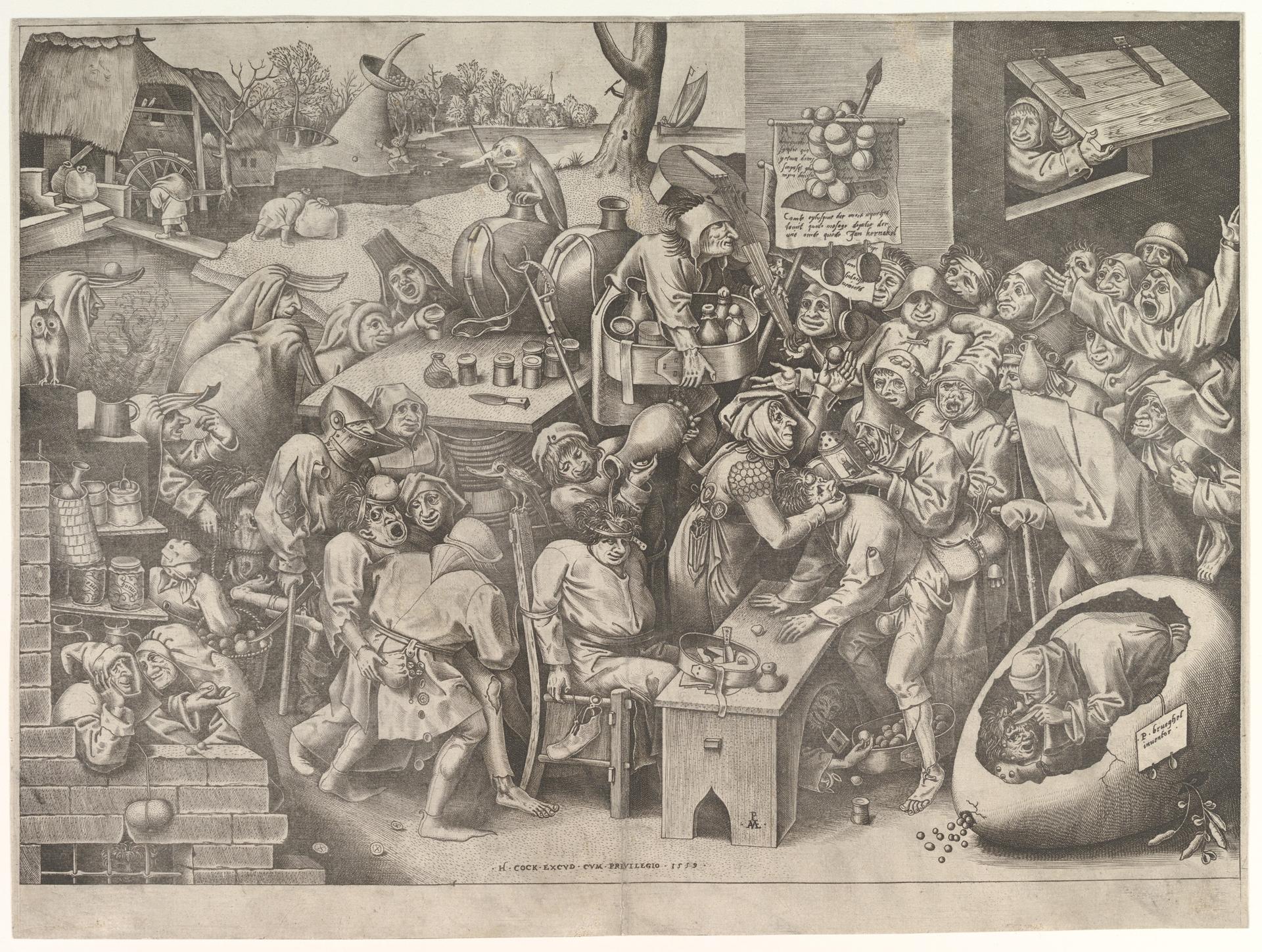
In 1559 Pieter Bruegel the Elder made this etching, in which a crowd presses around a table. The engraving survives in the third of five states and measures 35.4 by 47.6 cm. Its subject is the practice, common at the time, of the 'stone operation', in which supposed stones were pulled from a person's head to cure folly.
Description
The setting is a village, where several figures cluster round a table set with jugs, bottles and a knife. Some wear Renaissance dress, others lean from a window or are caught in motion. Buildings, trees and a mill in the distance root the action in the countryside. The varied postures of those taking part give the picture a lively structure. Everything is printed in a single colour, with the linear handling typical of an etching.
Context
The print was made in the Netherlands in 1559, when moralising and satirical subjects were in demand. With the 'stone operation' Bruegel took up a popular motif that attacked human stupidity and credulity. Such procedures were often performed by itinerant charlatans at fairs to cheat the gullible. This engraving belongs to a group of prints after Bruegel's designs that were circulated by publishers such as Hieronymus Cock.
Impact
The wealth of detail and the number of figures make the sheet immediately vivid and narrative. The absurd procedure of the 'stone operation' heightens the satire and is likely to raise a smile. The monochrome printing and precise lines give the impression a graphic elegance that does not feel tied to its period.
Technique
For the engraving the drawing was cut into a copper plate and then printed. The present impression is the third of five states, which points to later reworking of the plate. Fine lines and hatching create graduated contrasts of light and dark and record figures and background alike with precision.
AI-generated description text
Source: Metropolitan Museum of Art · Public Domain (CC0 1.0)