Gluttony (Gula) from The Seven Deadly Sins
Original title: Gluttony (Gula) from The Seven Deadly Sins
kurzbeschreibung
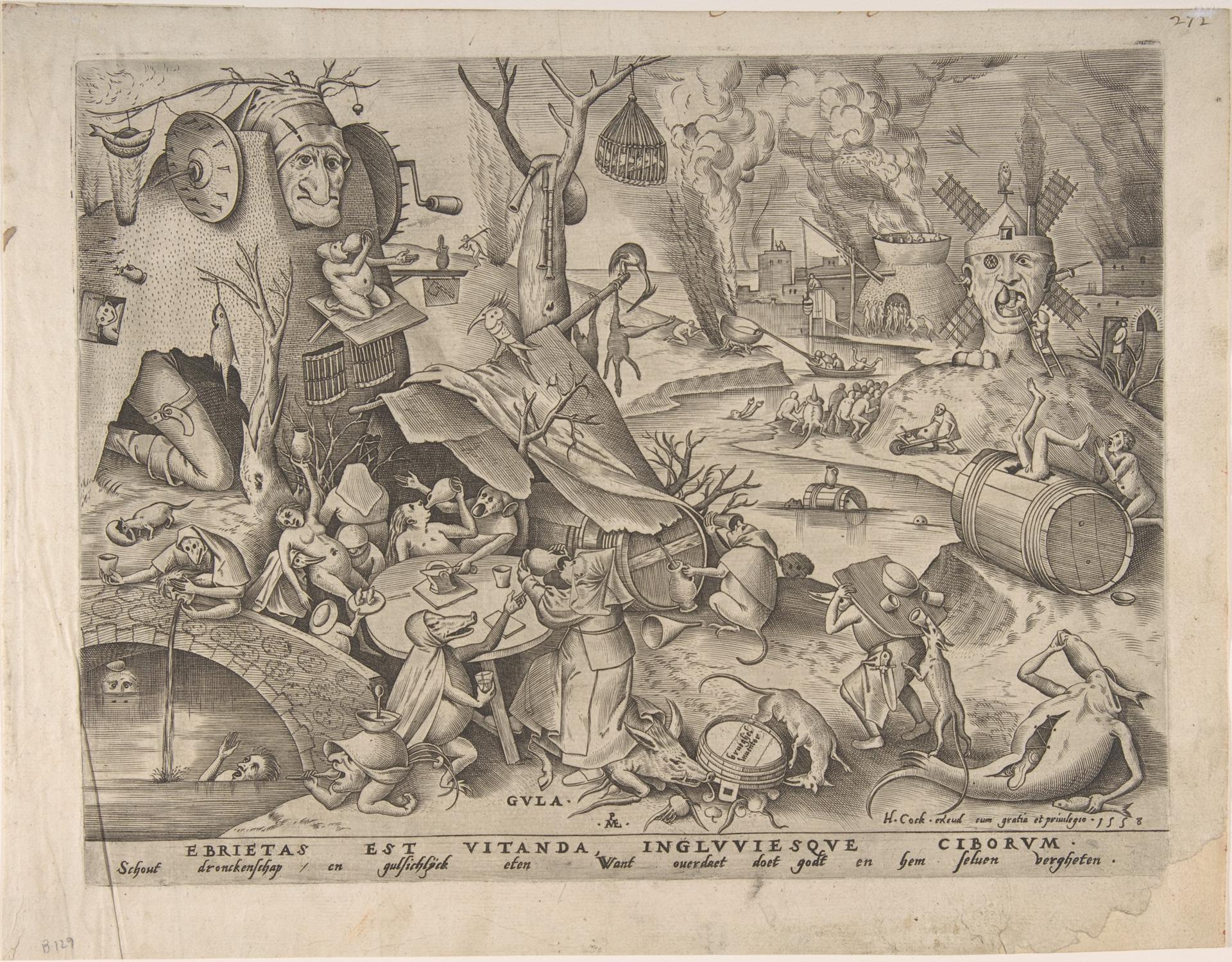
Pieter Bruegel the Elder made this print in 1558 as part of his series on the Seven Deadly Sins. Titled Gluttony (Gula), the etching presents excess in eating and drinking as an allegorical image. At its heart stands an oversized bottle, surrounded by a dense crowd of people and animals given over to excessive feasting. This vertical engraving belongs to Bruegel's most famous series of prints.
Description
A gigantic bottle dominates the centre, and inside it sits a man with a bloated belly and a face whose mouth and nose are grossly enlarged. Around this vessel, numerous figures and animals are scattered at set tables, barrels, and storage containers. The upper part of the image opens onto further debauchery, such as a burning city and people handling barrels. The layout is packed to overflowing with small details; the tonal range stays within greys and browns, as the etching technique dictates.
Context
This sheet from 1558 is one of seven motifs Bruegel devoted to the deadly sins. In the series he combined older moralising pictorial traditions with a dense, figure-rich narrative style. The prints were published by Hieronymus Cock in Antwerp, one of the leading publishers of the day. Allegorical representations of vices were widespread in the sixteenth century, joining religious admonition with satirical elements.
Impact
The overcrowded arrangement and the figures pushed to the grotesque provoke both revulsion and instruction in the viewer. The huge bottle and the distorted facial features create a caricatural, almost nightmarish mood. Through the precise depiction of excess, the audience is brought face to face with the consequences of gluttony.
Technique
For this print, a copper plate was worked with a burin, so that the lines are incised as engraving. Fine hatching and cross-hatching produce graduated grey tones and a sense of volume. The format measures 22.3 by 29.3 centimetres, matching the usual dimensions of prints from that period.
AI-generated description text
Source: Metropolitan Museum of Art · Public Domain (CC0 1.0)