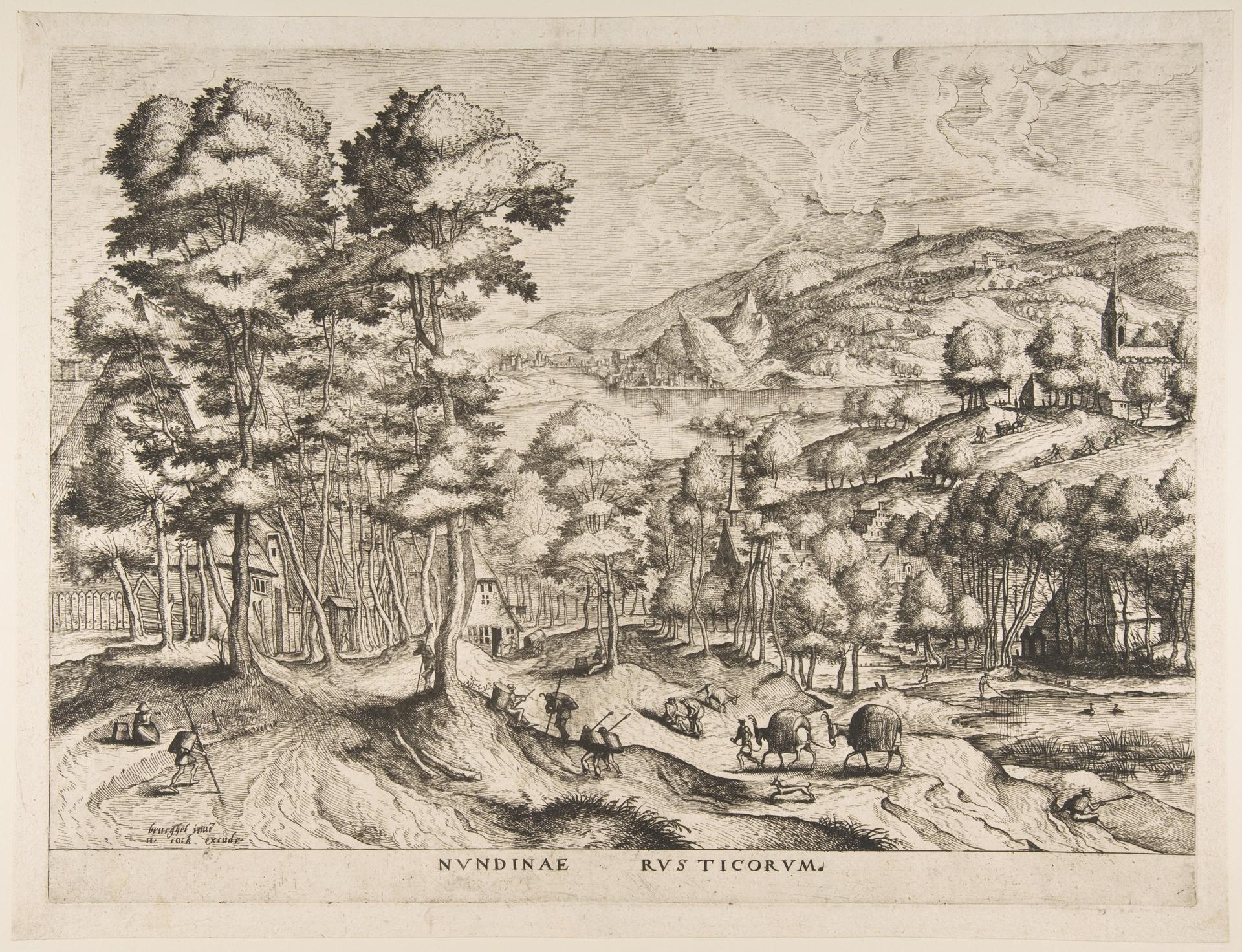
Rustic Market (Nundinae Rusticorum), from "The Large Landscapes" (ca. 1555–56, Met-Objekt 1870)
Original title: Rustic Market (Nundinae Rusticorum), from "The Large Landscapes"
kurzbeschreibung
Pieter Bruegel the Elder recorded a country market day around 1555–56, setting the fair within a broad stretch of open land. The print, titled Ländlicher Markt (Nundinae Rusticorum), was made as an etching with engraving and survives here in the second of three states.
Description
Trees line a road along the lower edge, where a dense crowd of people and animals pushes forward. Several figures haul bundles on their backs, while others move on in small groups. Hills rise beyond them, with trees between and a village whose church tower marks the horizon. The wide, low arrangement of the picture stresses how far the rural terrain extends. Grey tone spreads evenly across the sheet, with no deep shadows; the lines are drawn densely and cleanly, so that the surfaces and particular shapes of figures and objects stand out clearly.
Context
Within the series of Large Landscapes, published in the 1550s by the Antwerp printer Hieronymus Cock, this sheet holds a special place. Bruegel supplied the designs, which various engravers transferred into etching. Mostly the series gathers Alpine views; Ländlicher Markt is one of the few pieces in which people carry the action. The subject thus connects to the Netherlandish genre tradition and answers the taste of the time for country life and the observation of nature.
Impact
The image meets the viewer calmly and quietly: evenly distributed light and horizontal lines keep the action in a steady flow. Anyone who looks closely keeps finding new details, and so the impression arises of an incidental, unstaged moment of village activity.
Technique
Etched first and then reworked with the burin, the process allows the finest lines and graded hatching. What is shown here is the second of three states, which points to later changes to the plate. The grey tones come entirely from the biting of the lines and produce a sense of space and volume without any colour.
AI-generated description text
Source: Metropolitan Museum of Art · Public Domain (CC0 1.0)