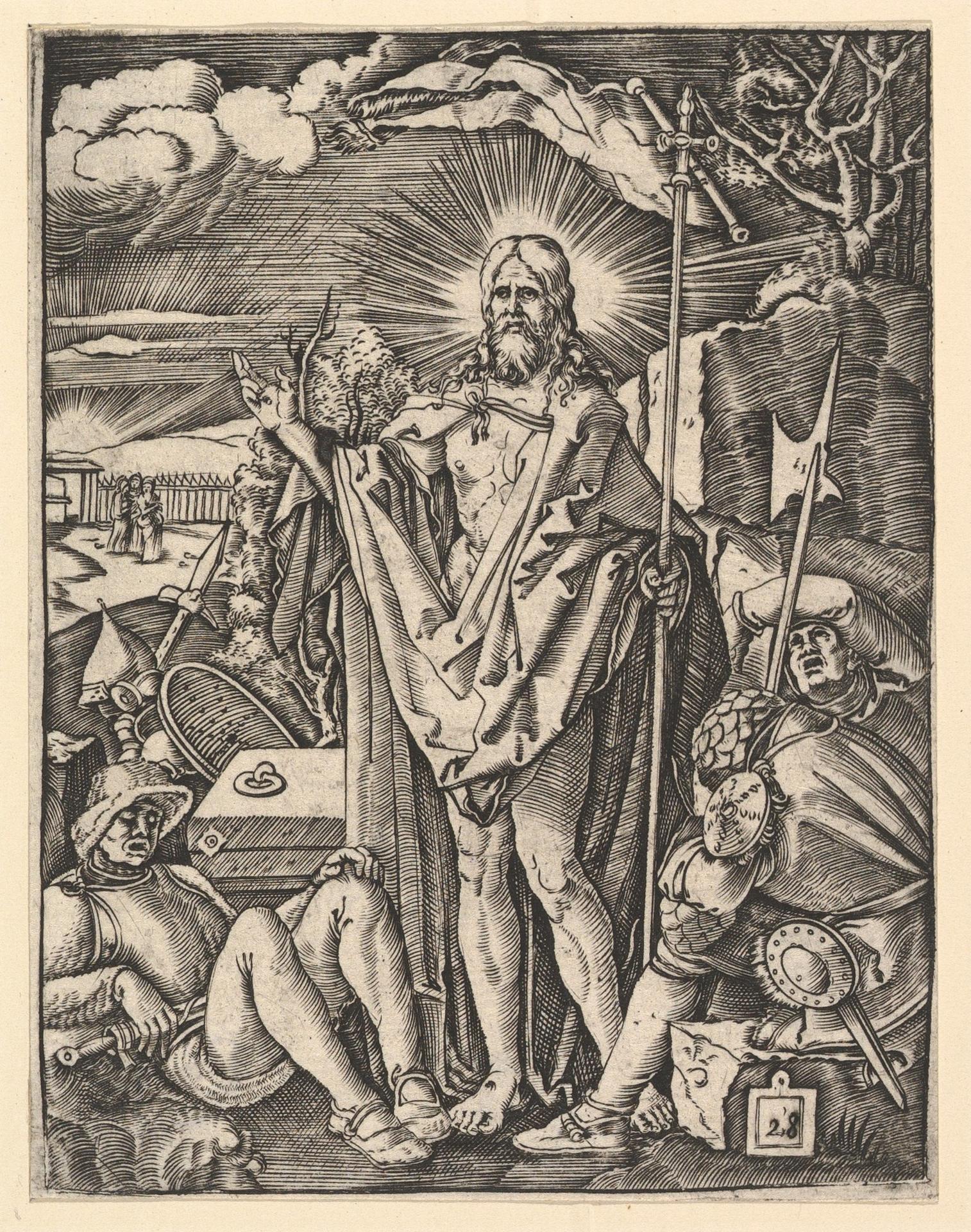
The Resurrection (ca. 1500–34)
Original title: The Resurrection; Christ standing in front of a closed tomb, holding a flag and giving a blessing, guards sleeping in the foreground, from "The Passion of Christ", after Dürer
kurzbeschreibung
Marcantonio Raimondi engraved The Resurrection at some point between about 1500 and 1534. Christ stands before a sealed tomb while soldiers sleep around him. The sheet belongs to the Passion of Christ series and derives from a design by Albrecht Dürer. This impression is the third of three states of the engraving.
Description
Christ wears a long white robe and stands barefoot, his right hand raised in blessing and a banner held in his left. A light falling from above glows over his head. Behind him a stone closes the tomb, and in front of it two armored guards lie or sit asleep. Further back, other figures and a post with a cross can be made out. The dark ground lends the view something nocturnal; the contours stay sharp and the lines are drawn in fine detail.
Context
Raimondi, an Italian Renaissance engraver, made this sheet after a model by the German artist Albrecht Dürer. The Passion of Christ series is one of several reproductive prints Raimondi produced after Dürer's woodcuts. Such copies circulated widely in the early sixteenth century and helped make Dürer's inventions known in Italy. The sheet was made in Rome, where Raimondi worked from around 1510.
Impact
The layout is clearly structured, and the figure of Christ gives off a calm majesty that stands in sharp contrast to the sleeping guards. The radiance around his head gives the image a transcendent quality, which the gloomy surroundings make all the more pronounced. The delicate linework produces a finely articulated surface that invites close looking.
Technique
This was made as an engraving: the lines are cut into a copper plate and then printed. Raimondi used closely spaced parallel hatching to build shadow and volume. Printing was in black on paper, which accounts for the monochrome character of the sheet. In the third state, wear to the plate may be visible, as is typical in printing history.
AI-generated description text
Source: Metropolitan Museum of Art · Public Domain (CC0 1.0)