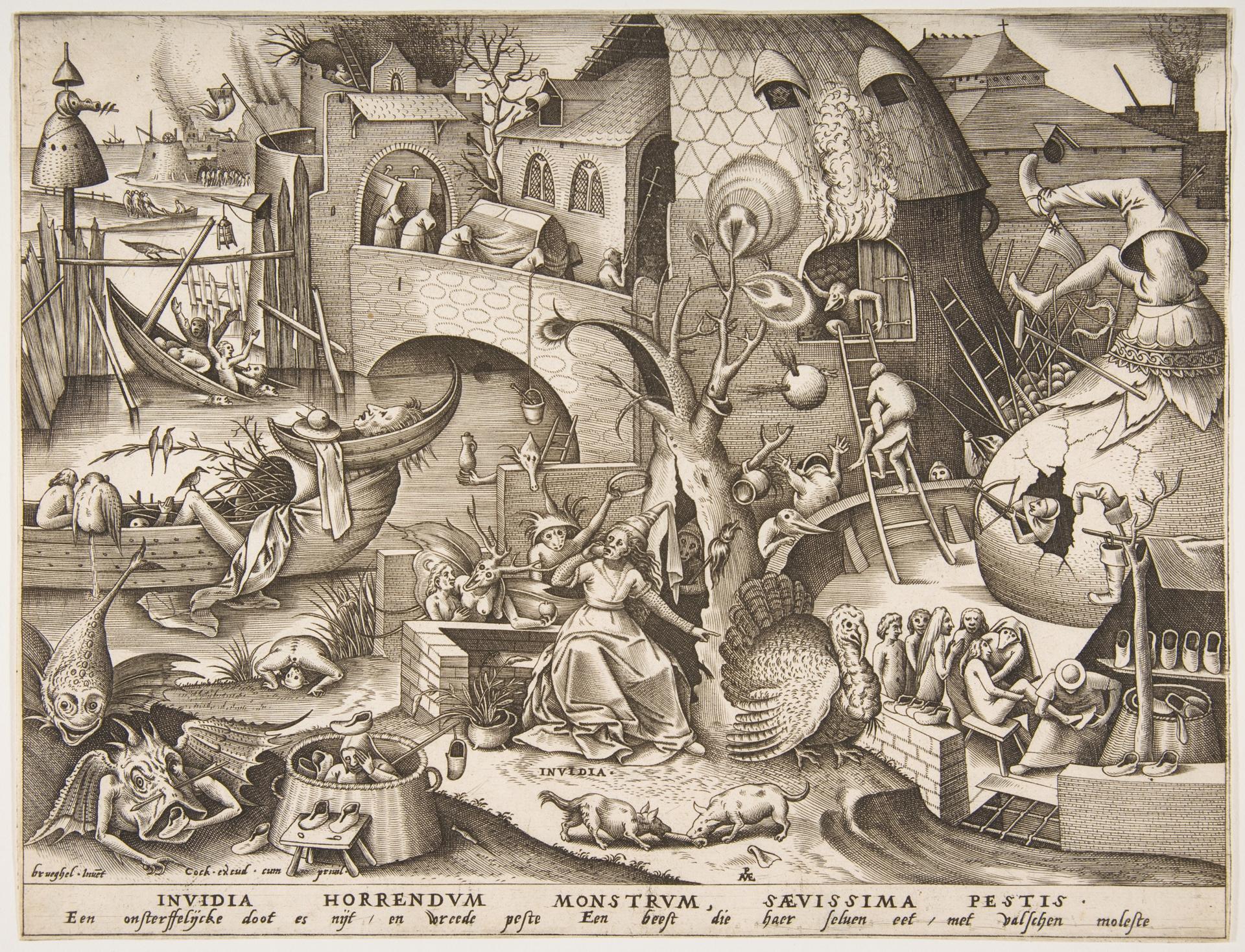
Envy (Invidia), from "The Seven Deadly Sins"
Original title: Envy (Invidia), from "The Seven Deadly Sins"
kurzbeschreibung
Pieter Bruegel the Elder made the engraving 'Envy' in 1558 as part of his series 'The Seven Deadly Sins'. A crowned woman with a snake personifies envy, while numerous subsidiary figures and emblems drive home the destructive consequences of this vice.
Description
A crowned woman sits on a pedestal inscribed 'INVIDIA'; in her hands she holds a snake that points back at her. Scenes spread around her: people in the open air, animals splashing in a well, and a figure perched on a large egg. Further back, buildings and a bridge appear, where people come to blows. A fruit-bearing tree, shoes and a fish on the ground complete the dense tangle of figures.
Context
This print belongs to Bruegel's seven-part series of the deadly sins, produced as a set of engravings around 1558. Hieronymus Cock in Antwerp, one of the leading print publishers of the day, issued the plates. Bruegel thus took up a theme widespread in moral theology and frequently treated in sixteenth-century art.
Impact
Precise linework and the tight stacking of figures create an unsettling, almost threatening mood. The central envious figure with the snake comes across directly and insistently, while the many details invite prolonged looking and reinforce the moral message.
Technique
Lines were incised into a copper plate and then printed on paper—a process that allows the finest hatching and strong light-dark contrasts characteristic of the Renaissance. The present impression is the first state of the print, indicating an early phase of pulling.
AI-generated description text
Source: Metropolitan Museum of Art · Public Domain (CC0 1.0)