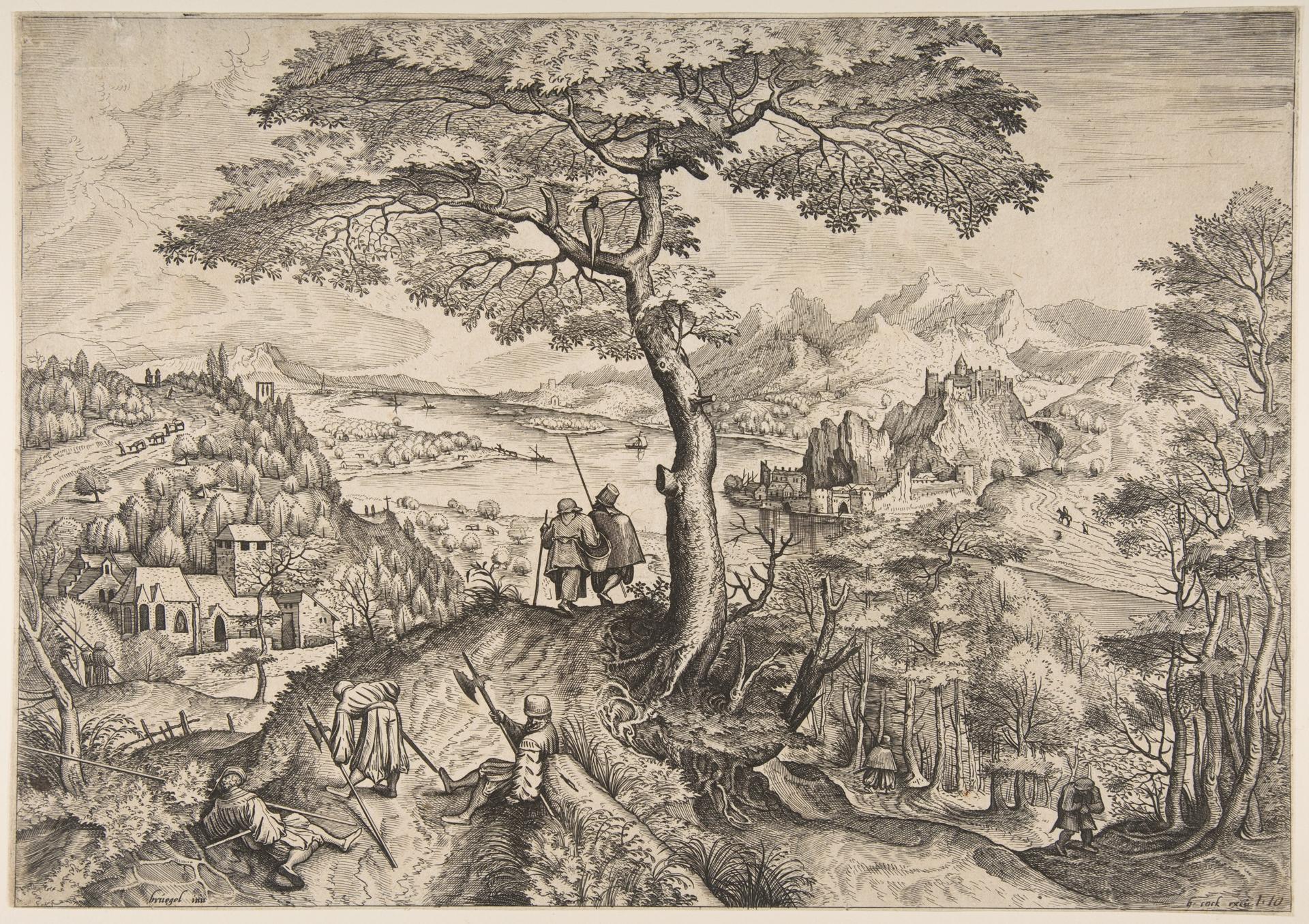
Soldiers at Rest (Milites Requiescentes), from "The Large Landscapes"
Original title: Soldiers at Rest (Milites Requiescentes), from "The Large Landscapes"
kurzbeschreibung
Unlike many contemporary soldier scenes that emphasize combat and turmoil, Pieter Bruegel the Elder's etching 'Soldiers at Rest' (c. 1555–56) gives precedence to lingering. From the series 'The Large Landscapes,' this print presents a group of soldiers in an expansive landscape, merging figure study with a view of nature. It was executed as an etching and subsequently reworked with a burin.
Description
A rural setting forms the stage for several figures: two soldiers stand elevated on a hill and gaze into the distance, a third lies stretched out on the ground, and a fourth stands nearby with a staff. A massive tree spans the hill and dominates the foreground. Beyond it, houses, a river, and mountains can be made out. The arrangement runs horizontally, clearly separating foreground from background; light comes from above, bringing out the textures of both landscape and figures.
Context
The series 'The Large Landscapes' was produced around 1555–56 in Antwerp, where Bruegel worked for the publisher Hieronymus Cock. These prints were not intended as book illustrations but as independent works of art, aimed at a wealthy audience with an interest in printmaking. Soldiers in landscapes were a common motif in Netherlandish printmaking of the time, often interpreted allegorically or moralizingly.
Impact
Instead of the tumult of war, a quiet, almost peaceful scene unfolds here: the men rest in nature, and nothing suggests immediate danger. The clear lighting and the wide view over the landscape create an orderly, harmonious mood that sets itself apart from the usual martial imagery and invites the viewer to linger.
Technique
For this print, Bruegel combined etching and engraving. The etching provided the initial lines, while the burin allowed for the finest hatching and precise details, so that both the surface qualities of the landscape and the figures appear richly differentiated. Printing was done from a copper plate in the publisher Cock's workshop.
AI-generated description text
Source: Metropolitan Museum of Art · Public Domain (CC0 1.0)