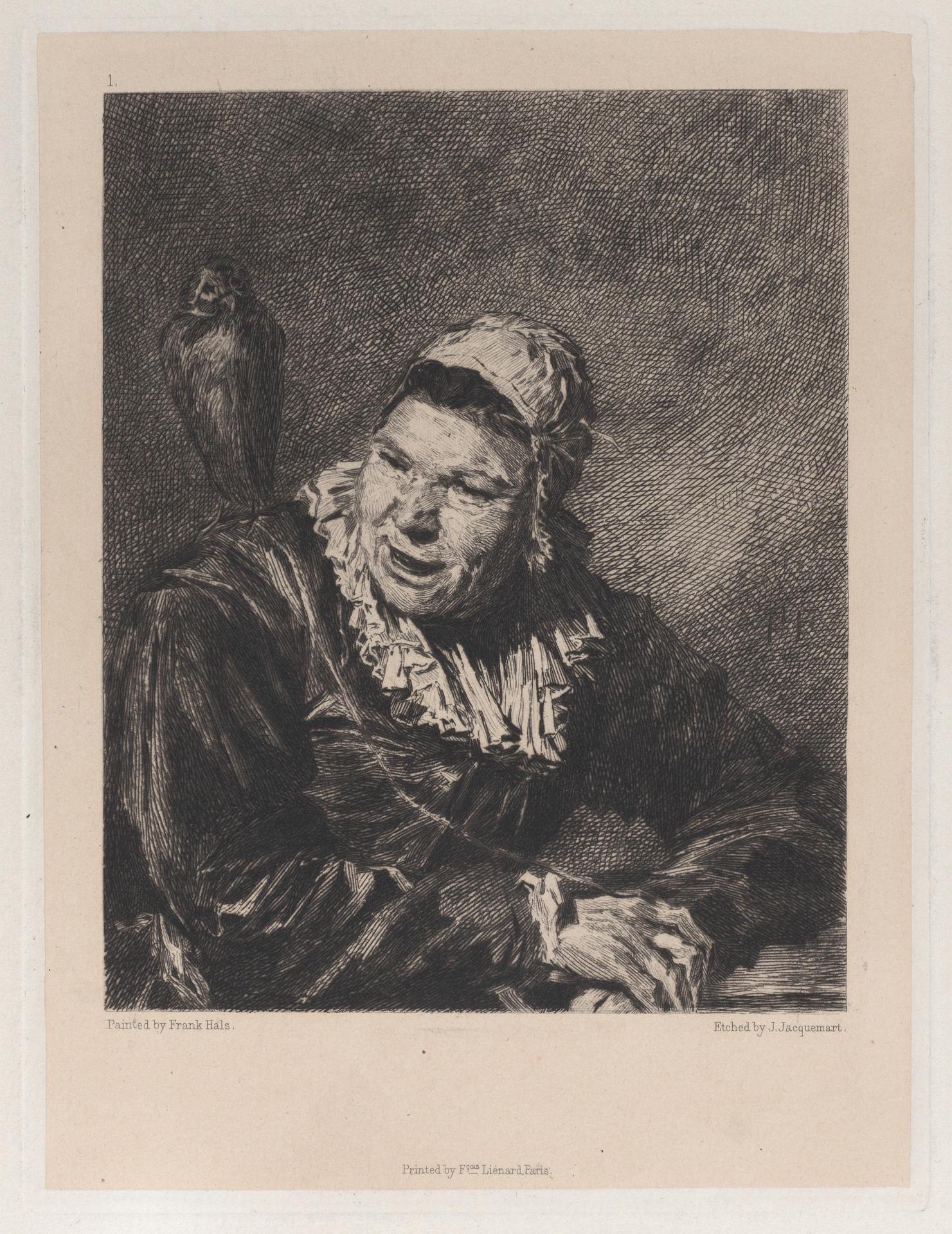
Malle Babbe, after Frans Hals
Original title: Malle Babbe, after Frans Hals
kurzbeschreibung
In 1871 Jules-Ferdinand Jacquemart produced an etching of the laughing Malle Babbe with a bird on her shoulder, based on the painting of the same name by Frans Hals. The sheet measures 48 × 35 cm, the plate 19.5 × 14.3 cm, and the work was executed as an etching on chine collé.
Description
Malle Babbe occupies the center of the sheet, her mouth open in laughter, her gaze directed sideways past the viewer. A headscarf and a dress with a ruffled collar are visible, the folds of the fabric built up from fine hatching. On her left shoulder sits a bird that turns toward her. The background appears dark and textured, making the lighter figure stand out; the gray tones of the image result from the line work and the chine collé.
Context
Jacquemart, who worked primarily as a reproductive printmaker, made this etching after Frans Hals's painting Malle Babbe, now in the Gemäldegalerie in Berlin. The original dates from around 1633–1635 and probably depicts an innkeeper or a mentally ill woman, a point still debated in scholarship. In the nineteenth century Jacquemart worked for art publications and used such prints to make Old Master works accessible to a wider audience.
Impact
Lively line work and the bright figure against a dark ground give the sitter an immediate presence. Naturalistic rendering and graphic reduction combine in a way that feels intimate and almost momentary, emphasizing the humorous expression.
Technique
In etching, the drawing is bitten into a metal plate, which then holds the ink. With chine collé, a thin sheet of Japan paper is laid on a support sheet, which makes the fine lines and gray gradations appear softer. Jacquemart used this combination to translate the painterly handling of Hals's painting into print.
AI-generated description text
Source: Metropolitan Museum of Art · Public Domain (CC0 1.0)