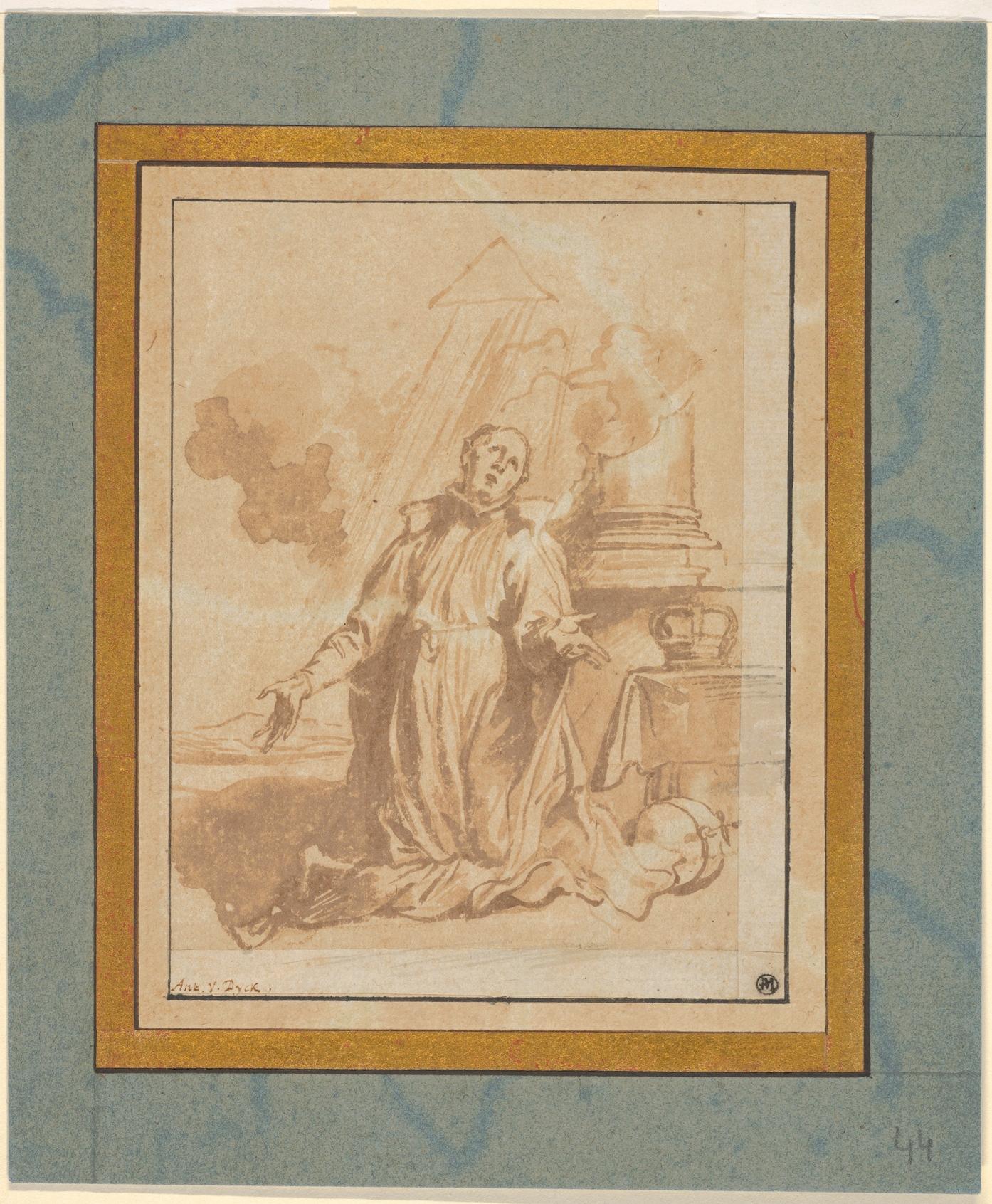
The Blessed Aloysius Gonzaga in Ecstasy
Original title: The Blessed Aloysius Gonzaga in Ecstasy
kurzbeschreibung
Unlike many devotional images of the same period, this sheet by Anthony van Dyck from around 1629 presents the Blessed Aloysius Gonzaga not in quiet contemplation but in violent religious ecstasy. Drawn in brush and brown ink, the work was later extended by Pierre-Jean Mariette. Within just 10.3 by 7.8 cm, the dramatic movement of the Baroque is concentrated to an unusual degree.
Description
The saint wears a long-sleeved garment, his arms flung wide as if reaching for an immediate connection with the divine. To one side rises a column pedestal topped by a globe, a reference to the world and the universe. Clouds and a rainbow behind him heighten the heavenly atmosphere. Browns dominate the drawing, shot through with gray washes; the light feels diffuse and otherworldly.
Context
The sheet was made in Antwerp after van Dyck's return from Italy, where he had worked for the Jesuits. Aloysius Gonzaga, canonized in 1726, was among the most popular subjects of the Counter-Reformation and embodied Jesuit ideals of piety. The drawing probably served as a preparatory study for a larger painting or as an independent devotional image. Mariette's later additions show that the sheet was valued as a collector's piece.
Impact
The outstretched arms and the gaze that reaches beyond the edge of the image pull the viewer straight into the event. Diffuse light and Baroque drama combine into a mystical intensity that makes the religious experience almost tangible.
Technique
Brush and brown ink define the execution; the later additions were made with gray wash and black ink. The fluidity of the brush allows soft transitions and stresses the movement of the figure. Narrow strips along the bottom and right edges testify to Mariette's subsequent enlargement of the sheet.
AI-generated description text
Source: Metropolitan Museum of Art · Public Domain (CC0 1.0)