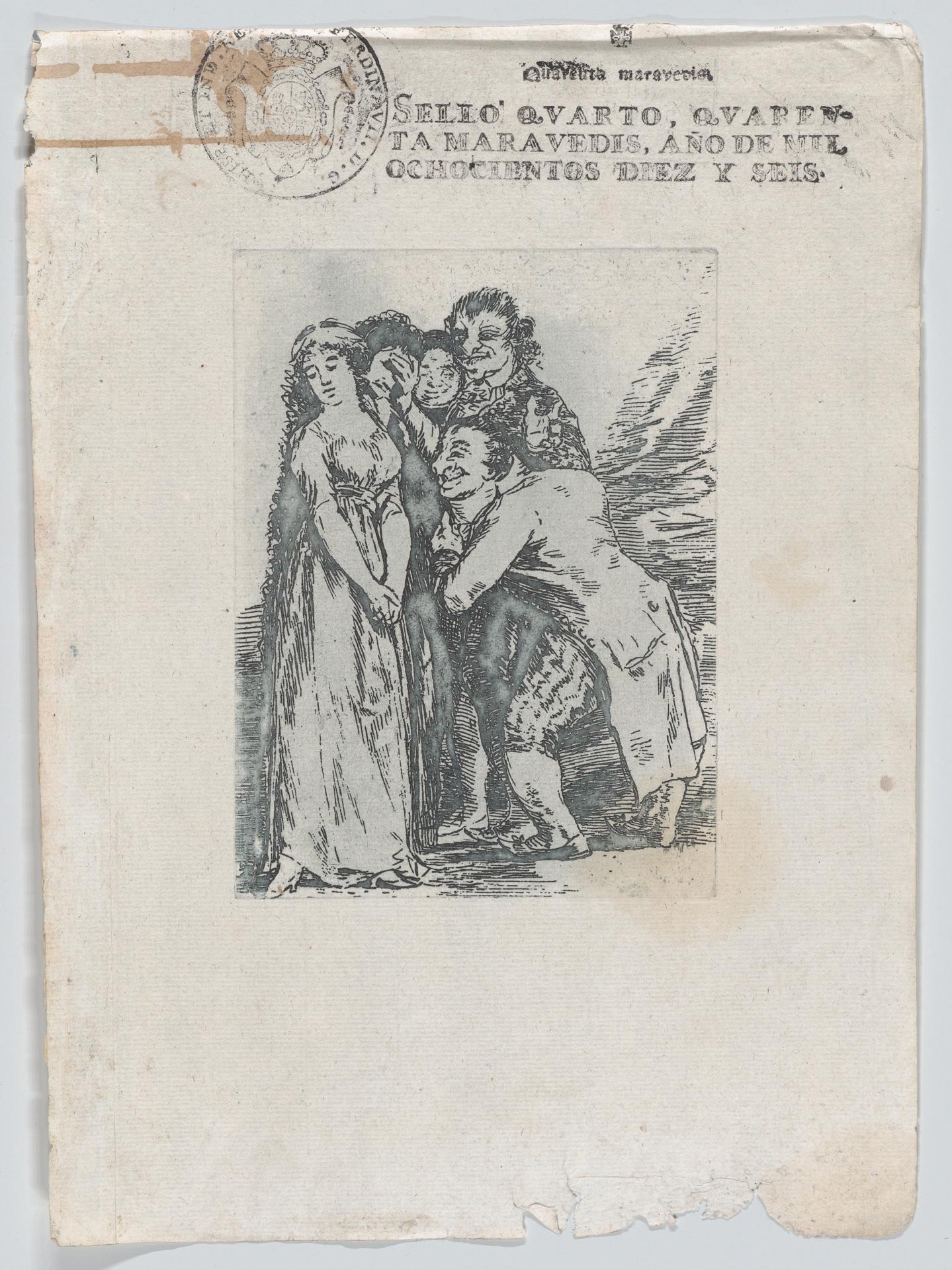
Reproduction in reverse of Goya's Sueño drawing that was preparatory for Plate 14 from Los Caprichos, 'What a sacrifice'
Original title: Reproduction in reverse of Goya's Sueño drawing that was preparatory for Plate 14 from Los Caprichos, 'What a sacrifice', a young woman surrounded by a group of men, which includes her fiancé, a rich hunchback
kurzbeschreibung
Made around 1830–50, this heliogravure with traces of green watercolor belongs to the later reproductions of Goya's Sueño drawings. A young woman is surrounded by several men, among them her fiancé and a wealthy cripple. The print reverses a preparatory study for the fourteenth plate of Los Caprichos.
Description
Black and white dominate, yet the overall effect is light, with a delicate green watercolor tone over it. The layout presses the figures tightly together: the young woman stands at the center, encircled by men in agitated, almost theatrical poses. Sharp contrasts of light and dark shape the bodies, while fine lines and graded tones reveal the engraving. At the top of the sheet, a seal and Latin text stand out.
Context
Goya used the Sueño drawings as preparatory works for Los Caprichos, the print series published in 1799. The fourteenth plate, titled 'Que sacrificio' (What a sacrifice!), attacks the forced marriage of a young woman to a rich but disfigured man. The heliogravure was likely made decades later, roughly between 1830 and 1850, as a reproductive technique that spread Goya's oeuvre. The image is reversed, which was typical of printing methods of the time that allowed a direct copy of the drawing.
Impact
A sense of oppression arises from the cramped group and the contrast between the delicate young woman and the men pressing in on her. The heliogravure gives the image a fine, detailed texture that heightens the drama of the scene. Scattered green watercolor adds a quiet accent, breaking through the monochrome.
Technique
As a heliogravure, the sheet uses a photomechanical intaglio process that produces fine tonal gradations. Traces of green watercolor indicate later coloring. The sheet measures 29.5 × 21.5 cm, the plate 15.9 × 11.8 cm.
AI-generated description text
Source: Metropolitan Museum of Art · Public Domain (CC0 1.0)