Clear Folly
Original title: 'Clear Folly' from the 'Disparates' (Follies / Irrationalities)
kurzbeschreibung
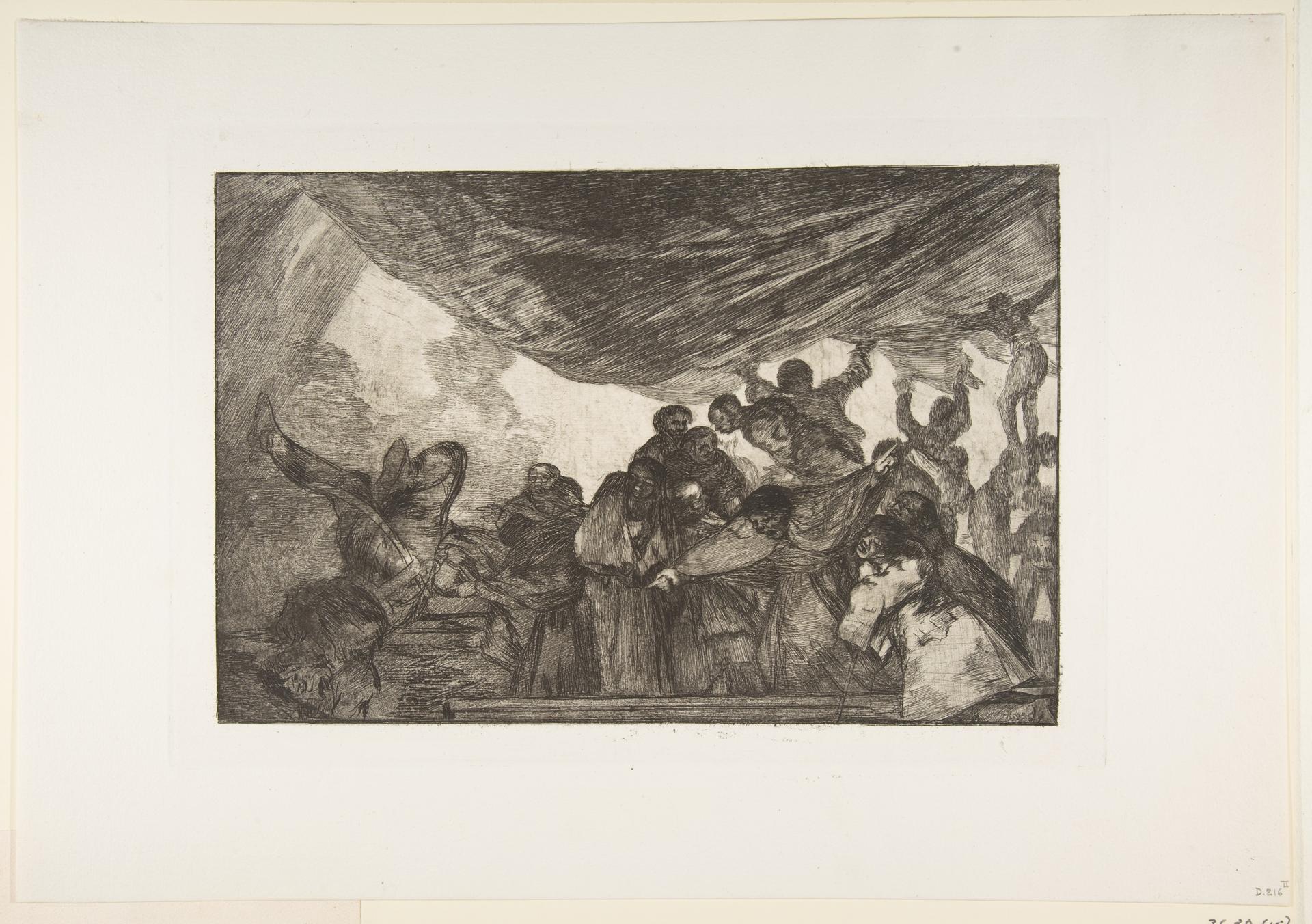
A tight knot of people fills a narrow, cave-like space in Goya’s etching “Clear Folly” (Klare Torheit), part of the Disparates series. It was made around 1815–19 and first printed posthumously in 1864. The figures’ gestures suggest a shared but muddled event.
Description
Stretching across the horizontal plate, the group presses into the middle and feels cramped. Some raise their arms, others lean forward or move about, creating a dense, pushing interplay. Diffuse light from above picks out the bodies against harsh contrasts of light and dark and gives a sense of depth. The setting recalls a catacomb or an underground hut, though the place cannot be pinned down.
Context
Between 1815 and 1819, during the political restoration that followed the Spanish War of Independence, Goya worked on the Disparates. The plates were only published in 1864 by the Madrid Academy of San Fernando—likely because of their critical, hard-to-decipher imagery. As Goya’s last major graphic cycle, they revolve around social folly, superstition and human irrationality; how individual plates such as “Clear Folly” should be read remains debated among scholars.
Impact
The print feels oppressive and enigmatic: the crowded throng and the unclear action leave the viewer without a firm footing. Bright and dark areas clash sharply, the gestures are agitated, and from this grows a dramatic, almost threatening tension. One is drawn into a sphere of the irrational, where human reason seems to be suspended.
Technique
Etching and burnished aquatint combine here to produce finely graded tones with a glossy surface. On the copper plate Goya joined the etching process for precise lines with soft, painterly zones of shadow. Figures and setting can thus be rendered in detail while retaining a strong graphic impact.
AI-generated description text
Source: Metropolitan Museum of Art · Public Domain (CC0 1.0)