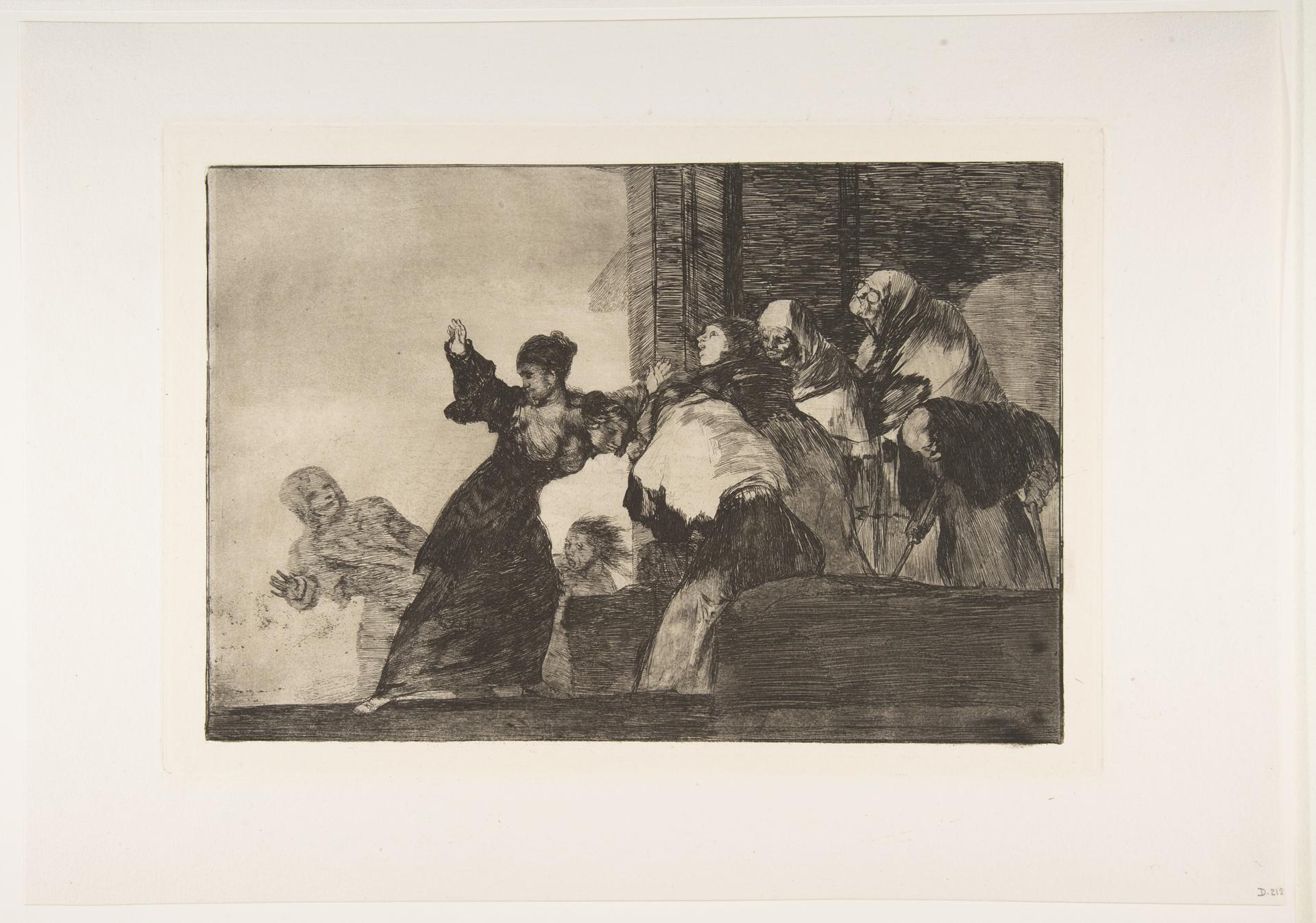
Poor Folly
Original title: 'Poor Folly' from the 'Disparates' (Follies / Irrationalities)
kurzbeschreibung
This print, titled "Arme Narrheit" (Poor Folly), belongs to Francisco de Goya's "Disparates" (Follies), a series made around 1815–19 but not published until 1864, after the artist's death. Executed as an etching with burnished aquatint and drypoint, the image gathers a group of people in a room, from which a central figure stands out through expansive gestures.
Description
Inside a room, several figures crowd together; some stand at a window, while in the middle one person stretches both arms outward, as if explaining something or emphasizing a point. The clothing of those present points to a bygone era. Light falling from the front brightens faces and bodies. Gray tones dominate the monochrome print, which combines realistic details in garments and space with pronounced expressiveness.
Context
The "Disparates" emerged in Goya's late work, after the Napoleonic Wars and during the political restoration in Spain. In them, the artist took up social follies and human irrationality, often with satirical or fantastic overtones. The plates were only published in 1864 by the Academia de San Fernando in Madrid, long after Goya's death.
Impact
The expressive gestures of the main figure and the somber monochrome give the image an immediate intensity. Realistic portrayal and dramatic heightening mix into an oppressive, almost grotesque mood that prompts viewers to puzzle over the meaning of the event.
Technique
Etching, burnished aquatint, and drypoint interlock: delicate lines merge with soft tonal values and strong shading. The aquatint produces graduated grays, while drypoint adds precise, sharp details. The result is a rich texture with dramatic contrast between light and dark.
AI-generated description text
Source: Metropolitan Museum of Art · Public Domain (CC0 1.0)