Cruel Folly
Original title: 'Cruel Folly', from the 'Disparates' (Follies / Irrationalities)
kurzbeschreibung
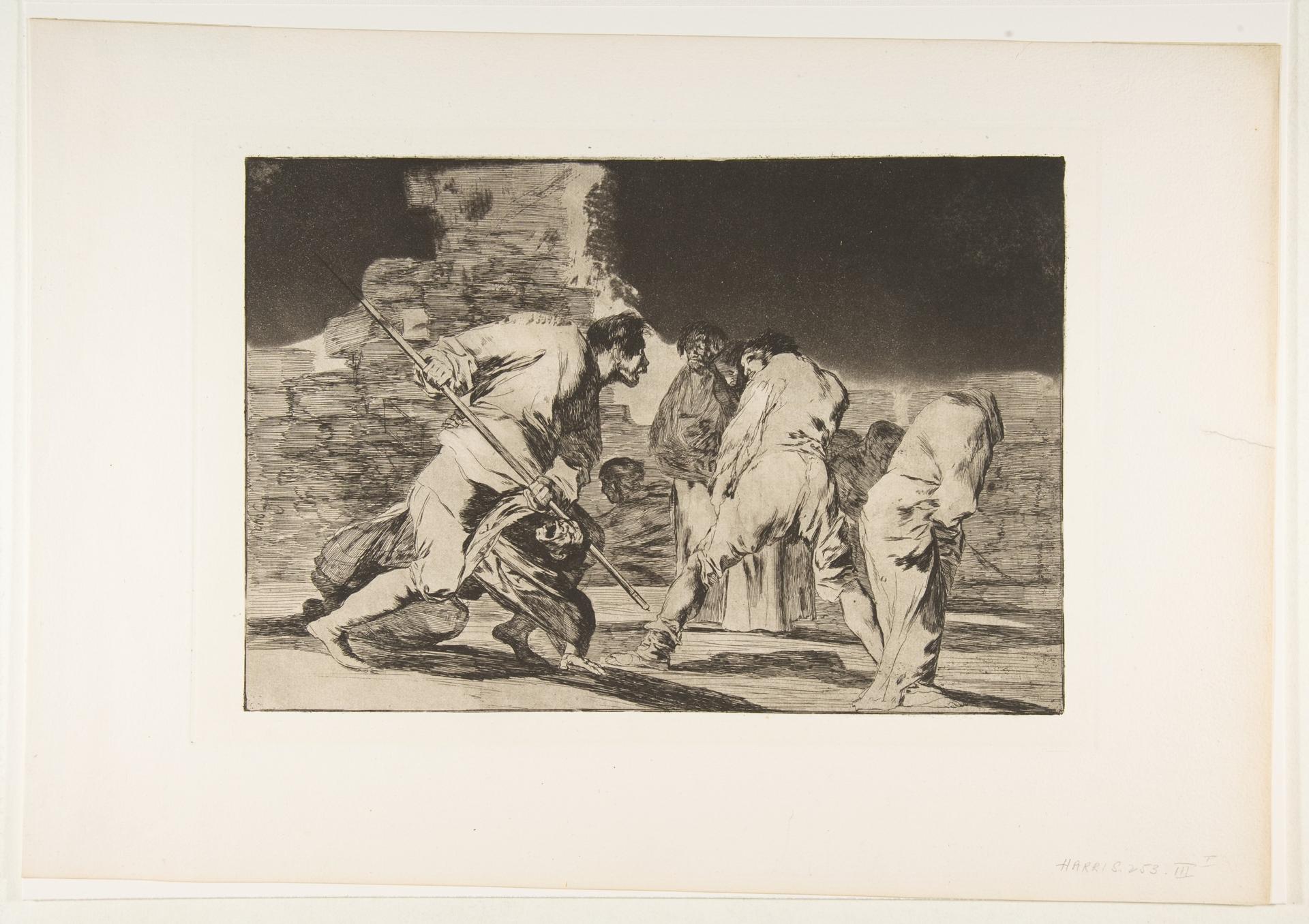
Goya's 'Grausame Torheit' belongs to the 'Disparates' (Follies), a series made around 1815–19 but not published until 1864, after his death. An etching with burnished aquatint, it presents a violent struggle in a ruined setting.
Description
In the foreground, a man in dirty, simple clothing crouches, fending off another kneeling figure with a long stick; the opponent also wields a stick. Behind them, other figures are hinted at, seemingly caught up in the confrontation. A damaged wall or tower forms the backdrop, lending a warlike mood. Frontal light sharply separates the figures' outlines, while aquatint provides the monochrome gray scale. The asymmetrical arrangement heightens the dynamism of the fight.
Context
The 'Disparates' emerged during a phase of Goya's career marked by political repression and social critique after the restoration of the Spanish monarchy in 1814. The plates were only published in 1864 by the Academy in Madrid, long after the artist's death. 'Grausame Torheit' is among Goya's later graphic works, which reveal an increasingly pessimistic view of the world. The series is often read as a continuation of the 'Desastres de la guerra' (Disasters of War), though here violence shifts into the allegorical.
Impact
A stifling intensity arises from the asymmetrical layout and harsh light, which isolates the figures as if under a spotlight. The rough, almost sketchy execution heightens the impression of immediacy and brutality, without allowing the scene a clear interpretation. What remains is an enigmatic, menacing atmosphere characteristic of Goya's late graphic work.
Technique
Etching with burnished aquatint allows for finely graduated gray tones. Aquatint creates soft, tonal areas, while etched lines define the contours and details of the figures. Certain passages were burnished to introduce highlights and emphasize the dramatic lighting.
AI-generated description text
Source: Metropolitan Museum of Art · Public Domain (CC0 1.0)