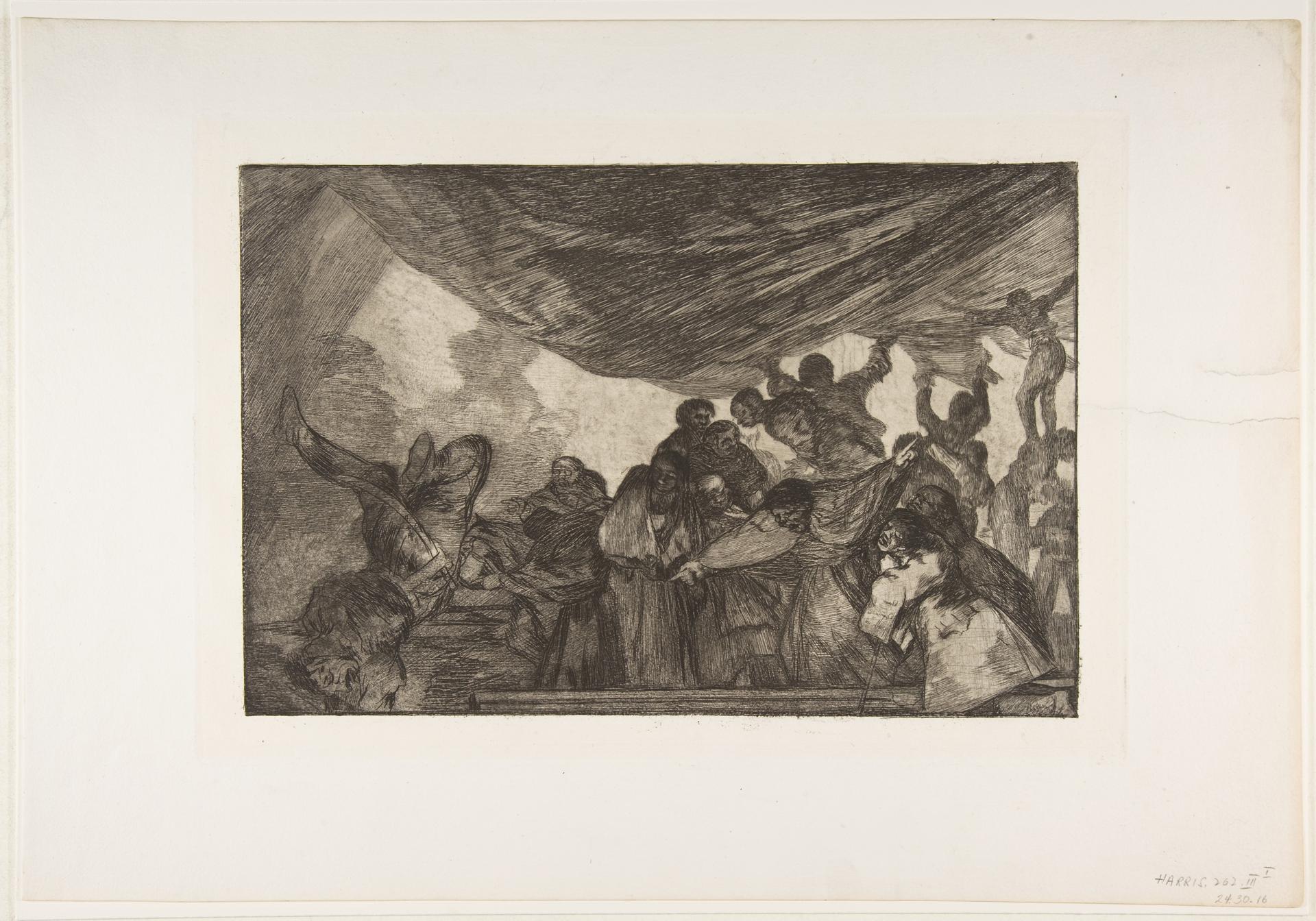
Clear Folly, from "The Disparates" (Follies / Irrationalities)
Original title: Clear Folly, from "The Disparates" (Follies / Irrationalities)
kurzbeschreibung
Francisco de Goya y Lucientes made Klare Torheit (Clear Folly) as part of his series Die Disparates between about 1815 and 1819; it was not published until 1864. The print measures 24.8 × 35.2 cm and shows a agitated crowd in violent motion, executed as an etching with burnished aquatint.
Description
A group of people is thrown into violent uproar: some have fallen to the ground, others stand upright or seem to be lifting something. Twisted bodies and outstretched gestures suggest a disorderly, possibly violent confrontation. Dark, almost monochrome tones dominate the image and heighten the drama. The pale light and the irregular distribution of the figures draw the eye to the middle, where the action becomes most dense.
Context
The Disparates belong to Goya's late work and were made after the atrocities of the Spanish War of Independence and the restoration under Ferdinand VII. The 22 plates of the series appeared only in 1864, long after Goya's death, published by the Royal Academy of San Fernando. Among his graphic cycles, the Disparates are considered the most enigmatic; their imagery resists fixed interpretation and is often read as a comment on social ills and human unreason.
Impact
The gloomy coloration and contorted bodies produce a sense of threat and unease. Subtle gradations of aquatint create an atmospheric depth that makes the event seem like a nightmare. The arrangement generates strong emotional tension that holds the viewer captive.
Technique
Goya combined etching with burnished aquatint, a process that allows soft tonal transitions and gentle shadows. The lines are drawn clearly and energetically, while the aquatint areas provide the strong light-dark contrasts. Through this combination he modeled the bodies with plasticity and at the same time deepened the somber mood.
AI-generated description text
Source: Metropolitan Museum of Art · Public Domain (CC0 1.0)