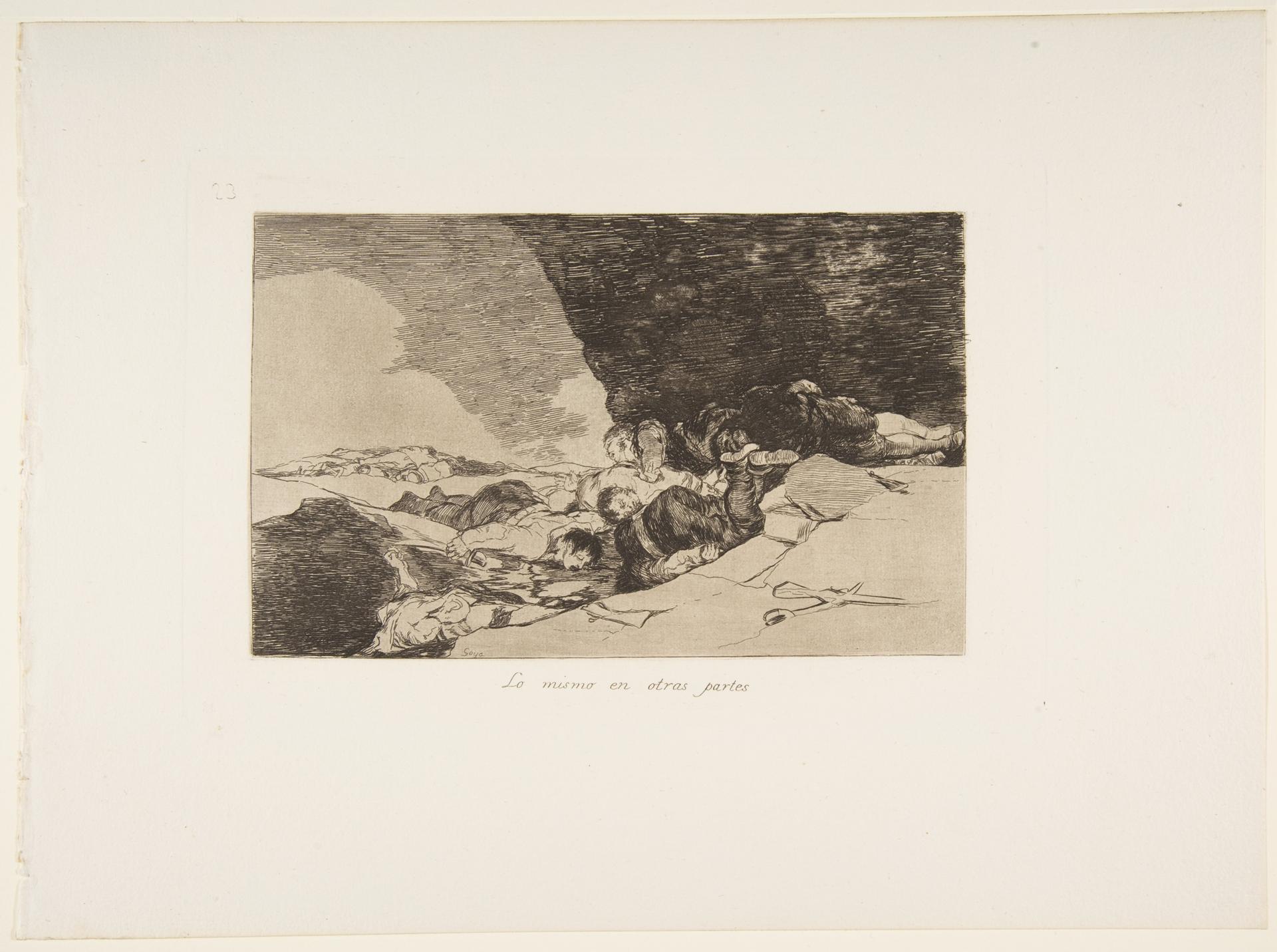
The Same Elsewhere (Lo mismo en otras partes)
Original title: Plate 23 from "The Disasters of War" (Los Desastres de la Guerra): 'The Same Elsewhere' (Lo mismo en otras partes)
kurzbeschreibung
This print, 'The Same Elsewhere' (Lo mismo en otras partes), belongs to Goya's series 'The Disasters of War' (Los Desastres de la Guerra), made in 1810 but published only posthumously in 1863. In the etching with drypoint, lavis, and burin, the artist presents a group of wounded or dying people in a cave—a motif that drives home the universal destruction of war.
Description
On the floor of a cave lie several figures, some on their backs, others on their stomachs, a few with arms raised. Their faces are marked by pain or fear. Dark, undefined shapes in the background suggest further victims or destroyed objects. Scattered on the ground: a pair of scissors and a sheet of paper. The deep tonal range and tight hatching create an oppressive, somber mood.
Context
Between 1810 and 1820, during the Spanish War of Independence against Napoleon and the subsequent restoration, Goya created the series. The prints were not published until 1863 by the Real Academia de Bellas Artes de San Fernando. The title 'The Same Elsewhere' alludes to the universality of wartime atrocities: Goya understood them not as isolated incidents but as a recurring phenomenon. Created without state commission, the series remained almost unknown during the artist's lifetime.
Impact
The dark lighting and distorted postures immediately unsettle the viewer. Because the victims lack any heroism, the portrayal feels unflinchingly close to reality. The raw violence of war emerges without aesthetic embellishment.
Technique
Goya combined several graphic techniques: etching for the underdrawing, drypoint for bold lines, lavis for flat tonal areas, and burin for precise details. The plate measures 16 × 24 cm, the sheet 25.2 × 34.4 cm. The nuanced gradation of light and dark demonstrates Goya's confident handling of printmaking.
AI-generated description text
Source: Metropolitan Museum of Art · Public Domain (CC0 1.0)