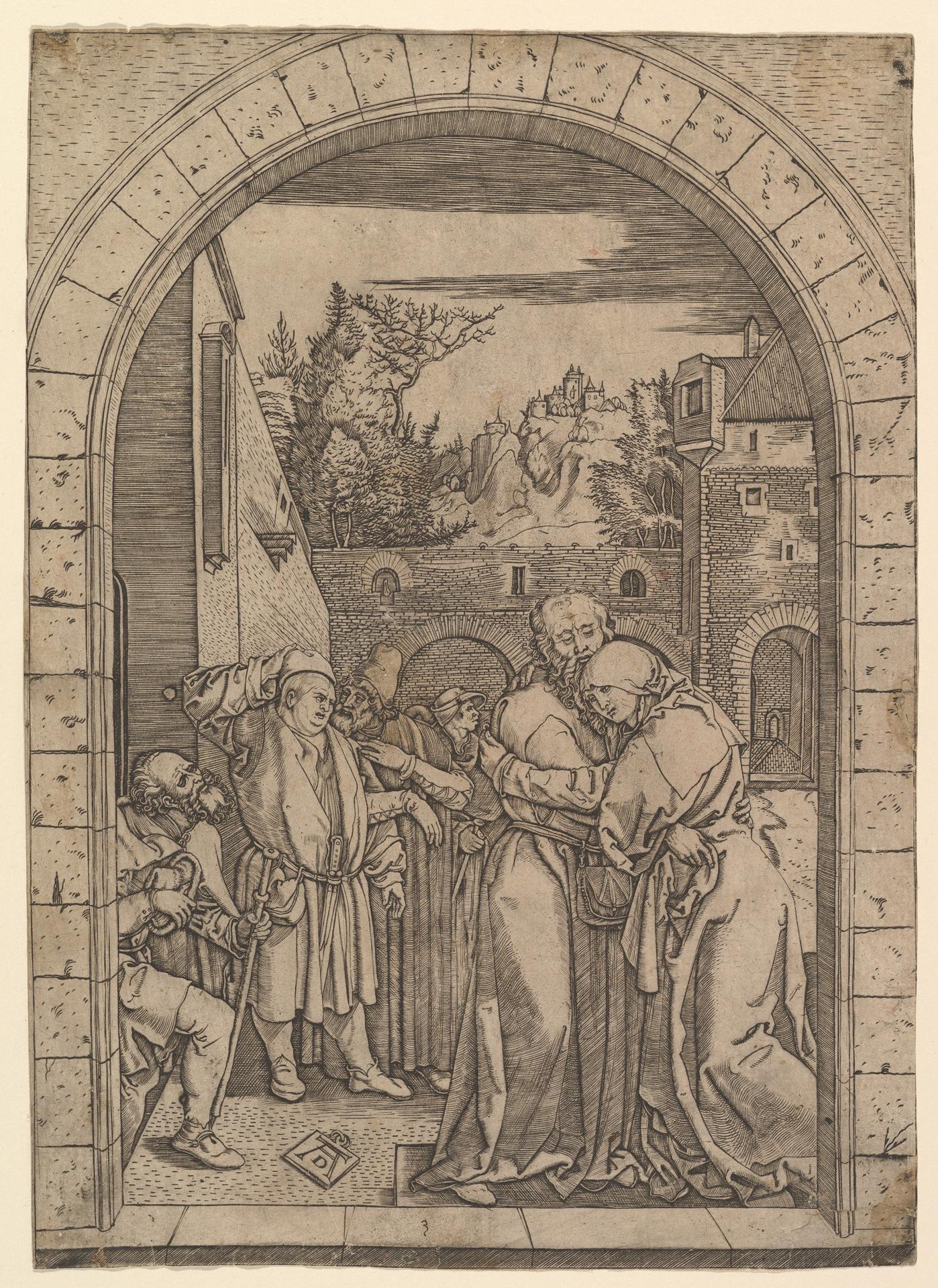
Joachim embracing Saint Anne under the golden gate in Jerusalem, after Dürer
Original title: Joachim embracing Saint Anne under the golden gate in Jerusalem, after Dürer
kurzbeschreibung
Unlike many contemporary prints that set the meeting of Joachim and Anna at the Golden Gate within a broad landscape, this engraving by Marcantonio Raimondi draws the figures tightly together. Made between about 1500 and 1534, it derives from an invention by Albrecht Dürer, whose detailed, Gothic manner is here translated into the language of Italian engraving.
Description
Within an archway, a group of men presses close; one of them holds a child in his arms in the foreground. To the left stands another man with a book. Beyond the arch, a landscape opens with trees, houses, and a castle. The figures' garments point to a bygone era. The layout is mirror-reversed, the group in the archway forming the still center, while light falls evenly across the surface.
Context
Raimondi, an Italian Renaissance engraver, became known above all for his reproductive prints after Dürer and Raphael. While working in Rome, he engaged with printmaking from north of the Alps. Dürer's model, which recounts the apocryphal legend of Joachim and Anna's meeting, was widely circulated in Europe; Raimondi's engraving made it accessible to a broader audience.
Impact
The calm, mirror-reversed arrangement of the figures and the fine linework create a dignified mood. Garments and background are rendered with great precision, giving the sheet an almost narrative depth and drawing the viewer into the biblical scene.
Technique
Engraving is an intaglio process in which lines are cut into a metal plate. Raimondi worked with a precise, fine stroke characteristic of his technique, allowing for high detail. The present impression is from the second state, indicating that the plate was reworked.
AI-generated description text
Source: Metropolitan Museum of Art · Public Domain (CC0 1.0)