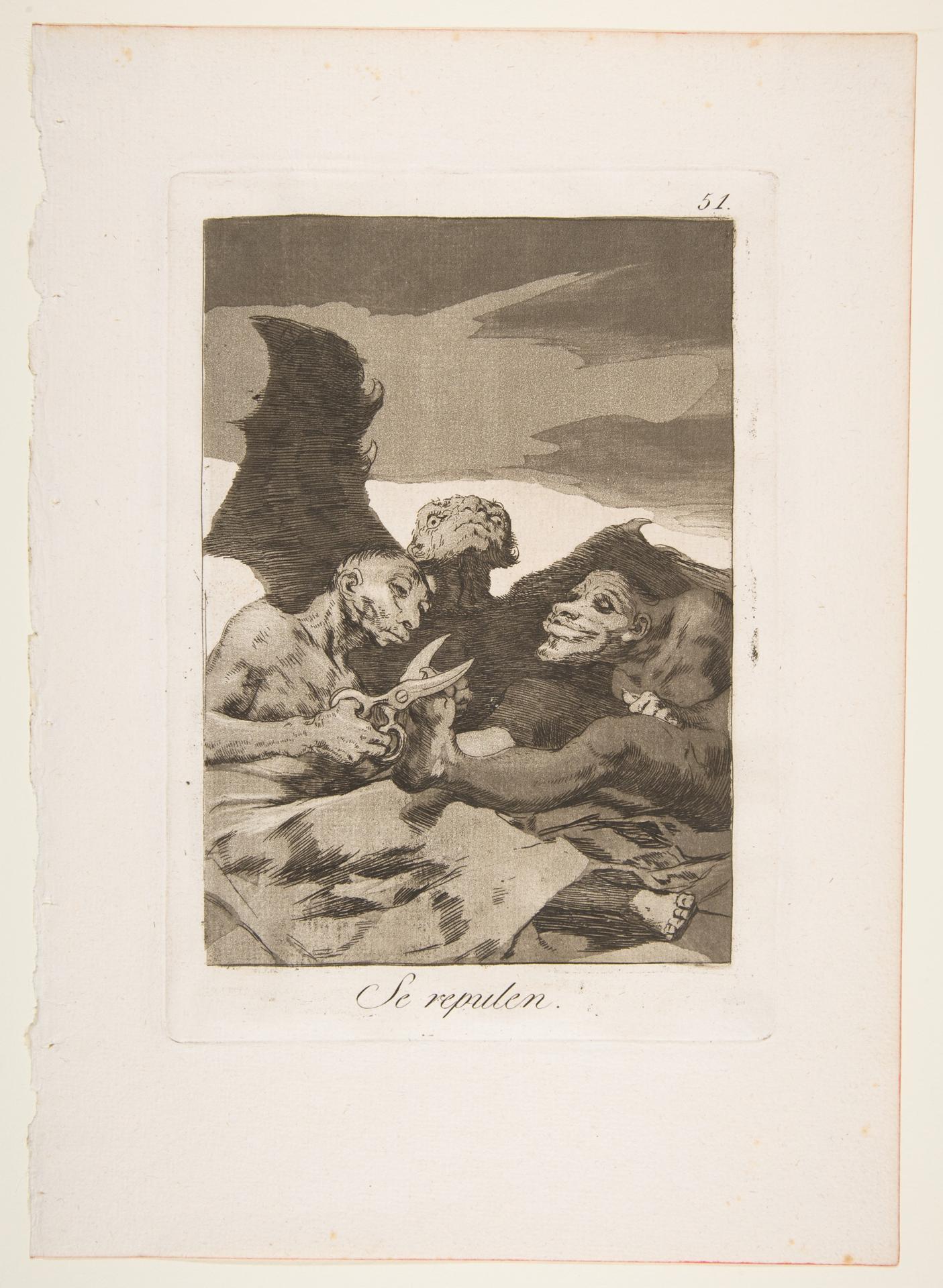
They spruce themselves up (Se repulen)
Original title: Plate 51 from "Los Caprichos": They spruce themselves up (Se repulen)
kurzbeschreibung
In 1799, Francisco de Goya published "They Comb Themselves" (Se repulen) as plate 51 of his series Los Caprichos. The etching shows two human-like figures trimming each other's hair, blending social critique with fantastical imagery. It was executed as an etching with aquatint and drypoint.
Description
Two figures with human faces but densely haired bodies tend to each other's hair, a scene that recalls monkeys grooming one another. They are placed in a barren, mountainous landscape that feels harsh and unwelcoming. The monochrome image is dominated by shades of grey, with diffuse light creating a sombre mood. Sharp lines and fine hatching, typical of etching, model the texture and volume of the figures. Along the bottom edge, the engraved title "Se repulen" appears in Latin script.
Context
Between 1797 and 1799, under the reign of Charles IV and during a period of social upheaval in Spain, Goya created Los Caprichos. The series comprises 80 etchings that satirize superstition, ignorance, and social ills. Plate 51 is one of the Caprichos that addresses human vanity and self-deception. In 1799, Goya published the series but withdrew it from sale shortly afterwards, presumably because of its biting criticism of the nobility and clergy.
Impact
The hairy creatures grooming each other seem both absurd and disturbing. This fusion of human and animal creates a grotesque aesthetic that unsettles the viewer and prompts reflection. The gloomy lighting and stark setting reinforce a sense of isolation and social decay.
Technique
Goya combined etching, burnished aquatint, and drypoint to achieve subtle transitions of light and shadow. Aquatint provides soft, tonal areas; drypoint adds precise lines for details such as hair and facial features. The print was made on paper measuring 11 9/16 by 8 1/4 inches, with the plate itself measuring 8 1/4 by 5 13/16 inches.
AI-generated description text
Source: Metropolitan Museum of Art · Public Domain (CC0 1.0)