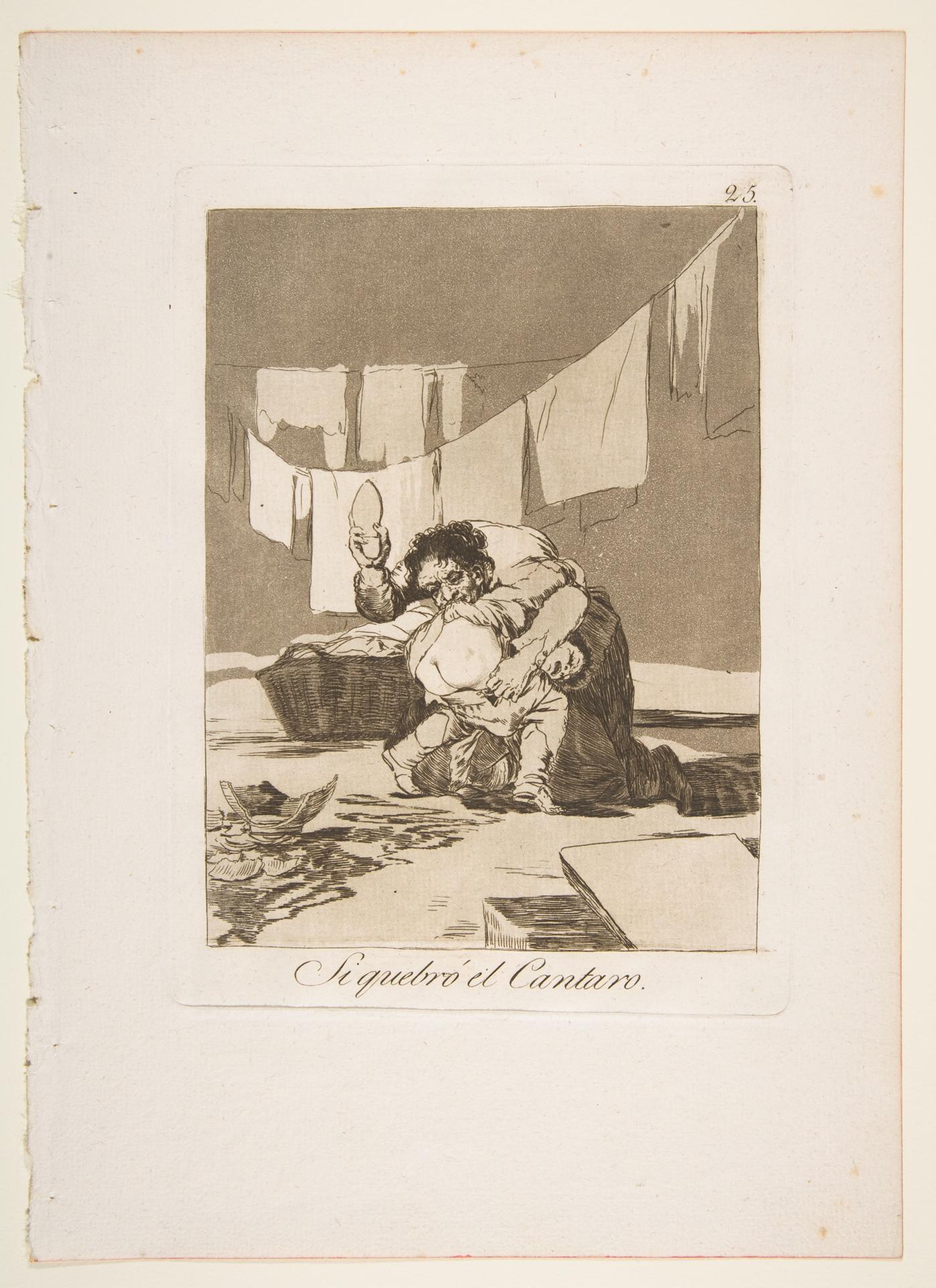
If he broke the pot (Si quebró el Cantaro)
Original title: Plate 25 from "Los Caprichos": If he broke the pot (Si quebró el Cantaro)
kurzbeschreibung
Unlike many plates from Goya's Los Caprichos, which mock human foolishness head-on, this print puts a domestic disaster at its heart. Titled "If He Broke the Jug" (Si quebró el Cantaro), the etching dates from 1799 and belongs to the 80-part series. A kneeling woman clutches a broken bucket against a backdrop of a clothesline. The image combines etching, aquatint, and drypoint.
Description
A kneeling woman in a plain, long gown grips a shattered bucket; her posture and expression reveal sorrow and helplessness. Her dark hair falls loose. Behind her, laundry hangs on a line, suggesting a household setting. Scattered sheets of paper and a second bucket lie on the ground. The layout is centrally focused and dominated by a monochrome gray palette. Light from above emphasizes shadows and textures of figure and objects.
Context
First published in 1799, the series Los Caprichos comprises 80 etchings and delivers sharp social criticism. It emerged during a period of political and social upheaval in Spain under Charles IV. Goya used aquatint to achieve dramatic chiaroscuro effects that heighten the satirical and often somber content. This sheet—plate 25—is among those that elevate everyday scenes into allegory, alluding to abuses such as violence or injustice.
Impact
The woman's expressive posture and the stark, shadow-filled surroundings trigger immediate emotional involvement. Because an everyday subject is paired with dramatic lighting, the scene feels oppressive and almost tragic. The monochrome and finely graded grays draw the eye to the figure's despair without distraction.
Technique
Etching, aquatint, and drypoint were combined, allowing fine lines and tonal gradations. Aquatint creates soft, flat areas of gray, while drypoint provides precise, strong contours. The paper size (29.5 × 21 cm) is typical for the Los Caprichos series, which was circulated in an edition of about 300 copies.
AI-generated description text
Source: Metropolitan Museum of Art · Public Domain (CC0 1.0)