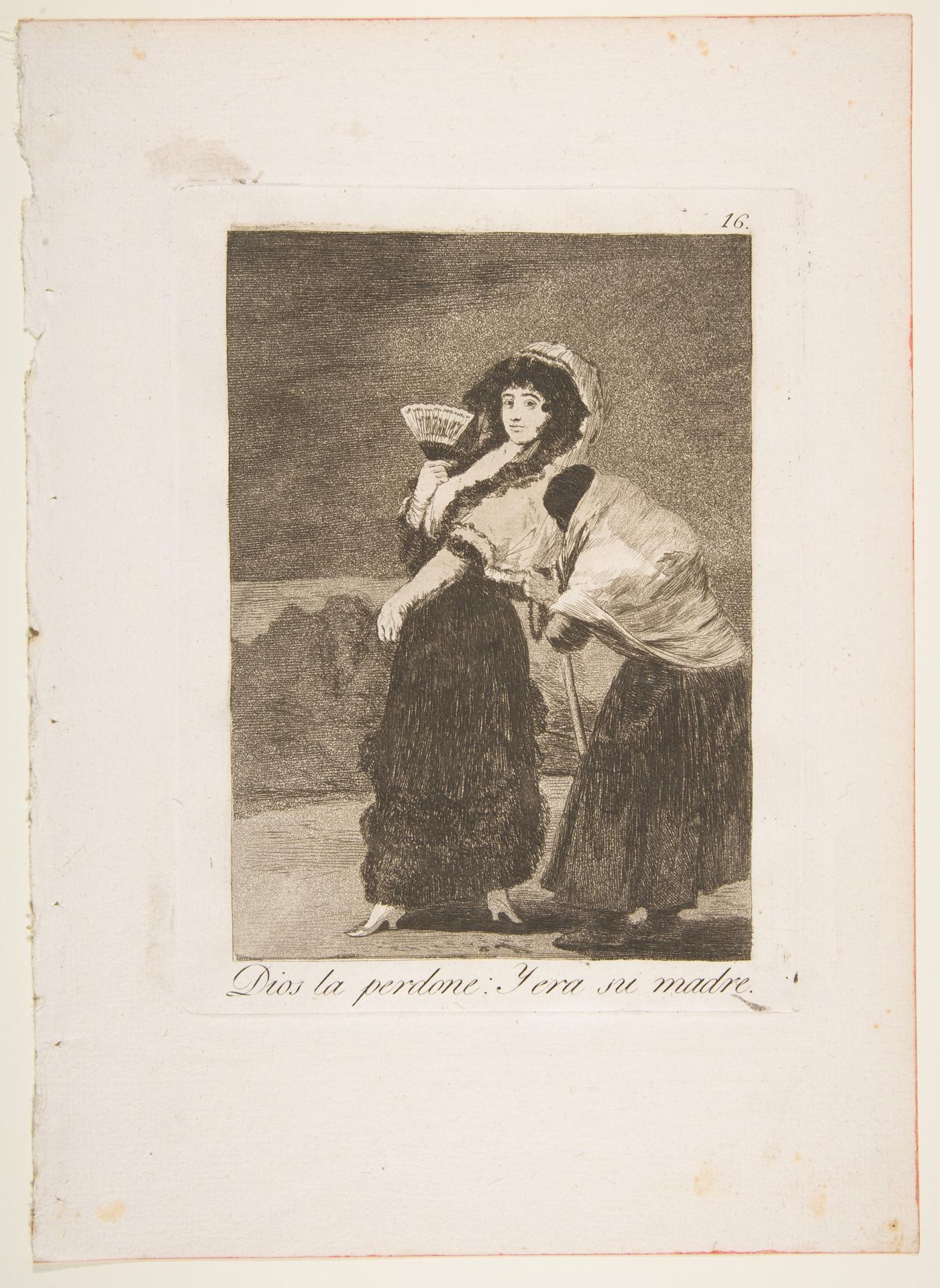
Los Caprichos, Plate 16: For heaven's sake: and it was her mother
Original title: Plate 16 from "Los Caprichos": For heaven's sake: and it was her mother (Dios la Perdone: Y era su madre)
kurzbeschreibung
This print, titled "God forgive her: And she was her mother" ("Dios la Perdone: Y era su madre"), is the 16th plate from Francisco de Goya's etching series "Los Caprichos," created in 1799. It depicts two women in a dark, loosely defined setting, executed as a drypoint etching with aquatint.
Description
Two women dressed in 18th-century clothing dominate the image. The one on the left, wearing a head covering and holding a fan, appears pensive or distressed; the one on the right, grasping a stick, looks toward her and stands slightly further back. A dark, blurred background makes the figures stand out. At the bottom appears the inscription "Dios la perdono: Y era su madre." The layout is balanced, with even lighting and no harsh contrasts.
Context
Between 1797 and 1799, Goya produced the 80 etchings of "Los Caprichos," a satirical series on social ills and human follies. The 16th plate deals with hypocrisy and double standards in Spain at the time, especially regarding the role of mothers and prostitution. Published in 1799, the series was soon withdrawn because of its sharp criticism. Goya used printmaking to circulate his observations without directly exposing himself to political danger.
Impact
The gloomy, eerie mood and the subdued coloration reinforce the moralizing tone of the plate. The figures seem isolated and brooding, which creates a sense of unease in the viewer. Clear lines and soft aquatint tones give the work a dense, graphic presence.
Technique
The execution combines etching, burnished aquatint, and drypoint. Etching allows fine lines, aquatint creates the tonal gray areas in the background, and drypoint models the bodies with soft, velvety edges. The paper size exceeds the plate size, as is usual for prints in the series.
AI-generated description text
Source: Metropolitan Museum of Art · Public Domain (CC0 1.0)