Saint Eustace
Original title: Saint Eustace
kurzbeschreibung
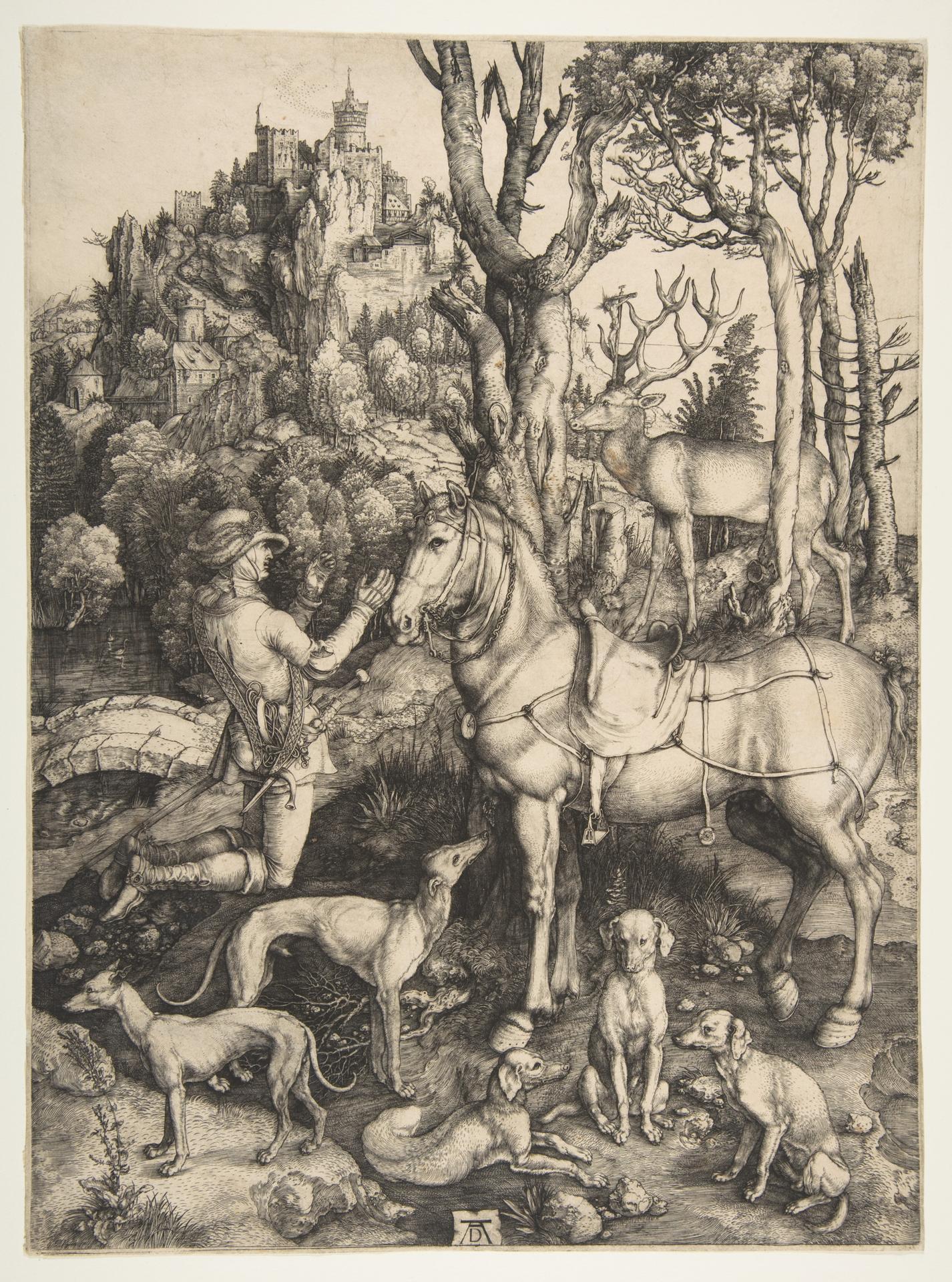
Saint Eustace is an engraving by Albrecht Dürer, created around 1501. The work depicts the legendary moment of Saint Eustace's conversion, when he encounters a stag with a crucifix between its antlers. The scene is rendered in fine detail, showcasing Dürer's mastery of engraving technique.
Description
In the foreground, a knight in armor kneels to the left, reaching out to touch the muzzle of a saddled horse, which wears a small medallion around its neck. Several dogs surround the horse, some lying and others standing or sitting. In the background to the right, a large stag with an impressive set of antlers stands among tree trunks. To the left, a steep cliff rises, crowned by a castle with multiple towers, and below it, a wooded landscape stretches down to a river crossed by a small stone bridge. The composition is anchored by the figure group in the lower right, while the castle provides a vertical counterpoint, and the river and bridge lead the eye diagonally through the scene.
Context
Dürer created this engraving during a period of intense artistic activity in Nuremberg, where he had established himself as a leading printmaker. The subject of Saint Eustace was popular in late medieval and Renaissance art, reflecting the era's interest in saints' lives and miraculous conversions. Dürer's depiction is notable for its detailed naturalism, particularly in the rendering of the animals and landscape, which was innovative for the time.
Impact
The engraving impresses with its intricate detail and the harmonious balance between the figures and the expansive landscape. The viewer's eye is drawn across the scene, from the intimate interaction in the foreground to the distant castle and river, creating a sense of depth and narrative. The contrast between the dark, textured foreground and the lighter background enhances the dramatic quality of the moment.
Technique
Dürer employed the technique of engraving on copper, using a burin to incise fine lines that hold ink for printing. The work is monochromatic, relying on varying line density and cross-hatching to create tonal gradations and light effects. The precision of the linework, especially in the fur of the dogs and the foliage, demonstrates Dürer's exceptional control and skill in the medium.
AI-generated description text
Source: Metropolitan Museum of Art · Public domain (CC0)