Erasmus of Rotterdam
Original title: Erasmus of Rotterdam
kurzbeschreibung
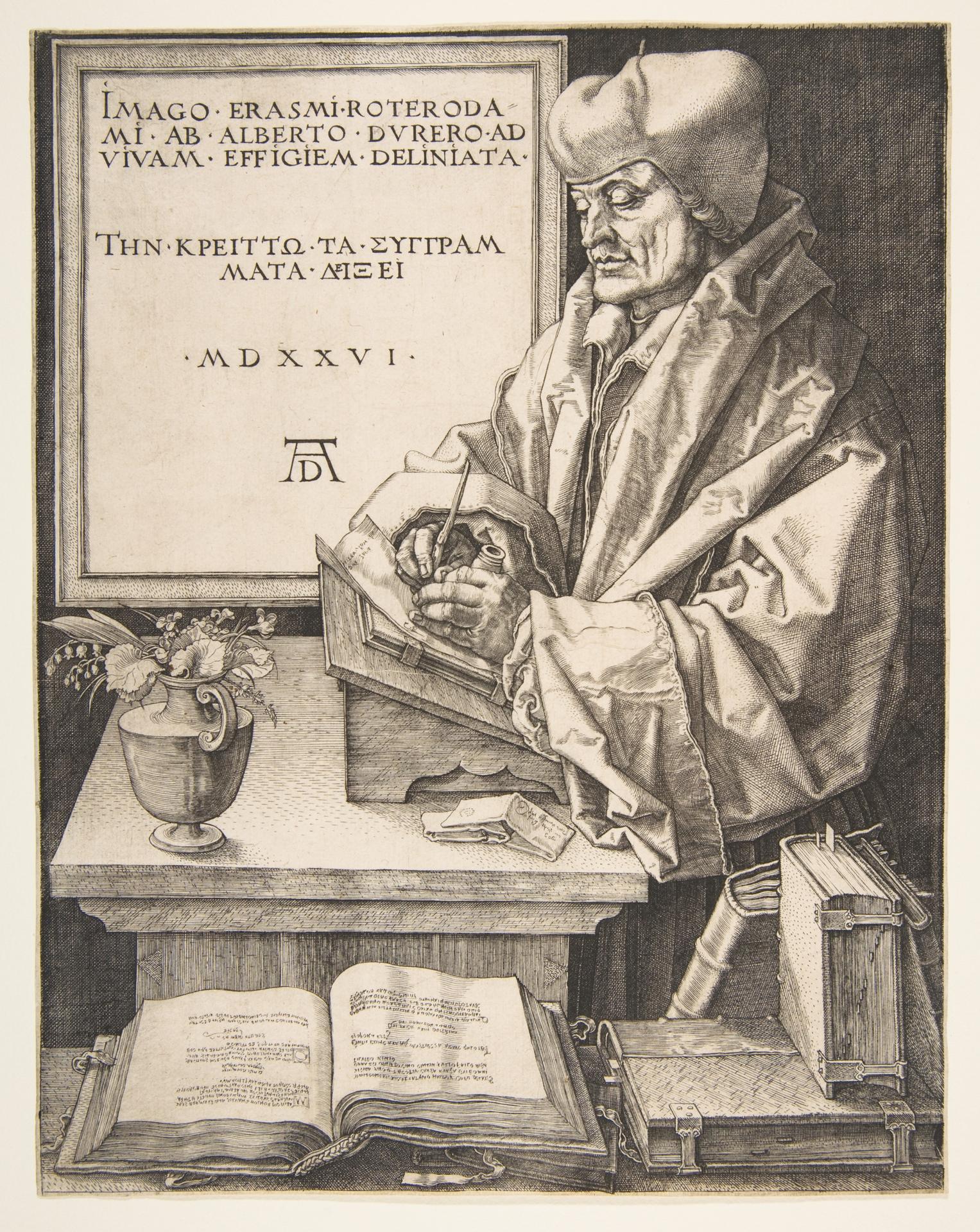
Albrecht Dürer's 1526 engraving depicts the renowned humanist Desiderius Erasmus of Rotterdam in a studious setting. The portrait shows Erasmus seated at a desk, writing in a book, with a vase of flowers and other books nearby. This work is a masterful example of Dürer's late printmaking, capturing the intellectual spirit of the age.
Description
The composition centers on Erasmus, portrayed in profile facing left, with his head turned slightly toward the viewer. He wears a voluminous gown and a cap, holding a quill in his right hand as he writes in a book on a wooden table. To the right of the table are bound books and a box, while a framed text block with a Latin inscription occupies the upper left. The background is dark and plain, focusing attention on the figure and objects, with lighting from the upper left creating subtle shadows.
Context
Dürer created this engraving in 1526, during the height of the Reformation, when Erasmus was a central intellectual figure in Europe. The two men had a complex relationship, with Dürer admiring Erasmus's scholarship but also disagreeing with some of his theological positions. This portrait was made two years before Dürer's death, showcasing his mature skill in engraving. The Latin inscription, likely added by Erasmus himself, emphasizes his commitment to writing and scholarship.
Impact
The engraving conveys a sense of quiet intellectual intensity, with Erasmus's focused gaze and the orderly arrangement of objects suggesting a life devoted to study. The detailed rendering of textures and the interplay of light and shadow give the image a remarkable depth and realism, drawing the viewer into the scholar's world.
Technique
Dürer employed the technique of engraving on copper, using a burin to incise fine lines that create tonal variations through cross-hatching and stippling. The meticulous linework captures the fabric of the gown, the texture of the books, and the subtle modeling of the face, demonstrating Dürer's technical virtuosity. The print was likely produced in multiple impressions, making it accessible to a wide audience.
AI-generated description text
Source: Metropolitan Museum of Art · Public domain (CC0)