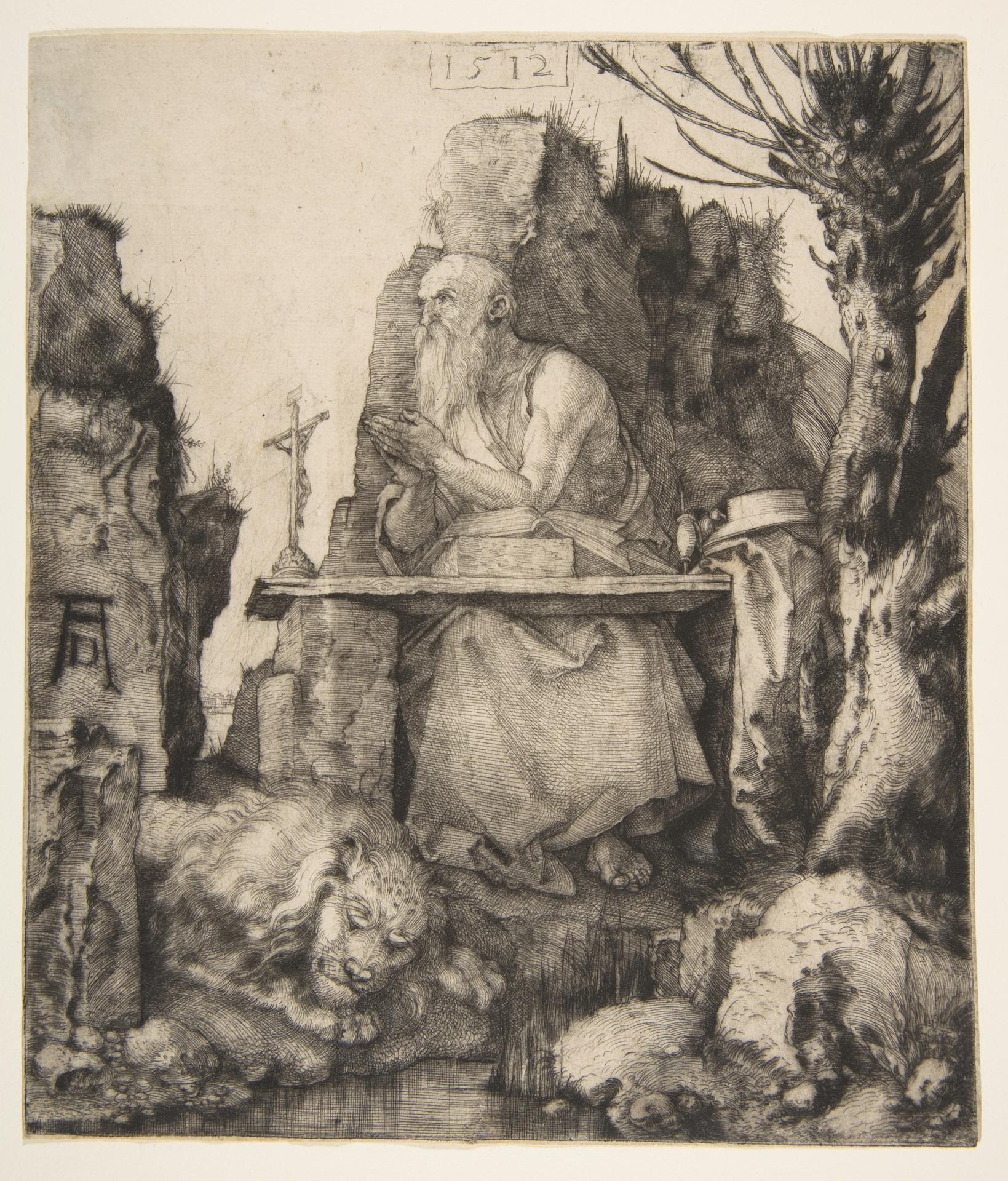
Saint Jerome by the Pollard Willow
Original title: Saint Jerome by the Pollard Willow
kurzbeschreibung
Albrecht Dürer's drypoint print from 1512 depicts Saint Jerome in a rocky landscape, seated in prayer before an open book. The composition includes his traditional attributes: a lion, a crucifix, and a dove, all rendered in monochrome line work.
Description
The print shows an elderly, bald Saint Jerome with a long beard, seated slightly angled toward the viewer, his hands folded in prayer. Before him, on a flat stone slab, lies an open book; to the left stands a crucifix on a small pedestal, and to the right, a bowl with a dove. In the lower left foreground, a lion rests by a stream that flows across the scene, while a pollard willow rises on the right. Rugged rock walls or ruins frame the saint on both sides, and in the left background a landscape with water and a tower or weir is visible. The date '15 12' appears in a cartouche at the top center.
Context
Dürer created this drypoint in 1512, a period when he was exploring intaglio techniques beyond his more common engravings and woodcuts. The subject of Saint Jerome was a recurring theme in Dürer's work, reflecting the humanist interest in the scholar-saint. The drypoint medium was relatively new at the time, and Dürer was among the first artists to use it for original prints.
Impact
The print has a quiet, contemplative atmosphere, emphasized by the saint's serene pose and the calm landscape. The rough, sketch-like quality of drypoint lends the image a sense of immediacy and intimacy, drawing the viewer into the saint's secluded world. The use of light and shadow through dense line work creates a dramatic yet peaceful contrast.
Technique
This work is a drypoint, a technique where the artist scratches directly onto a metal plate with a hard needle, producing a burr that holds ink and creates soft, velvety lines. This is the second state of three, indicating Dürer made minor revisions to the plate. The monochrome image relies entirely on the density and direction of these lines to model form and suggest depth.
AI-generated description text
Source: Metropolitan Museum of Art · Public domain (CC0)