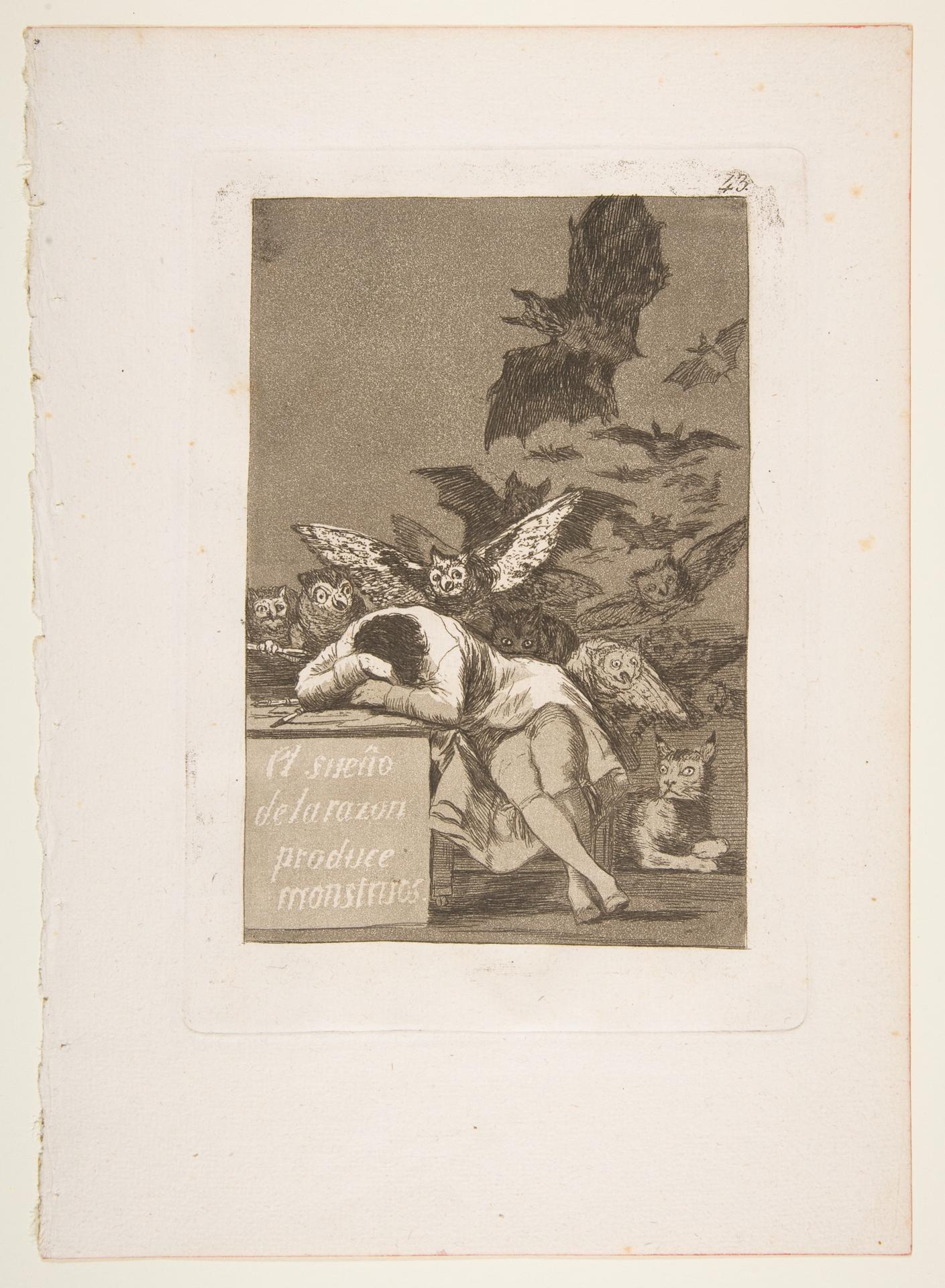
The sleep of reason produces monsters (El sueño de la razón produce monstruos)
Original title: Plate 43 from "Los Caprichos": The sleep of reason produces monsters (El sueño de la razon produce monstruos)
kurzbeschreibung
Plate 43 of Los Caprichos, the print series Goya published in 1799, carries the title "The Sleep of Reason Produces Monsters" (El sueño de la razón produce monstruos). This etching with aquatint presents a man asleep at a table, surrounded by owls and bats that emerge from the darkness behind him.
Description
In the foreground a plainly dressed figure rests on a tabletop with arms folded, head laid down on the surface. Behind him several owls rear up in various postures, some with wings spread, while bats trace their paths above them. At the bottom crouches a creature with the head of a cat and an owl; lower right hints at a wolf- or dog-like animal. Beneath the figure runs the inscription "El sueño de la razón produce monstruos." Light falls from above and picks out the contours; the greys range from pale to deep black.
Context
Los Caprichos comprises 80 etchings, which Goya issued in Madrid in 1799. Plate 43 had originally been intended as the title page of the series and was later moved to position 43. Goya made the composition as he turned toward Enlightenment thought while attacking the social ills of Spain. The sleep of reason is often read as a warning against the dangers of superstition and ignorance, which thrive in the night of irrationality.
Impact
Dense hatching and deep shadows create a menacing, almost nightmarish mood. The contrast between the calm, slumped figure and the dynamically fluttering creatures gives the print an unsettling tension. The viewer is drawn straight into the conflict between reason and imagination.
Technique
Etching with aquatint, a technique that allows fine tonal gradations. Goya used aquatint to achieve soft transitions from light to shadow, while the etched lines pin down the contours and details of the figures precisely. Linear and tonal elements together produce the characteristic dense texture of the print.
AI-generated description text
Source: Metropolitan Museum of Art · Public Domain (CC0 1.0)