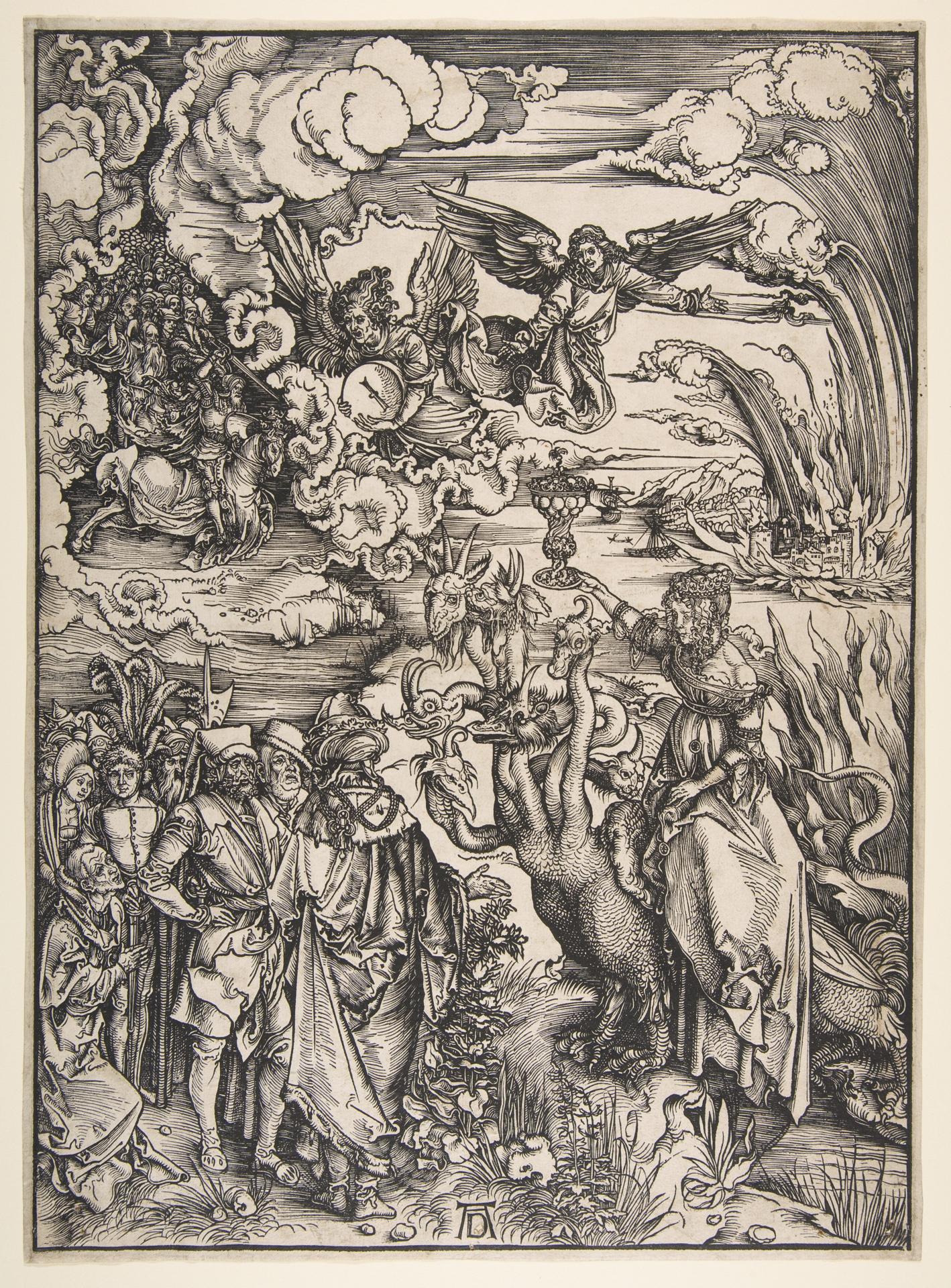
The Whore of Babylon, from "The Apocalypse"
Original title: The Whore of Babylon, from "The Apocalypse"
kurzbeschreibung
Albrecht Dürer's woodcut from 1498 depicts the Whore of Babylon riding a seven-headed beast, as described in the Book of Revelation. The scene is crowded with figures, including a group of contemporary onlookers, an angel, and a burning city in the background. It is one of fifteen prints from Dürer's famous Apocalypse series.
Description
In the foreground, a group of men in contemporary dress with hats and furs stand on the left, gazing toward the right. On the right, a large woman with long, wild hair sits astride a multi-headed beast; one head is human, another a lion, and a third a dragon, with flames issuing from their mouths. She holds a golden cup in her right hand, while in the background a city burns, sending smoke into the sky, and a ship floats on nearby water. Above, a figure on a horse appears among clouds on the left, and an angel with spread wings gestures down from the upper right.
Context
Dürer created this woodcut in 1498 in Nuremberg, a time of intense religious and apocalyptic fervor in Europe. The Apocalypse series was the first book both authored and illustrated by an artist, and it was published in Latin and German editions. Dürer's prints drew on earlier illustrations but introduced a dramatic, highly detailed style that was unprecedented in woodcut. The work reflects late medieval anxieties about the end of the world, which were widespread in the years leading up to the Reformation.
Impact
The dense, intricate composition draws the eye across multiple focal points, from the calm observers to the monstrous beast and the fiery city. The contrast between the serene onlookers and the violent, chaotic scene creates a sense of impending doom. Dürer's masterful use of line gives the image a sculptural solidity and emotional intensity that was revolutionary for the medium.
Technique
This is a woodcut, a relief printing technique where the image is carved into a wooden block, inked, and pressed onto paper. Dürer achieved remarkable detail and tonal range by using fine, varied line work and cross-hatching. The print is part of a series that showcased his skill in transferring complex narratives into the relatively new medium of printmaking.
AI-generated description text
Source: Metropolitan Museum of Art · Public domain (CC0)