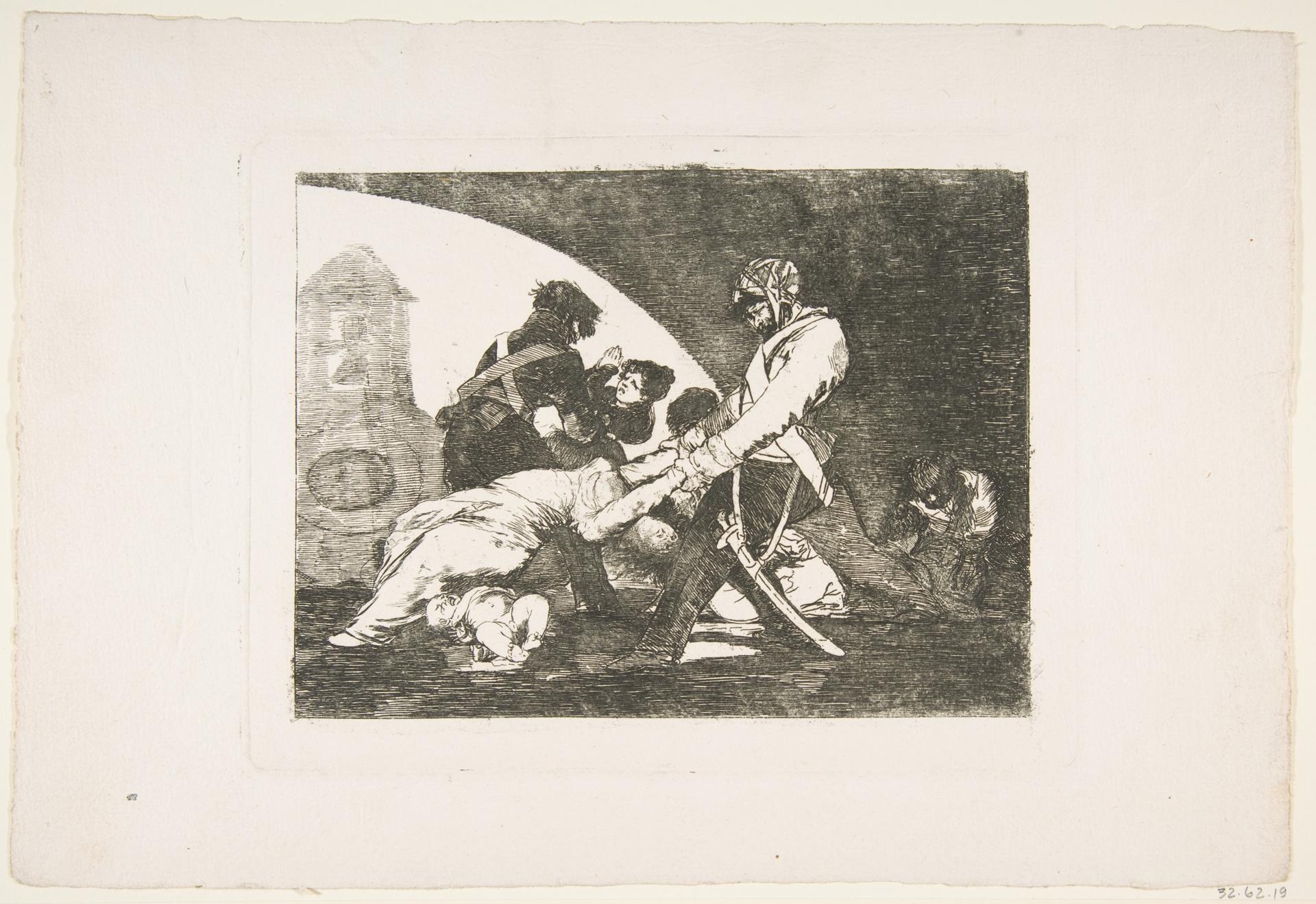
Neither do these
Original title: Plate 11 from "The Disasters of War" (Los Desastres de la Guerra): 'Neither do these' (Ni por esas)
kurzbeschreibung
Francisco de Goya y Lucientes made this eleventh plate of his series 'The Disasters of War' (Los Desastres de la Guerra) around 1810. The etching, supplemented with drypoint and burin, presents a group of people in a war-ravaged landscape. As a working proof, the sheet measures 16.1 × 21.2 cm (plate).
Description
In a restless, asymmetrical arrangement, several figures crowd around a body lying on the ground. A main figure holds a weapon aimed at another person—a gesture somewhere between threat and protection. Behind the group, the ruins of a building that recalls a church or similar structure can be made out. The traditional clothing of the figures suggests a past era. Dim light reinforces the somber mood, while the monochrome gray-scale technique heightens the drama.
Context
Between 1810 and 1820, Goya responded to the Napoleonic Wars and the Spanish War of Independence with the series 'The Disasters of War'. The plates were not published until 1863, after Goya's death, because publication during his lifetime would have been politically too risky. The eleventh plate is titled 'Ni por esas' (Not even so) and points to the vain hope that certain groups would be spared from the atrocities. The existence of a working proof shows that Goya was still revising the plate—evidence of his labor-intensive process.
Impact
Oppression and menace emanate from the restless arrangement and the subdued light; the horror of war becomes immediately palpable. Asymmetry and the dense group of figures draw the eye to the central scene of violence and intensify its emotional force. Goya's realistic style, with dramatic accents, makes the cruelty of the event comprehensible without glossing over it.
Technique
The etching was further worked with drypoint and burin, producing fine lines and deep incisions. This method allows precise rendering of shadows and details that are crucial to the somber effect. The working proof shows that Goya did not yet consider the plate finished—evidence of an experimental and corrective working process.
AI-generated description text
Source: Metropolitan Museum of Art · Public Domain (CC0 1.0)