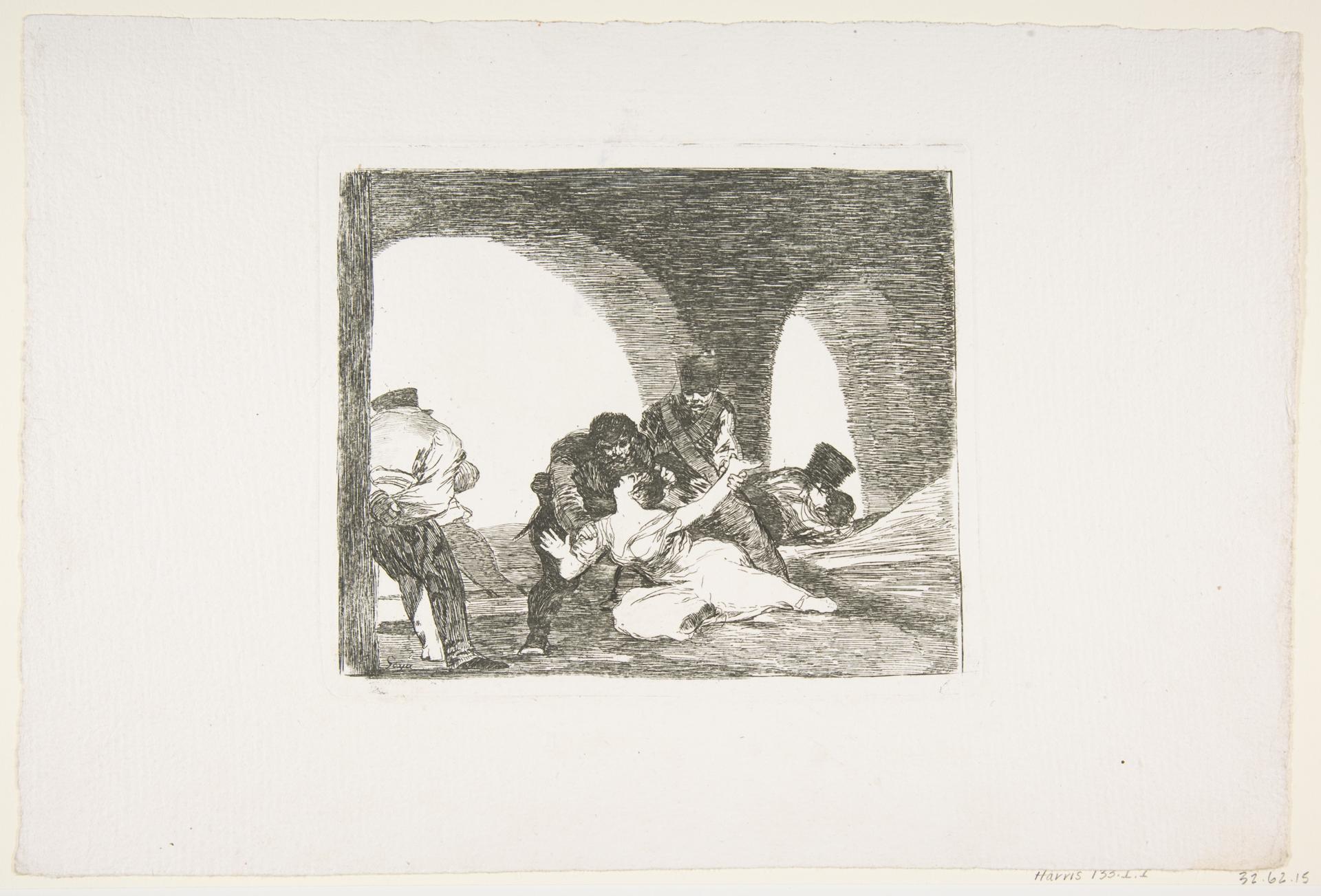
Bitter to be Present (Amarga presencia)
Original title: Plate 13 from "The Disasters of War" (Los Desastres de la Guerra): 'Bitter to be Present' (Amarga presencia)
kurzbeschreibung
A group of people in a dark, arched space: one lies on the ground while others stand around. This is the thirteenth print from Francisco de Goya's etching series Los Desastres de la Guerra, made in 1810. The small plate lays bare the immediate aftermath of violence and the helplessness of those who look on.
Description
In the foreground a figure lies on the ground, surrounded by several people in various poses—some seem to help, others watch or struggle. Two large arches divide the space and let in light that illuminates parts of the action. The clothing points to a past era. The layout is dynamic and directs the eye to the interplay among those present; shadows and outlines emerge through the incoming light. The etching is monochrome in greys and blacks, with thin lines and hatching that create surface and depth.
Context
Between 1810 and 1820 Goya made the etchings of Los Desastres de la Guerra as a response to the horrors of the Spanish War of Independence (1808–1814) against Napoleon's troops. The series was not published until 1863, after the artist's death, because publication during his lifetime was impossible for political reasons. Plate 13 is among the early works of the cycle, dealing with the direct consequences of war and human cruelty. Goya drew on his own experiences and contemporary reports of violence and misery.
Impact
A somber, pity-inducing mood emanates from the print, intensified by the interplay of light and shadow. The closeness of the figures and the unresolved action leave the viewer perplexed and shaken. Because everything is reduced to black and white and the lines are urgent, the image gains an insistent, almost documentary force.
Technique
Etching and burin are used together, allowing fine lines and precise hatching. Goya employed the technique to achieve both dark areas and bright accents; the plate was bitten with acid. The combination of etching and engraving permits a detailed rendering of the figures and the architectural space.
AI-generated description text
Source: Metropolitan Museum of Art · Public Domain (CC0 1.0)