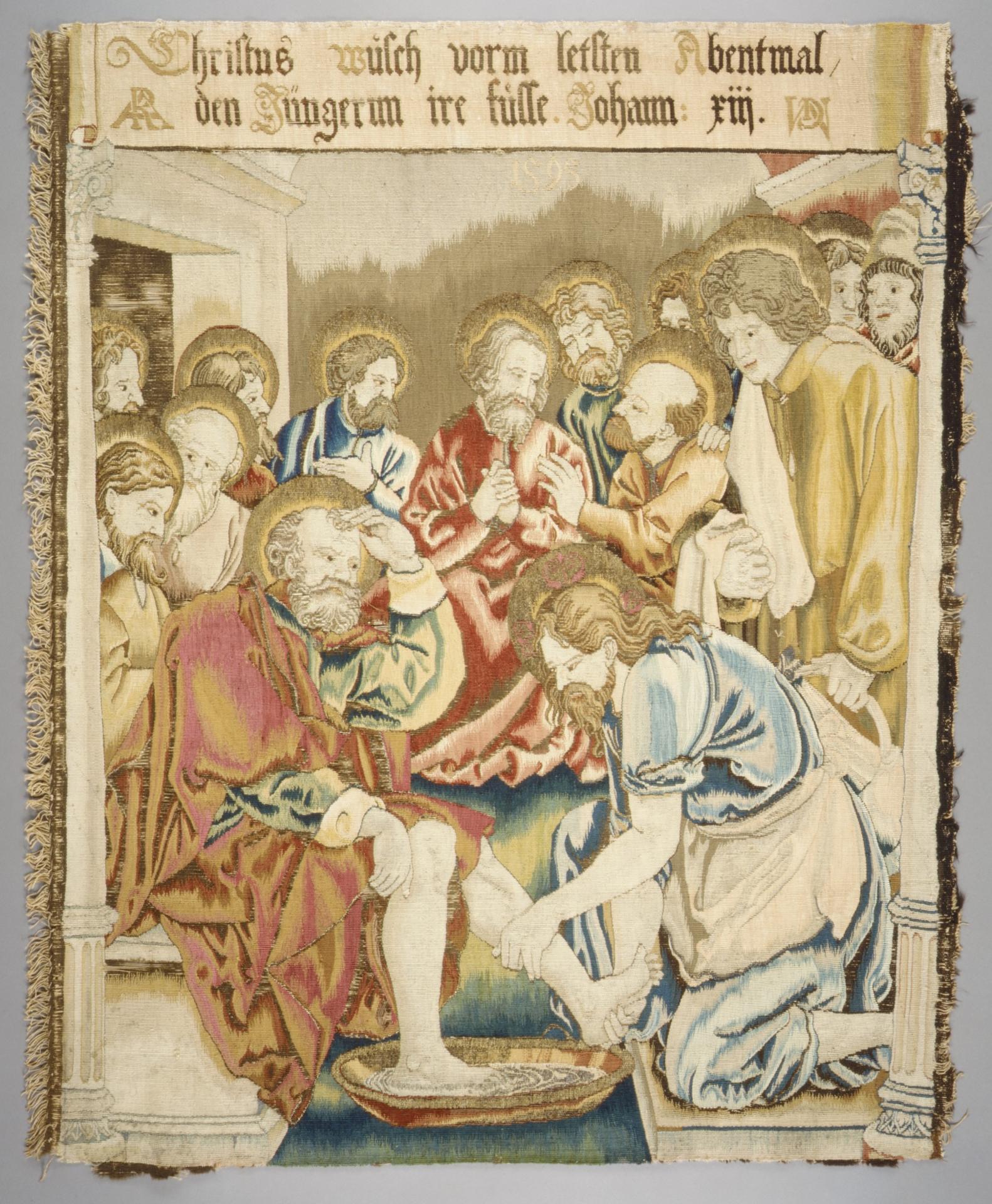
Christ Washing the Feet of His Disciples
Original title: Christ Washing the Feet of His Disciples from a set of The Passion
kurzbeschreibung
This tapestry, part of a set depicting the Passion of Christ, shows Jesus kneeling to wash the feet of his disciples. Made around 1595, it is woven with wool, silk, and metal threads, and is attributed to the workshop of Albrecht Dürer. The scene captures a moment of humility and service from the biblical narrative.
Description
In the foreground, a man in a blue robe kneels before another seated figure wearing a red garment, gently washing his feet. Behind them, several other disciples are depicted in varied poses, some in robes with gold and blue accents, others in simpler attire. The interior setting is framed by columns and arches, with a band of Latin text running across the top. The composition is balanced, drawing the eye to the central act of washing, while the warm palette of reds, golds, and blues dominates.
Context
This tapestry is part of a series on the Passion, a subject popular in Northern European art for private devotion and church decoration. Although attributed to the influence of Albrecht Dürer, the actual weaving likely took place in a workshop in the late 16th century, possibly in the Southern Netherlands. The use of metal threads suggests a commission for a wealthy patron, as such materials were costly and reserved for prestigious pieces.
Impact
The scene conveys a sense of quiet reverence, with the kneeling figure of Christ drawing the viewer's attention to his act of humility. The rich colors and metallic highlights add a sense of opulence, contrasting with the modest action depicted. The orderly composition and detailed textile work create a dignified, contemplative atmosphere.
Technique
The tapestry is woven with wool, silk, and metal threads, with a density of 20 warp threads per inch (8 per cm), indicating a fine weave. This technique allowed for detailed shading and intricate patterns, visible in the varied textures and color transitions. The use of metal threads would have added a shimmering effect, enhancing the visual richness of the piece.
AI-generated description text
Source: Metropolitan Museum of Art · Public domain (CC0)