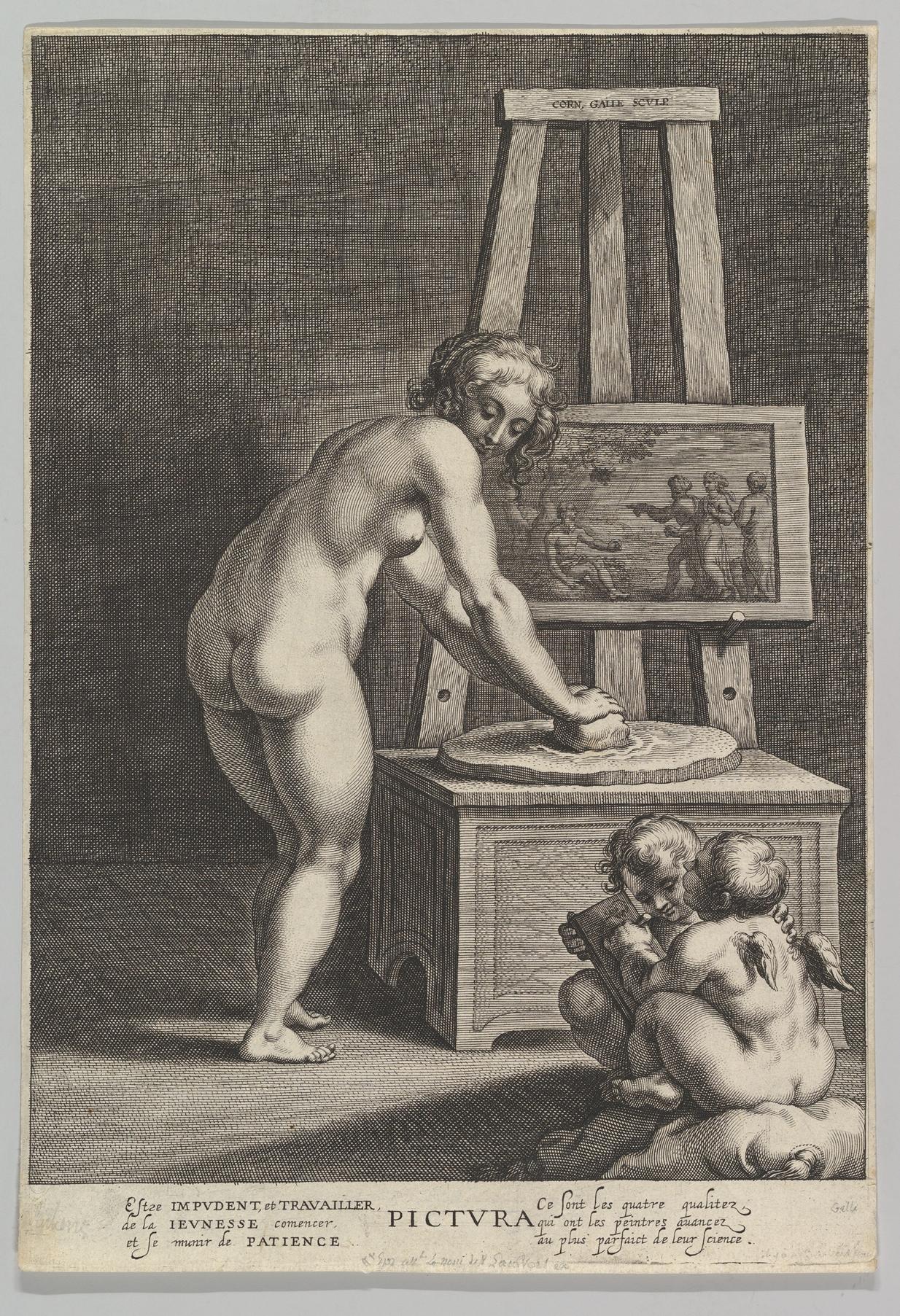
Pictura: Allegory of Painting (ca. 1610–50, Met-Objekt 1207)
Original title: Pictura: allegory of painting, with a nude woman at center grinding pigments, two putti drawing at lower right
kurzbeschreibung
Unlike typical allegories of painting, this engraving by Cornelis Galle I (ca. 1610–50) turns its attention to the craft itself: a nude woman grinds pigments at a table while two putti draw in the lower right. The print is in its second state of two.
Description
A nude woman stands at the center, mixing colors on a tabletop, her gaze fixed on a canvas resting on an easel. On that canvas, a scene with numerous figures can be made out. Below the easel on the right, two putti sit together studying a book. The layout is clearly structured, with the central figure drawing all attention. The monochrome rendering in many shades of gray brings shadows and contours into sharp relief.
Context
The Fleming Cornelis Galle I worked as an engraver in Antwerp. Allegories of painting were highly popular in the seventeenth century, often in connection with artist training and art theory. The nude woman as an embodiment of Pictura belongs to an iconographic tradition that goes back to Cesare Ripa's Iconologia.
Impact
The focus on the main figure and her calm, composed posture give the print its expressive power. Clear lines and an ordered arrangement create a scholarly yet sensual mood, characteristic of Baroque allegories.
Technique
As an engraving, the process relies on incising lines into a copper plate. The existence of a second state points to later reworking of the plate, as often happens with prints. Fine strokes and hatching produce graduated gray tones and a sense of space.
AI-generated description text
Source: Metropolitan Museum of Art · Public Domain (CC0 1.0)