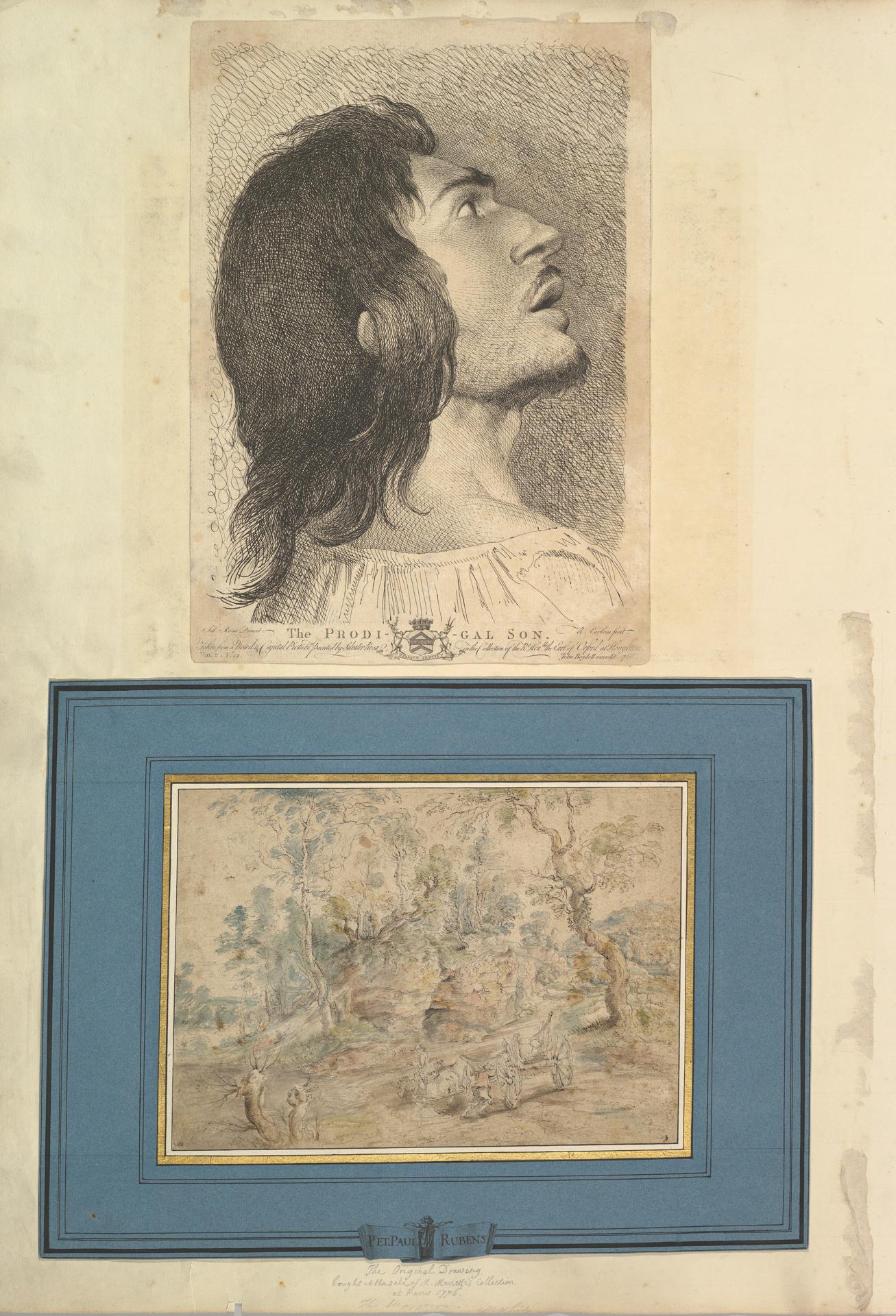
Leaf from Aedes Walpolianae mounted with a print and a drawing (a): Head in Profile of Prodigal Son; (b): The Wagonner (after Peter Paul Rubens) in Jean-Paul Mariette mount
Original title: Leaf from Aedes Walpolianae mounted with a print and a drawing (a): Head in Profile of Prodigal Son; (b): The Wagonner (after Peter Paul Rubens) in Jean-Paul Mariette mount
kurzbeschreibung
This album leaf from the Aedes Walpolianae collection, made between 1620 and 1766, brings together two works by Richard Earlom: an engraving with the profile head of the Prodigal Son and a watercolor drawing after Peter Paul Rubens. The portfolio to which the leaf belongs measures 73.5 × 52 cm.
Description
Two artworks are mounted one above the other. The upper part, in black and white, reproduces the profile of a man with curly hair, his mouth open, gazing upward. Below lies a watercolor: a landscape through which a group of people moves along a path between trees and shrubs; rocks and plants close the view. A blue frame with a gold edge surrounds both works, and beneath it the name 'Peter Paul Rubens' can be read.
Context
The leaf belongs to the Aedes Walpolianae collection, assembled by British Prime Minister Robert Walpole at Houghton Hall. Richard Earlom, an eighteenth-century English printmaker, produced these works as part of a series of reproductions after Rubens. The mounting in a Jean-Paul-Mariette frame reflects the contemporary practice of collecting and displaying prints among the nobility. The dating 1620–1766 covers the period from the creation of the originals to the production of this leaf.
Impact
The monochrome engraving and the colored watercolor create a tension between graphic sharpness and painterly softness. The blue-and-gold framing gives the sheet a noble, museum-like appearance. The Prodigal Son's upward gaze feels emotional and urgent.
Technique
The upper section is an engraving, in which lines were incised into a metal plate. The lower part was made with watercolor, graphite, and black ink on paper. Both techniques allowed for precise details and fine gradations, characteristic of eighteenth-century reproductive printmaking.
AI-generated description text
Source: Metropolitan Museum of Art · Public Domain (CC0 1.0)