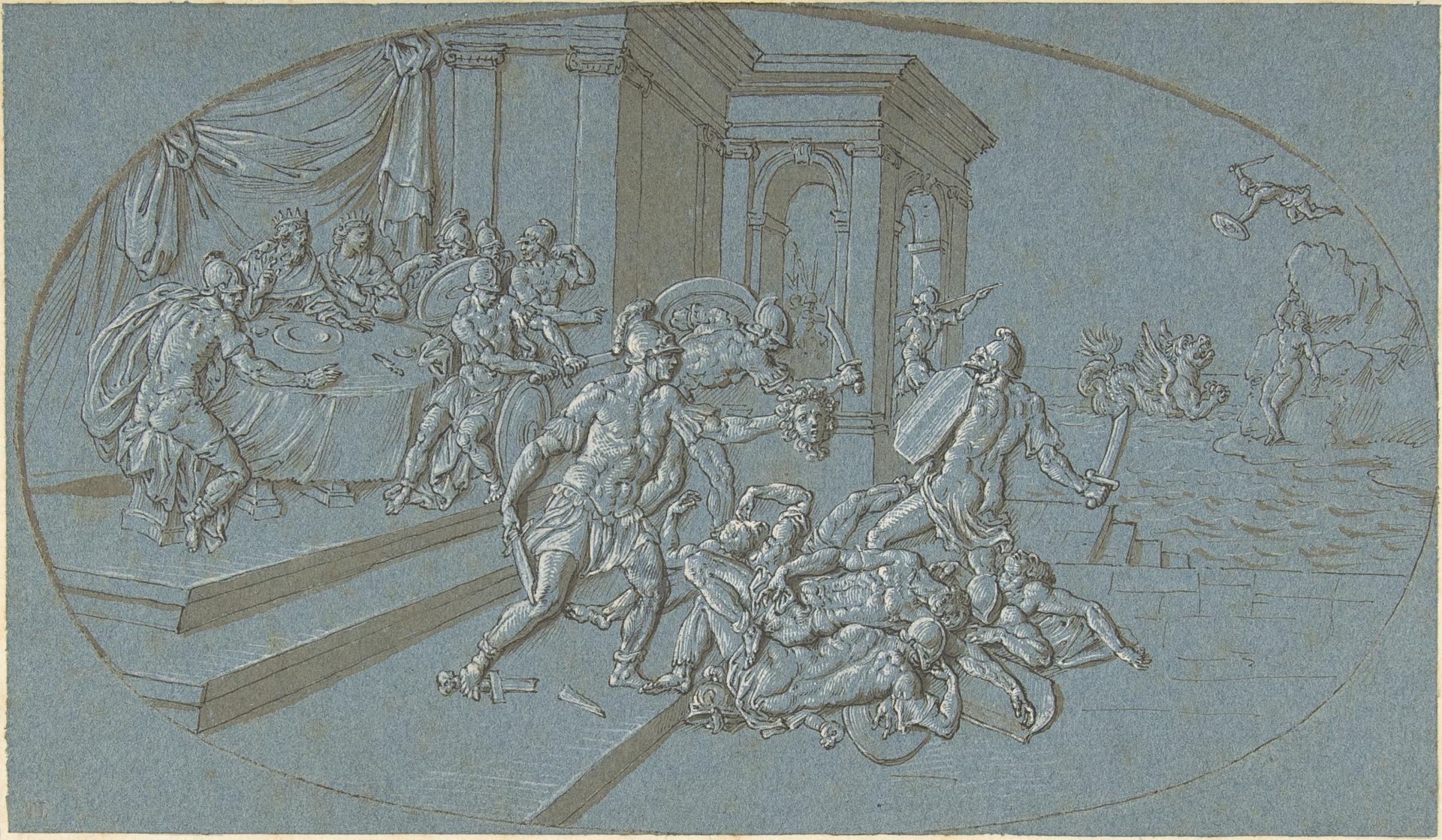
Fight Between Perseus And Phineus in the Palace of Cephus
Original title: Fight Between Perseus And Phineus in the Palace of Cephus
kurzbeschreibung
Bernard Picart captures the bloody confrontation that, according to Ovid, takes place in the throne room of Cepheus: Perseus, newly wed to Andromeda, faces an attack by Phineus and his followers. Drawn between the late 17th and early 18th century, the sheet uses pen and brown ink with brush and wash to present a multi-figure scene charged with movement.
Description
In the foreground two armed men clash; one wields shield and sword, his opponent stands similarly equipped. Several figures lie on the ground, remnants of the fighting already underway. Behind a table further back, onlookers watch the battle unfold. The entire arrangement is enclosed in an oval frame, suggesting it was intended as a design for a wall or ceiling painting. Greek-style garments and finely graduated hatching and cross-hatching define the figures.
Context
This drawing belongs to the decades around 1700, an era when subjects from ancient mythology were eagerly taken up in European art. Picart, French by birth, later worked in the Netherlands and left behind numerous works on classical themes. The oval format suggests the drawing was meant as a design for a ceiling or wall painting; such mythological subjects were common in the decoration of Baroque palaces.
Impact
The agitated poses of the combatants and the fallen bodies create immediate tension. At the same time, the oval frame and softly applied wash temper the horror of the event, placing it at a calm, almost decorative distance.
Technique
Pen and brown ink define the execution, supplemented by brown wash and white heightening. This produces sharp contours as well as gentle transitions that give the figures physical presence. The combination of drawing and wash was a common means for designs and studies in the Baroque period.
AI-generated description text
Source: Metropolitan Museum of Art · Public Domain (CC0 1.0)