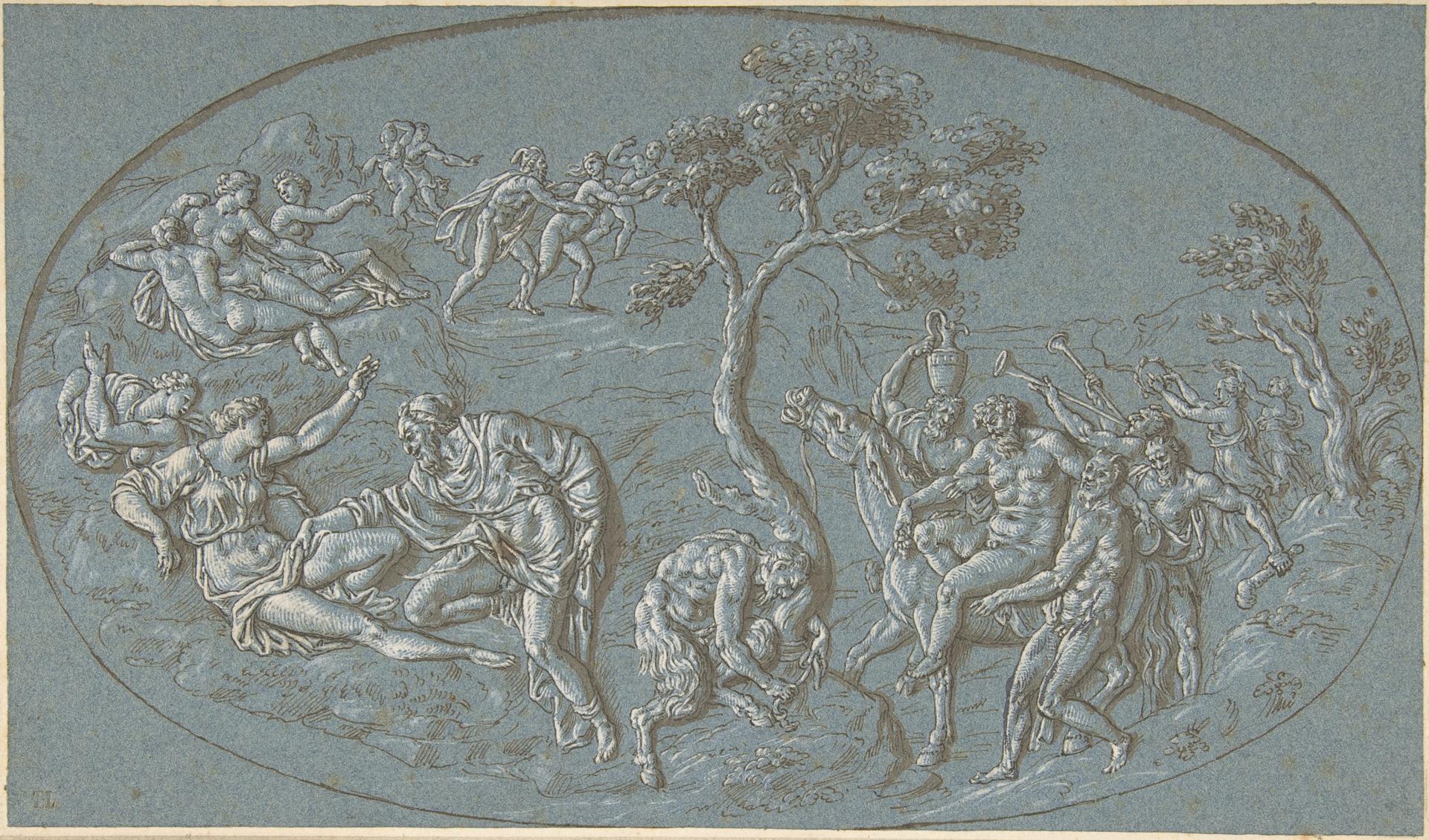
Nymphs And Satyrs
Original title: Nymphs And Satyrs
kurzbeschreibung
In Bernard Picart's drawing "Nymphs and Satyrs," created between the late 17th and early 18th century, several figures frolic in a rural setting. The sheet is executed with pen and brown ink, brush and brown wash, and white heightening on blue paper.
Description
In the foreground, two male figures wrestle: one lies stretched out on the ground, while the other bends over him and holds him fast. Behind them, several female figures recline or sit on a rock, while others are engaged in dance-like movement. On the right, musical satyrs have gathered with trumpet and shawm. Trees and bushes frame the action and emphasize the natural backdrop. The oval framing and the figures pointing in various directions create a palpable tension.
Context
Bernard Picart, a French engraver and draughtsman, gained fame through mythological and biblical subjects. In Amsterdam, he specialized in book illustrations. The sheet was created in an era when mythical themes were highly popular in art and often expressed sensuality and a connection to nature. Such works frequently served as models for prints or were valued as independent artworks.
Impact
The drawing thrives on its lively, almost theatrical staging, which radiates movement and energy. The contrast between the brown tones and the blue paper feels warm and brings the figures clearly forward. The oval framing gives the sheet an intimate, almost decorative quality.
Technique
The work is executed with pen and brown ink, supplemented by brush and brown wash; white heightening sets light accents. These heightenings are slightly oxidized, due to the age of the paper. The blue paper acts as a tonal ground that unites light and dark areas.
AI-generated description text
Source: Metropolitan Museum of Art · Public Domain (CC0 1.0)