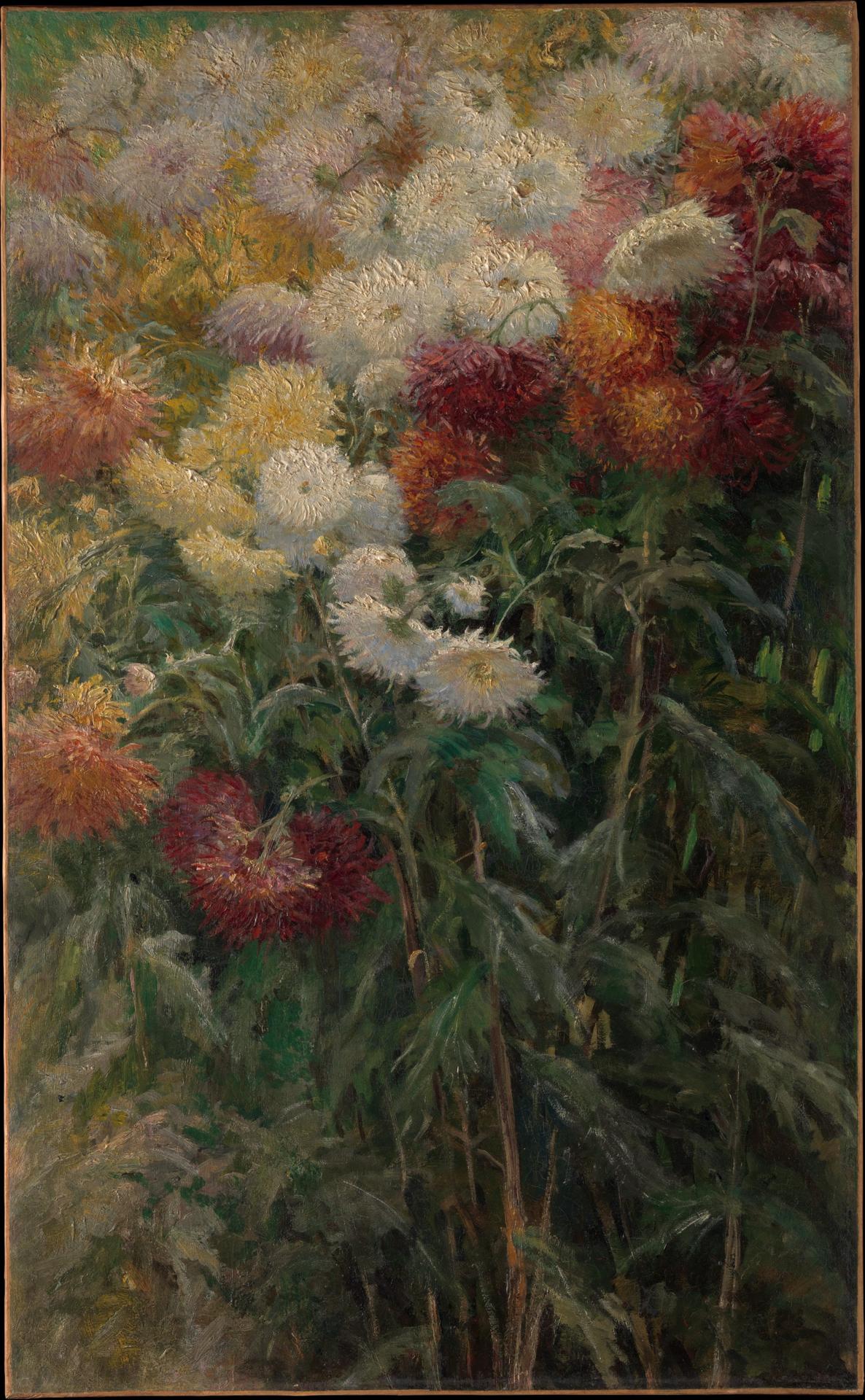
Chrysanthemums in the Garden at Petit-Gennevilliers
Original title: Chrysanthemums in the Garden at Petit-Gennevilliers
kurzbeschreibung
In 1893, Gustave Caillebotte captured a lush group of chrysanthemums in his garden at Petit-Gennevilliers, working in oil on canvas. Unlike many of his garden paintings that isolate individual blooms, this one presents the plants as a single, unified bed. The flowers appear in white, red, orange, and yellow, nestled among green foliage.
Description
A dense mass of chrysanthemums spreads across the entire canvas. Some blossoms stand in the foreground, while others recede behind. The leaves are deep green and form a thick carpet that heightens the brilliance of the white, red, orange, and yellow flowers. The arrangement is broad and open, inviting the eye to wander over petals and foliage. The light feels even and bright, as if a sunny day had been caught.
Context
Caillebotte painted this picture in 1893 at Petit-Gennevilliers, west of Paris, where he had settled in 1888. During these years, his garden became a favorite subject, and he devoted himself increasingly to flower painting. Known also as a patron of the Impressionists, he explored new effects of light and color in this phase of his career.
Impact
The luminous colors and the crowded abundance of blooms create an immediate freshness that seems to place the viewer in the garden. The even lighting and the visible brushwork of the Impressionist method give the picture a calm, sunny mood.
Technique
Executed in oil on canvas, the Impressionist style is evident in the clearly visible brushwork. Colors are placed side by side to shape light and shadow. This method emphasizes the surface texture of the flowers and leaves, giving the painting a lively feel.
AI-generated description text
Source: Metropolitan Museum of Art · Public Domain (CC0 1.0)