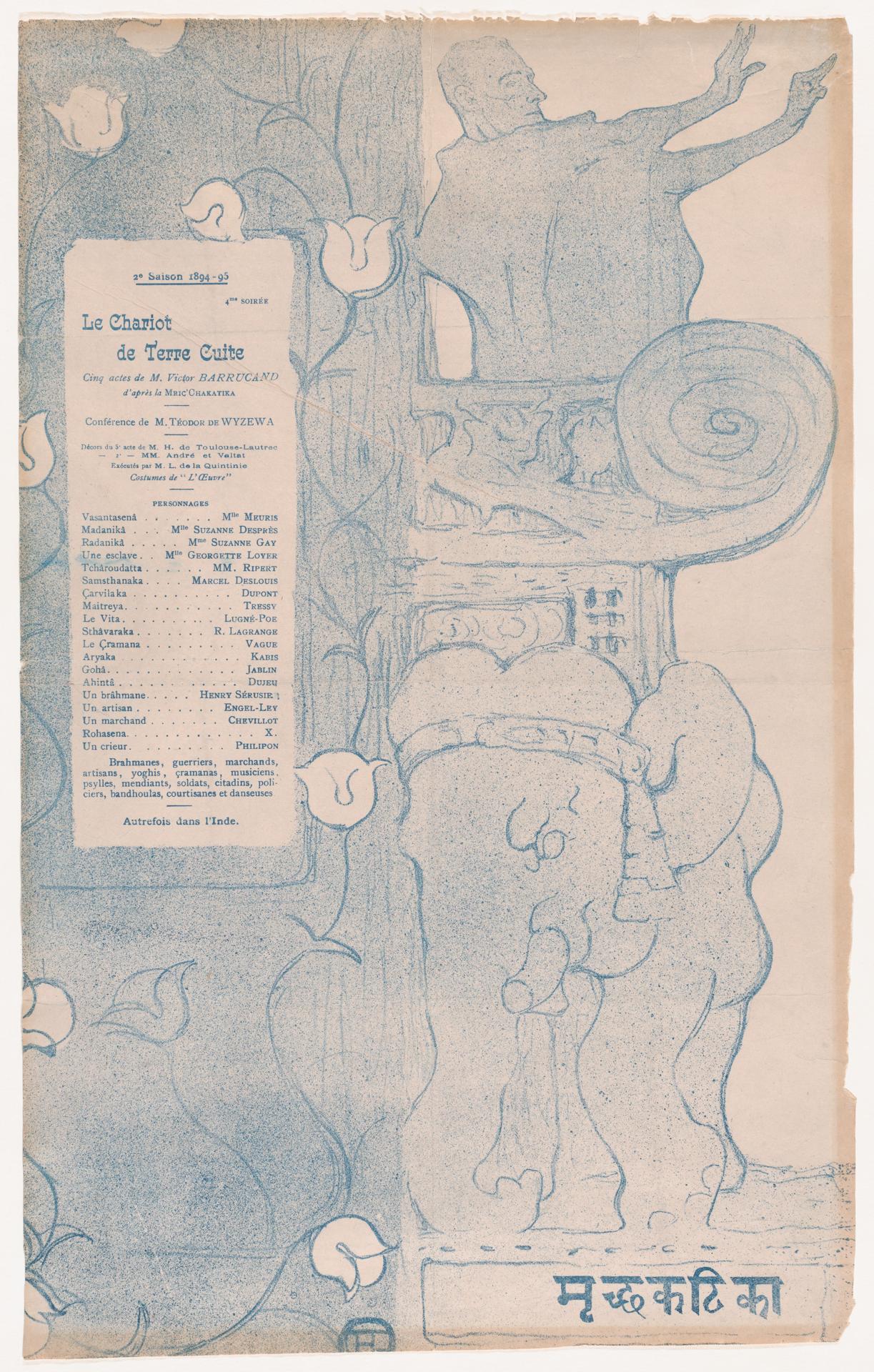
Playbill for "Le Chariot de Terre Cuite" (The Little Clay Cart)
Original title: Playbill for "Le Chariot de Terre Cuite" (The Little Clay Cart)
kurzbeschreibung
Henri de Toulouse-Lautrec created this poster in 1895 to advertise M. Victor Barrucand's drama 'Le Chariot de Terre Cuite'. The blue lithograph, in vertical format, measures 44 × 28.2 cm and presents a cart drawn by two horses.
Description
A stylized cart drawn by two horses appears. On it, a man with arms flung wide, as if explaining or presenting something. Stylized flowers and leaves frame the motif. In the lower right, a text in Devanagari gives the drama's title in Sanskrit. The sheet also includes a cast list and further performance details.
Context
The poster dates from 1895 and served the production of 'Le Chariot de Terre Cuite', a drama by M. Victor Barrucand after the ancient Indian play 'Mrichchakatika'. Toulouse-Lautrec was known for his posters of Parisian nightlife; here he took up an exotic subject. The Devanagari script points to the play's Indian origin.
Impact
The restriction to blue gives the sheet a calm, almost nocturnal mood. Clear lines and stylized rendering feel decorative and emphasize the drama's exoticism. The layout draws the eye to the central figure with outstretched arms, an inviting gesture.
Technique
Executed as a lithograph in blue, the sheet shows the typical mix of bold areas and fine lines for this process. In planographic printing, a greasy crayon is drawn on limestone, then the plate is treated with water and ink. Toulouse-Lautrec often used this technique for his posters.
AI-generated description text
Source: Metropolitan Museum of Art · Public Domain (CC0 1.0)