Polaire
Original title: Polaire
kurzbeschreibung
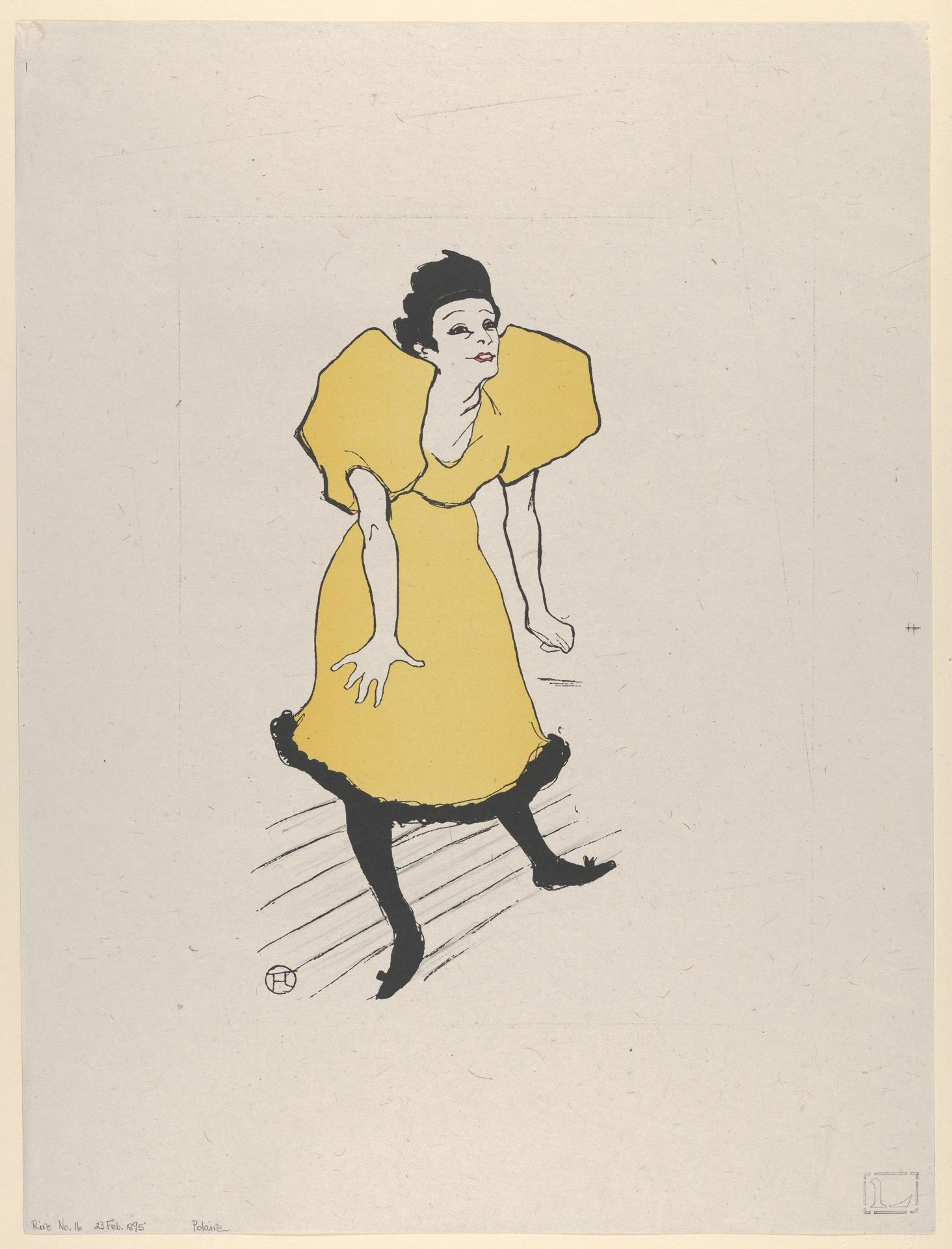
Henri de Toulouse-Lautrec made the lithograph Polaire in 1895. It portrays the French singer and actress Émilie-Marie Bouchaud, known as Polaire, wearing a yellow dress with wide sleeves. The print belongs to a series of artist portraits Toulouse-Lautrec produced for the stage.
Description
A woman in a striking yellow dress with large sleeves steps forward elegantly. Short black hair is emphasized by a headpiece. Dynamic lines behind her underscore the lightness of her pose. The strong contrast between the dress's yellow and the black background pulls the eye to the figure. Sharp outlines and clear lines define the image.
Context
The lithograph dates from 1895, when Toulouse-Lautrec often portrayed Parisian nightlife and stage performers. Polaire was a well-known singer and actress who gained fame through appearances in Montmartre. The sheet is part of his series of portraits used for posters and programs. It reveals the artist's fascination with theater and music.
Impact
The dynamic pose and bold colors make the image immediately lively. Yellow and black face each other to create a strong visual presence that captures the subject's energy. The clear lines give the print a graphic clarity typical of Toulouse-Lautrec's poster art.
Technique
As a lithograph, the work relies on a printing process in which fat chalk is drawn on a stone and then printed. The precise lines and sharp outline point to the accuracy of this technique. Clearly defined areas of color attest to careful execution of the print.
AI-generated description text
Source: Metropolitan Museum of Art · Public Domain (CC0 1.0)