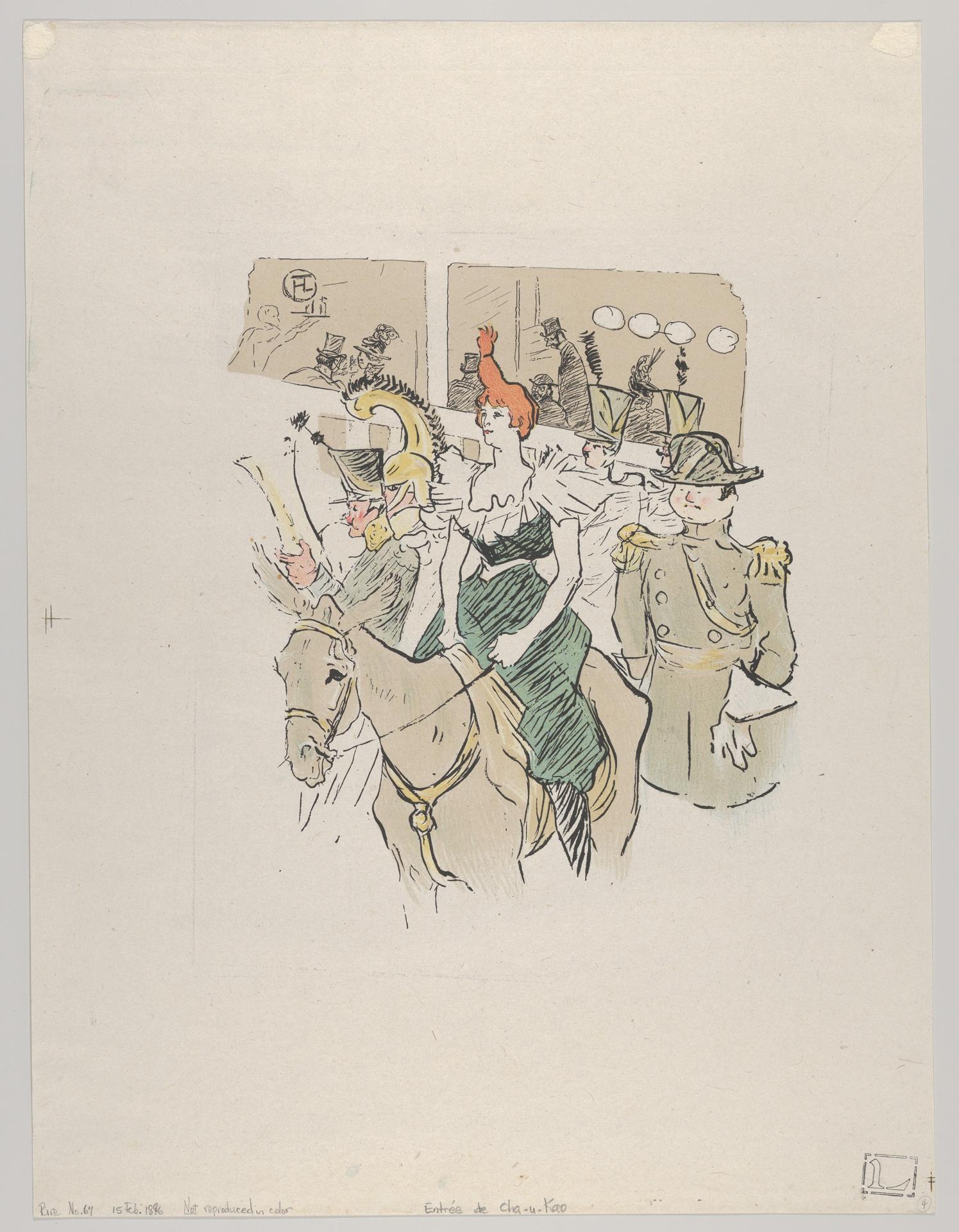
Entrée de Cha-u-Kao, from Le Rire, No. 67, 15 February 1896
Original title: Entrée de Cha-u-Kao, from Le Rire, No. 67, 15 February 1896
kurzbeschreibung
A rider is captured by Henri de Toulouse-Lautrec in the lithograph 'Entrée de Cha-u-Kao', made in 1896 and published as a supplement in the satirical magazine 'Le Rire' (no. 67, 15 February 1896). The print introduces the world of circus and variety theatre.
Description
At the front, a red-haired woman in a white top rides a horse and looks straight ahead; beside her is a man in uniform, also facing forward. Further back, more riders appear, looking in various directions. Light, pastel-like tones dominate the image, creating a clear sense of illumination. Two smaller scenes in the background show figures in an interior.
Context
The lithograph was created for the Parisian satirical magazine 'Le Rire', founded in 1894 and valued for its artistic supplements. Toulouse-Lautrec drew on the world of variety and circus, which he often visited. Cha-u-Kao was a well-known clown and performer in the Montmartre entertainment district of Paris. During this period, the artist was deeply engaged with capturing movement and performers.
Impact
The pastel-like colors and the dynamic equestrian scene give the print a light, almost floating quality. The layout places Cha-u-Kao at the center while also conveying the liveliness of the circus performance.
Technique
The lithograph was printed on paper; the image area measures 26.1 × 22.5 cm. Toulouse-Lautrec preferred this process for capturing quick, spontaneous impressions. The print features fine linework and subtle gradations of color, typical of his graphic works.
AI-generated description text
Source: Metropolitan Museum of Art · Public Domain (CC0 1.0)