Study of a Woman (1893, Met-Objekt 942)
Original title: Study of a Woman
kurzbeschreibung
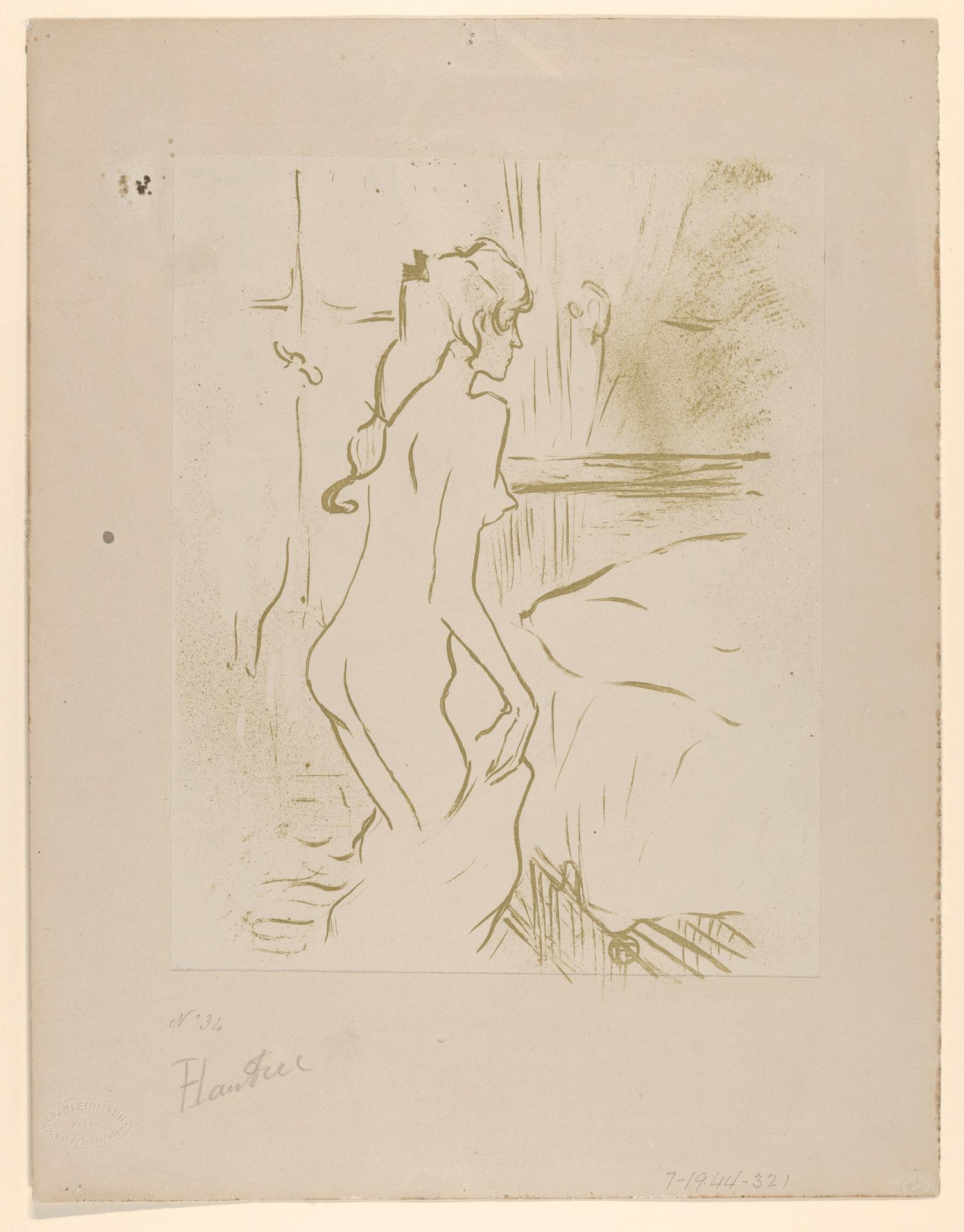
Henri de Toulouse-Lautrec made this lithograph, Study of a Woman, in 1893. It shows a half-nude woman in profile, rendered in brush and spatter technique with olive-green ink on japan paper. The print belongs to the artist's later work.
Description
The woman appears in profile, looking to the left, her arms slightly raised. Long, wavy hair is hidden under a hat. Behind her, vague shapes suggest a window or wall opening. The expressive handling emphasises contours and shadows through spatter. The olive-green ink creates a sombre, forceful atmosphere. At the bottom, the name "Flaherty" and an inventory number are visible.
Context
This study dates from 1893, a period when Toulouse-Lautrec was deeply exploring Parisian nightlife and its marginal figures. He used lithography for posters and illustrations, but also for independent artistic works. The motif belongs to a series of studies capturing the movement and posture of women in intimate moments. Japan paper was common in printmaking at the time because its fine surface allowed detailed impressions.
Impact
The restrained colour and expressive line give the sheet an immediate, sketch-like presence. Olive-green ink and rough texture evoke a wistful mood, drawing the viewer into the private sphere of the sitter. The spatter technique lends the view a dynamic, almost raw energy characteristic of Lautrec's late work.
Technique
This is a lithograph in which ink was applied to the stone with brush and spatter. It exists in the only state, printed in olive-green ink on japan paper. The spatter creates irregular, expressive structures that bring out contours and shadows. The sheet measures 36 × 28 cm; the printed image is 26.5 × 20 cm.
AI-generated description text
Source: Metropolitan Museum of Art · Public Domain (CC0 1.0)