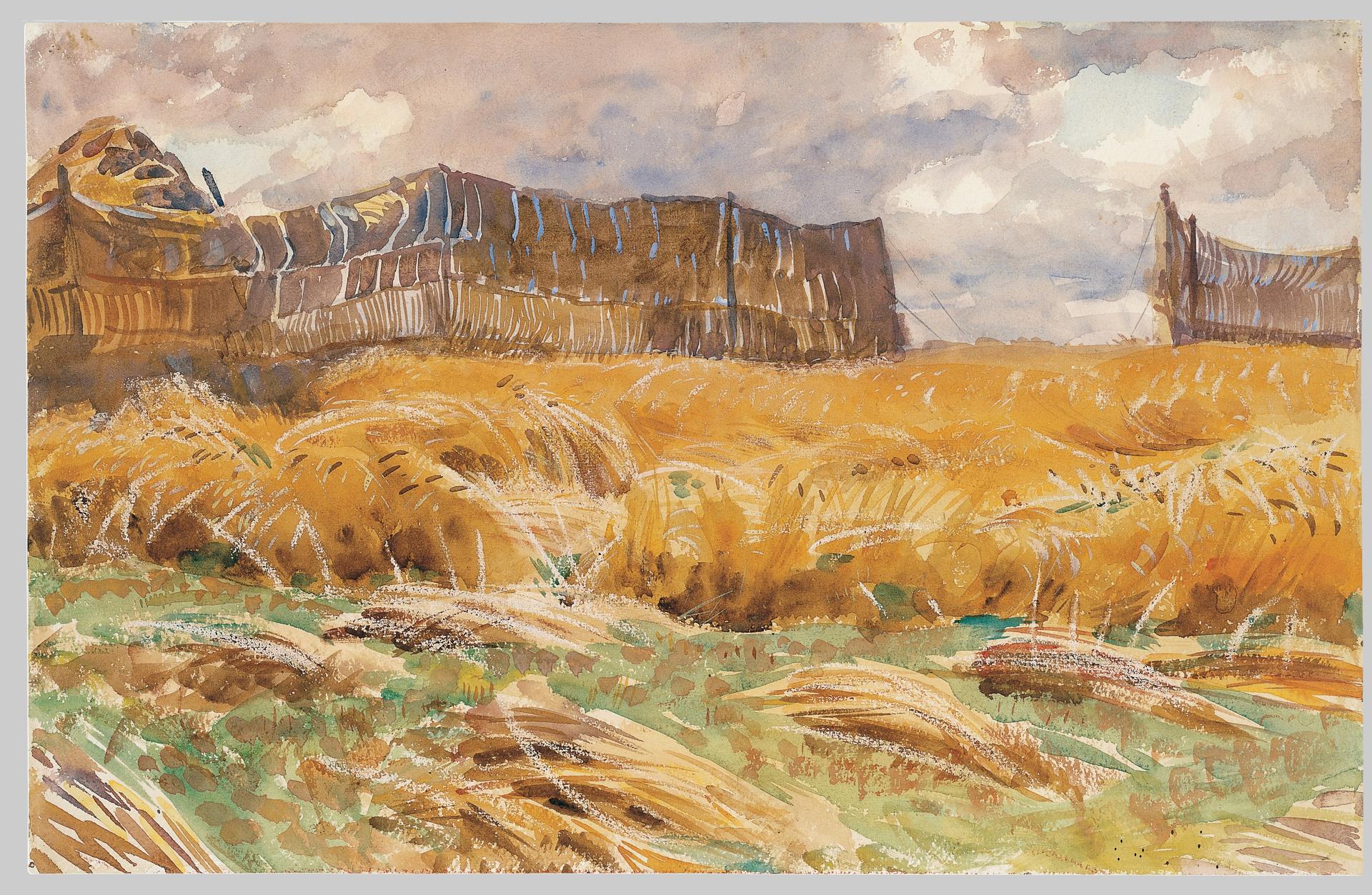
Camouflaged Field in France
Original title: Camouflaged Field in France
kurzbeschreibung
John Singer Sargent made this sheet in France in 1918, a landscape from the First World War. Watercolor, gouache, graphite, and wax crayon on white wove paper come together in a view that shows camouflaged military vehicles set within open fields.
Description
Warm yellows and browns dominate the foreground fields, where grain or similar plants stand. Farther back, along a path or road, a line of military vehicles blends into the surroundings through their camouflage colors. The sky is gray and white, suggesting foggy weather. Overall the palette stays muted and true to life.
Context
As an official war artist for the British government, Sargent served during the First World War. This work was made in 1918 on the Western Front in France, where camouflage was gaining importance as a military tactic. Sargent recorded the war not only in portraits but also in landscapes like this one, which capture the everyday life and technology of the conflict.
Impact
The restrained colors and realistic rendering create a calm, almost ordinary mood that embeds the war within the landscape. Because the vehicles' camouflage tones merge so well with their surroundings, the viewer has to look closely to pick them out—a quiet but insistent effect.
Technique
On white wove paper, Sargent combined watercolor, gouache, graphite, and wax crayon. This mix allowed him to use both transparent and opaque layers of color and to build textures. The wax crayon gives certain passages a distinct surface quality that makes the fields and vehicles feel alive.
AI-generated description text
Source: Metropolitan Museum of Art · Public Domain (CC0 1.0)