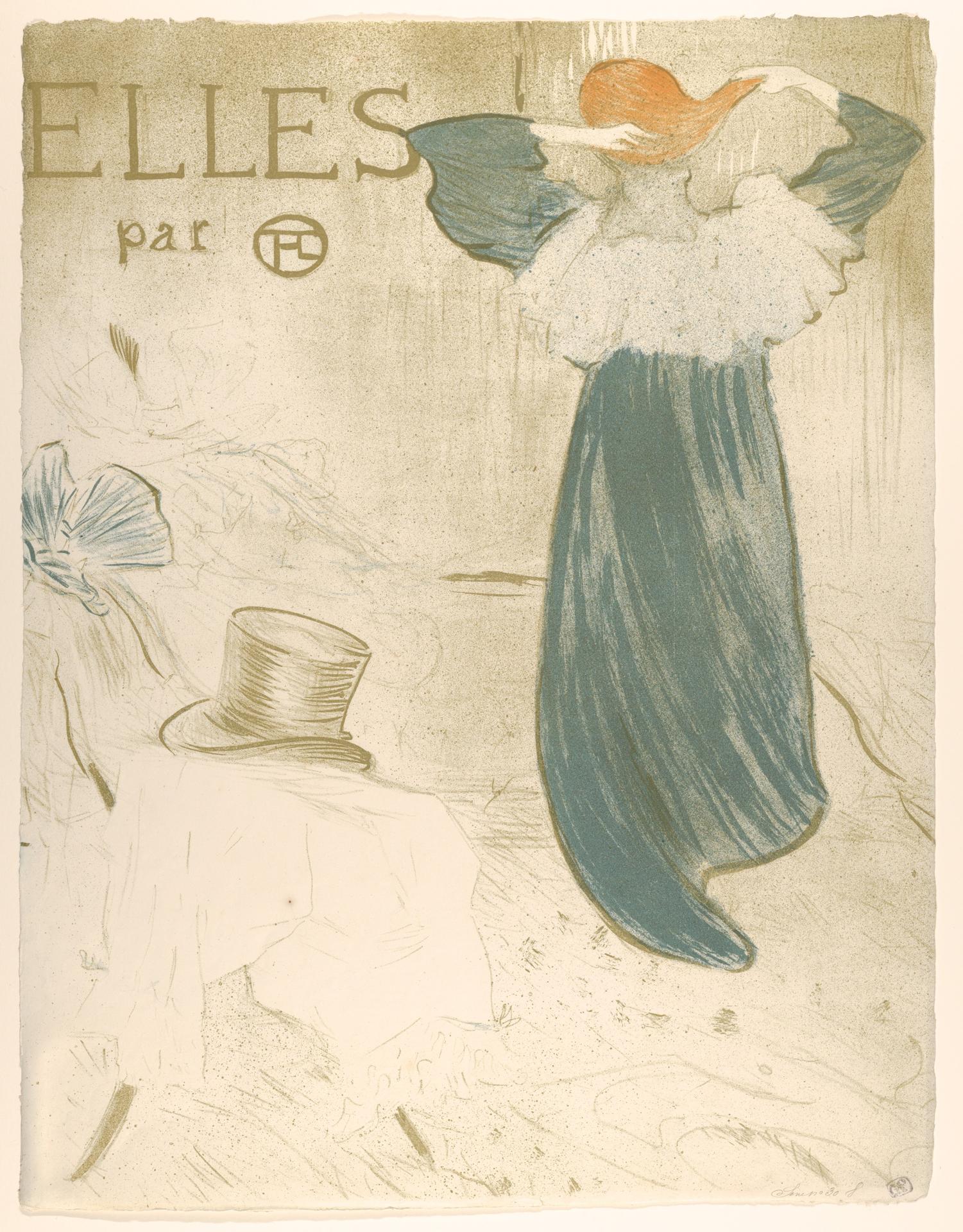
Elles (portfolio cover) (1896, Met-Objekt 911)
Original title: Elles (portfolio cover)
kurzbeschreibung
Unlike related sheets from the same series, Henri de Toulouse-Lautrec's 1896 lithograph 'Elles' does not rely on a calm juxtaposition but on tense movement: a woman bends upward with raised arms, while behind her a seated figure in a top hat watches. The cover for the 'Elles' portfolio was made as a crayon, brush, and spatter lithograph in olive green and black on Japan paper.
Description
In the foreground, a woman in a blue dress and orange cap leans upward, her arms stretched high. Her pose feels lively and open, almost as if caught in the instant of straightening up. Behind her, on an armchair, sits a figure in a white coat and top hat, gaze directed at the standing woman. The layout gets by with a few clearly contoured forms; strong lines separate the figures from one another. The tones remain restrained, the light falls evenly and leaves no shadows or harsh contrasts.
Context
The 'Elles' portfolio, made in 1896, is devoted to the daily lives of prostitutes in Paris—a subject Toulouse-Lautrec returned to repeatedly. It appeared in an edition of 100 copies and was intended to offer an intimate look at the lives of women in brothels. During a phase in which the artist was deeply engaged with Parisian nightlife, he created these lithographs; the portfolio counts among his most important works in this field. The present print is the first of three states and thus the earliest version of the motif, which makes it especially rare for collectors.
Impact
The subdued palette and clear linework give the figures an almost sign-like quality. From the woman's animated pose and the calm gaze of the seated person behind her arises a tension that draws the viewer into the scene. The muted tones and even light create a quiet, intimate mood.
Technique
For this sheet, Toulouse-Lautrec drew on the stone with crayon and brush and additionally used the spatter technique; it was printed in olive green and black on Japan paper. The spatter technique leaves fine dot patterns that structure the background, while crayon and brushstrokes precisely outline the figures. Three states of the motif exist; the first state present here reproduces the earliest version and is of particular interest to collectors.
AI-generated description text
Source: Metropolitan Museum of Art · Public Domain (CC0 1.0)