Débauché
Original title: Débauché
kurzbeschreibung
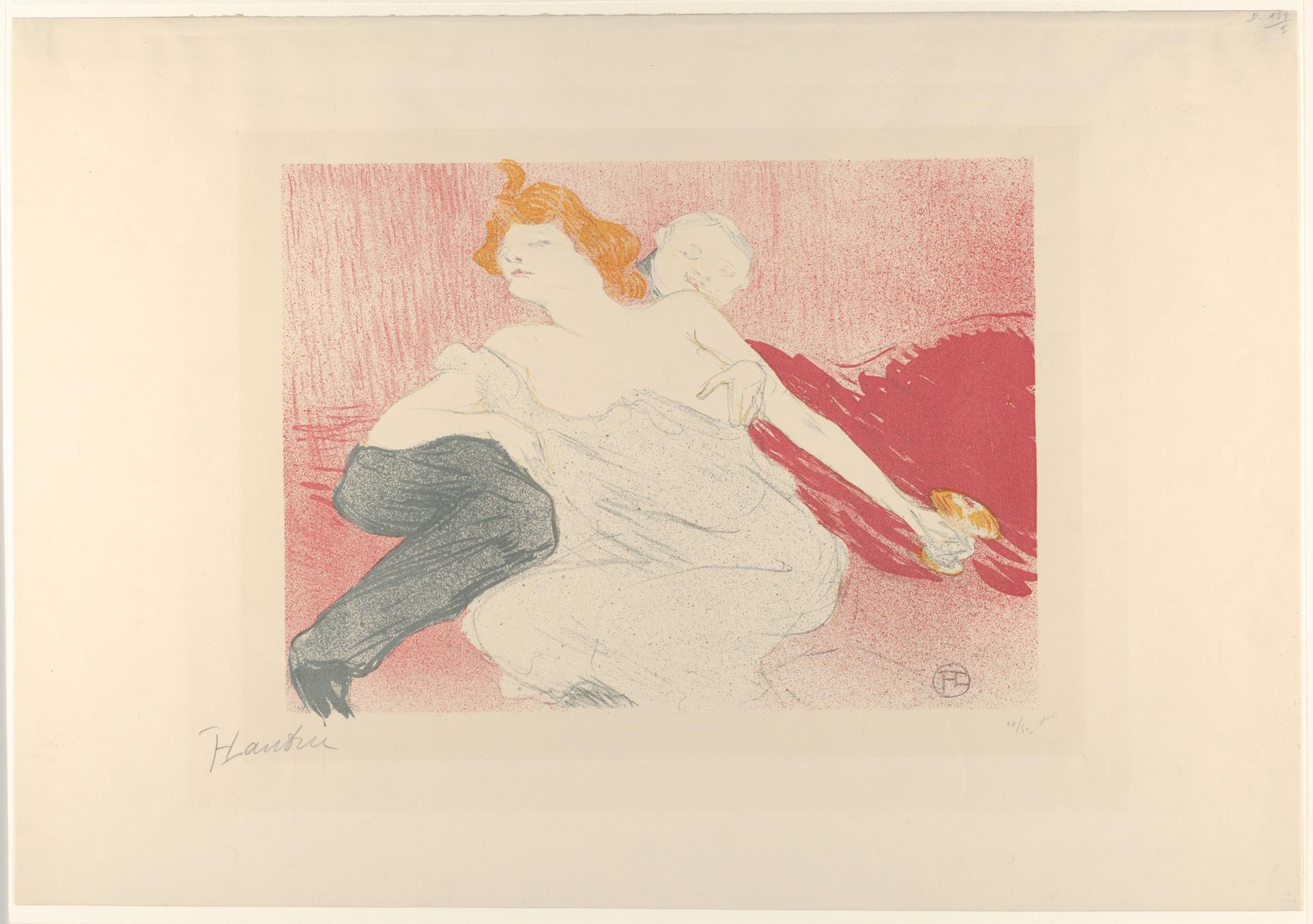
Two half-naked figures lie close together on a bed. Henri de Toulouse-Lautrec captured this intimate subject in his 1896 lithograph 'Débauché'. Printed in three colors on vellum, it is one of the Frenchman's later works.
Description
In the foreground, a figure in a white top and black trousers rests, while behind them another with red hair, also in white, reclines. Both are half-naked on a red surface that reads as a bed. The rear figure holds a bottle. Red dominates the palette, creating a warm, enclosed mood. The arrangement is centered, and the bodies are boldly stylized—a hallmark of Art Nouveau.
Context
In 1896, when Toulouse-Lautrec made this lithograph, his interests revolved heavily around Parisian nightlife and prostitution. Intimate scenes appear repeatedly in his late work, often set in brothels and cabarets. Color lithography was common practice at the time and allowed artists like him to distribute prints in larger editions.
Impact
The subdued reds and even lighting give the image a quiet, almost melancholy note. The simplified figures emphasize the familiarity of the moment without being intrusive. The layout draws the eye to the interaction of the two people in the middle.
Technique
Executed as a lithograph in three colors, printed on vellum, a fine parchment paper. The red tones likely resulted from multiple printing passes.
AI-generated description text
Source: Metropolitan Museum of Art · Public Domain (CC0 1.0)