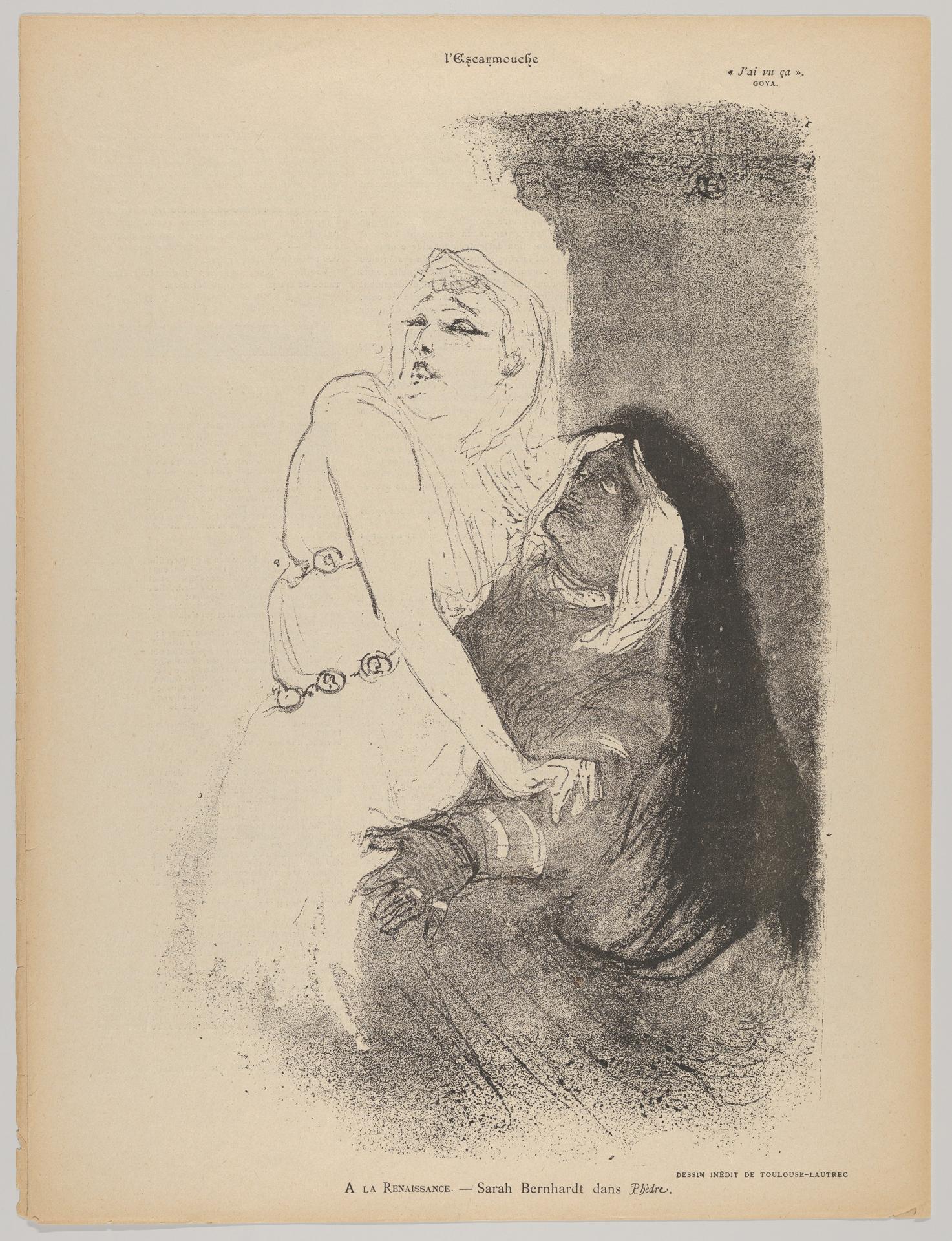
At the Théâtre de la Renaissance: Sarah Bernhardt in Phèdre (1893, Met-Objekt 896)
Original title: At the Théâtre de la Renaissance: Sarah Bernhardt in Phèdre
kurzbeschreibung
In 1893 Henri de Toulouse-Lautrec captured Sarah Bernhardt as Phèdre. This crayon, brush, and spatter lithograph, printed in black on wove paper, fixes a dramatic moment of the play on paper.
Description
Two figures face off in black and white, stark and full of contrast. On the left, a woman in a light gown, her hair disheveled and buttons prominent, leans upward. On the right, a dark-robed figure with long hair and an apron bends downward. The gloomy, bare background makes the bodies stand out. The layout is asymmetrical; delicate lines and scattered spatters create texture and movement. French inscriptions at the top and bottom of the sheet give the title and artist's name.
Context
This 1893 lithograph belongs to a series in which Toulouse-Lautrec chronicled Parisian theatrical life. Sarah Bernhardt was then one of France's most celebrated actresses; her portrayal of Phèdre in Racine's tragedy drew high praise from critics. At the time of the Belle Époque, the Théâtre de la Renaissance was a hub of Parisian stage culture.
Impact
A dramatic interplay of light and shadow defines the print, along with the expressive poses of the figures. The harsh contrast between the light and dark characters generates a tension that makes the tragedy of the play palpable. The spare arrangement directs the eye straight to the actress and her stage presence.
Technique
For this lithograph, Toulouse-Lautrec used crayon, brush, and spatter technique. That allowed fine lines and soft tonal gradations, while the spatters produced a grainy surface. It was printed in black on wove paper, which underscores the graphic impact of the subject.
AI-generated description text
Source: Metropolitan Museum of Art · Public Domain (CC0 1.0)