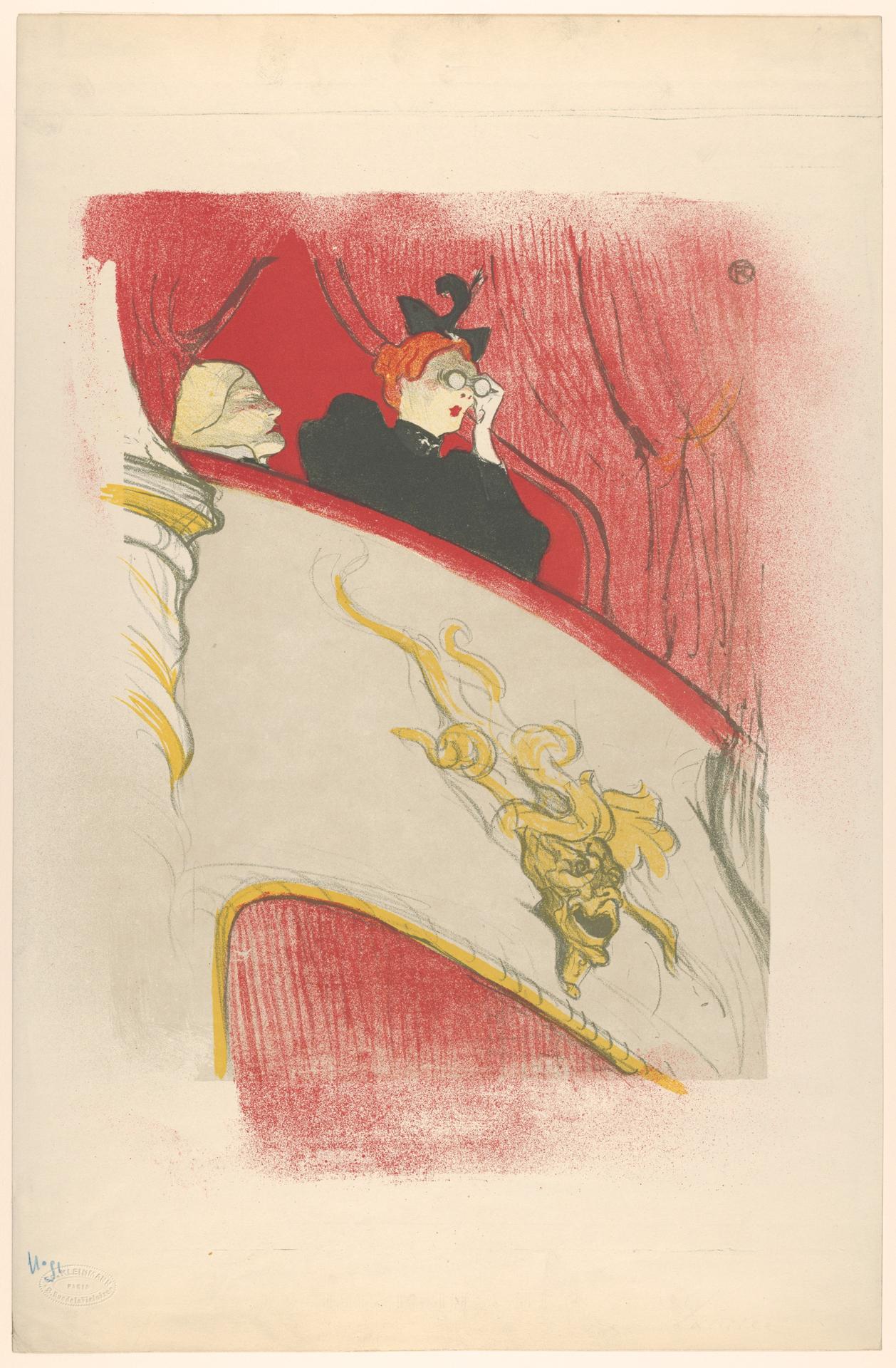
The Box with the Gilded Mask (1894, Met-Objekt 882)
Original title: The Box with the Gilded Mask
kurzbeschreibung
Henri de Toulouse-Lautrec's lithograph "The Box with the Gilded Mask" dates from 1894. It shows two figures in a theater box, framed by red curtains and a golden mask. The print was made in five colors using crayon, brush, and spatter techniques on Japan paper.
Description
On the left, a figure in a white cap looks left; on the right, someone with a red wig, black jacket, and feathered hat holds a glass and looks right. Both sit on a red bench with yellow ornaments. Red curtains frame the background, while beneath the bench a golden grinning head appears, mouth wide open and teeth visible. Bold, contrasting colors—especially the dominant red—give the scene dramatic intensity.
Context
Toulouse-Lautrec created this work in 1894, when he was deeply engaged with Parisian nightlife and the theater. The lithograph belongs to his series of depictions of the entertainment milieu. Because it was printed in only one state, this suggests a limited edition. The motif of the box and the mask refers to contemporary theater and opera culture.
Impact
The luminous reds and the sharp contrast between the figures and the golden mask feel immediate and expressive. The spattered technique creates a lively, almost vibrating surface that captures the dynamism of the theater. Through the intense colors and the unusual perspective, the viewer is drawn into the scene.
Technique
For this lithograph, Toulouse-Lautrec used crayon and brush and also employed a spatter technique to create fine dotted patterns. A scraper served to bring out details and add highlights. The print was made in five colors on imitation Japan paper, which gives the colors particular depth.
AI-generated description text
Source: Metropolitan Museum of Art · Public Domain (CC0 1.0)