Miss Loïe Fuller
Original title: Miss Loïe Fuller
kurzbeschreibung
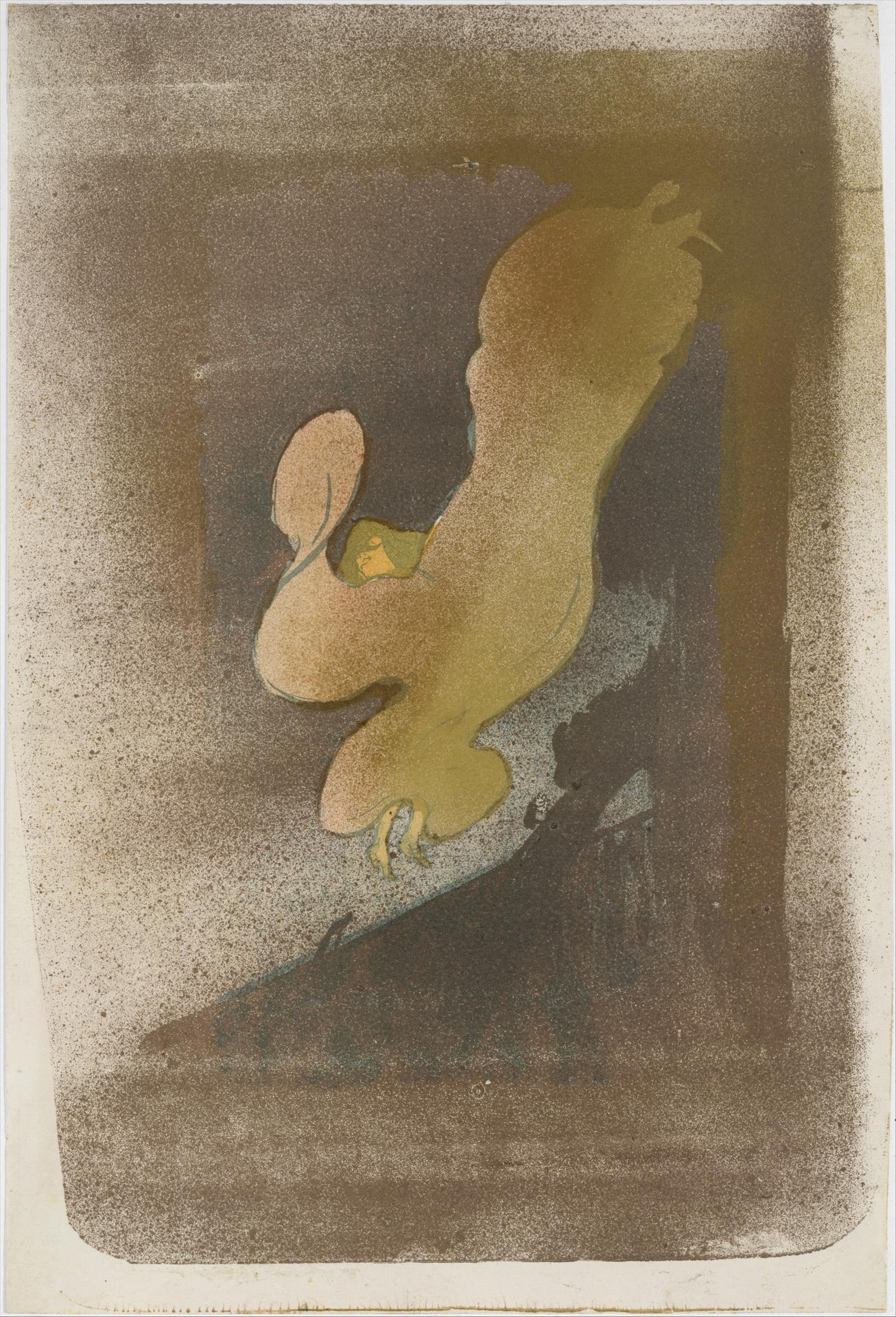
Henri de Toulouse-Lautrec's lithograph "Miss Loïe Fuller" from 1893 captures the American dancer in an abstracted, dynamic scene. Printed in five colors using brush and spatter technique on wove paper, it belongs to the artist's works that engage with Parisian nightlife and the world of dance.
Description
An abstract dancer sweeps diagonally across the image from lower left to upper right. Rendered in bright yellow, she stands out against a darker, gray-brown background. Yellow and green accents create color contrasts, while the lines suggest flowing movement. The background hints at structures without naming concrete objects. The asymmetrical arrangement draws attention to the central figure, whose contours are emphasized by frontal light.
Context
In the 1890s, Loïe Fuller became famous for her performances at the Parisian variety theater "Folies Bergère," where she worked with elaborate lighting and fabric effects. Toulouse-Lautrec, who frequently depicted Parisian nightlife, created several images of the dancer. This print was made in 1893, when the artist was experimenting with various printing methods. Since it was printed in five colors and only in one state, a limited edition can be assumed.
Impact
The abstracted rendering generates a strong dynamism that makes the dancer's movement almost physically palpable. By limiting itself to areas of color and lines, the image acquires a modern, almost expressionistic aura that goes beyond mere representation. The contrast between the bright figure and the dark background lends the print dramatic depth.
Technique
The work was executed as a brush and spatter lithograph in five colors on wove paper. The spatter technique leaves fine, even dots that shape the areas and create a soft texture. It was printed in only one state, so no further revisions or editions followed.
AI-generated description text
Source: Metropolitan Museum of Art · Public Domain (CC0 1.0)