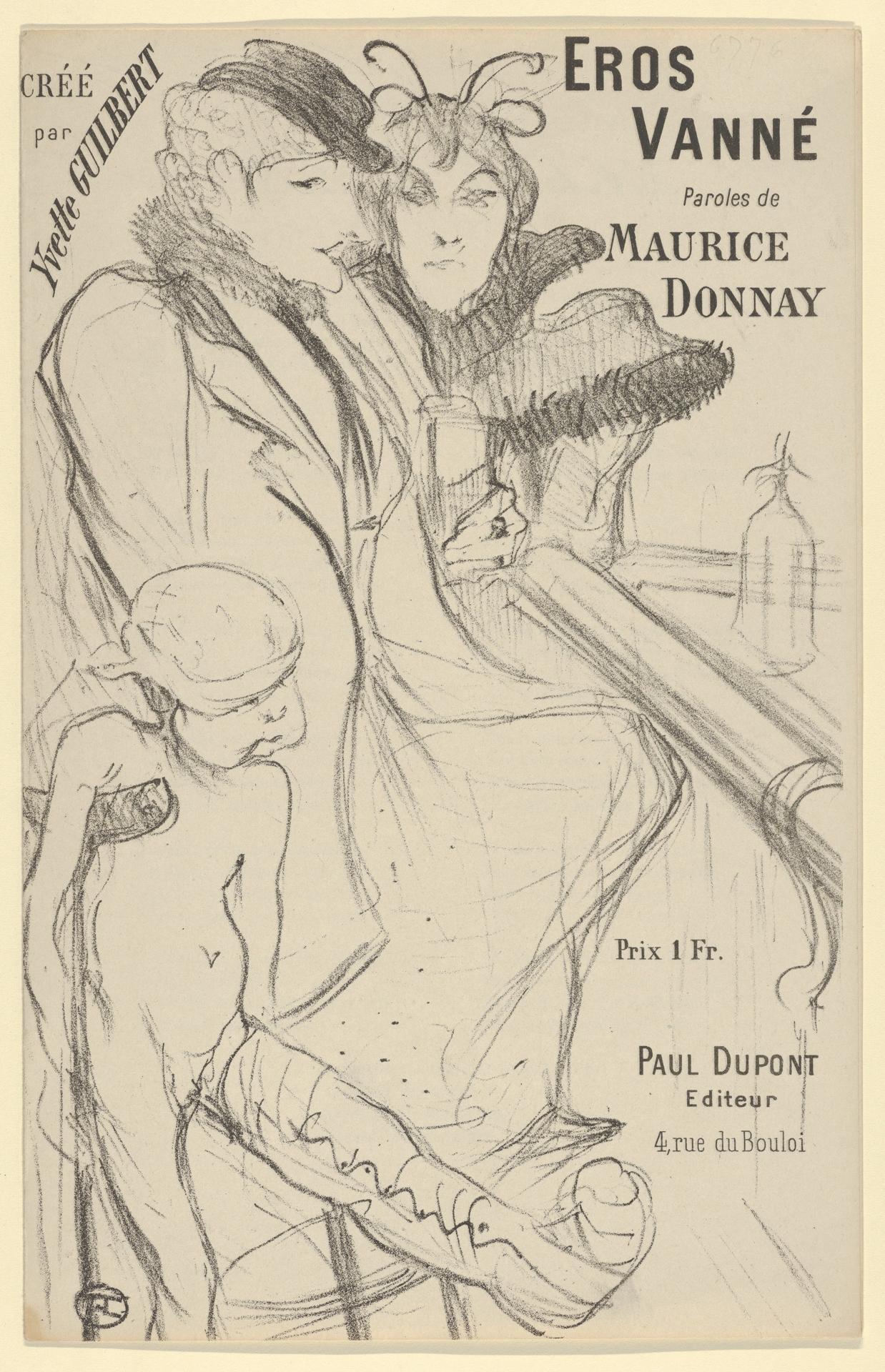
Eros Vanquished (1894, Met-Objekt 871)
Original title: Eros Vanquished
kurzbeschreibung
Henri de Toulouse-Lautrec made this black-and-white lithograph in 1894 as the title page for the songbook 'Eros Vanné'. Unlike many of his purely decorative posters, the sheet brings together two figures—a woman with a winged headband and a man in a fur-trimmed coat—with a semi-transparent nude in the background. It is a crayon lithograph on wove paper, issued in the first edition of the songbook.
Description
In front stands a woman in a long-sleeved dress, her winged headband alluding to Eros. She looks to the left and holds an object. Close behind her is a man in a cap and fur-trimmed coat, also facing left. From the pale paper, a smaller, translucent nude emerges in the background. At the lower right sits a small glass vial. The drawing bears the inscription 'Eros Vanné', along with the publisher's mark of Paul Dupont and the price of 1 franc.
Context
In 1894 the print was made for the songbook 'Eros Vanné' with lyrics by Maurice Donnay, a French playwright and chansonnier. The Paris publisher Paul Dupont brought it out as the first edition of the sheet music. During the 1890s Toulouse-Lautrec produced numerous prints for cabarets and music publishers, often with humorous or ironic undertones. This work also belongs to a series made for the Paris entertainment market.
Impact
Clear lines and the absence of color—black on white—give the image a calm, precise presence. The winged woman with the vial, as Eros, comes across as an ironic, disenchanted allusion to love. The translucent nude in the background adds a subtle, almost surreal depth.
Technique
Executed as a crayon lithograph, printed in black on wove paper. The process allows fine gradations of gray, which here create the transparency of the background nude. Only a single state exists, underscoring the rarity of the print.
AI-generated description text
Source: Metropolitan Museum of Art · Public Domain (CC0 1.0)